5 Best Movies for Escape Room Fans
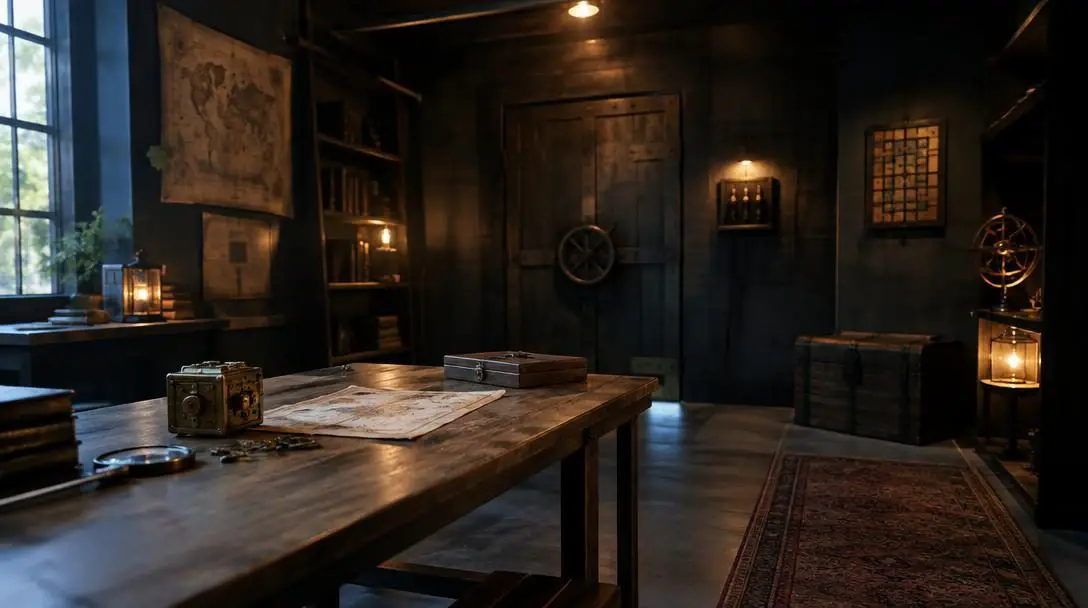
Escape rooms have rapidly transformed from niche interactive games into a global recreational phenomenon, captivating millions of players who relish deciphering riddles, cracking mechanical locks, and racing against an unforgiving countdown. That same rush translates effortlessly to cinema, where filmmakers can amplify the tension far beyond what any real-world venue could safely attempt. By raising the stakes from friendly social competition to life-or-death survival, movies transform the tactile fun of physical puzzles into white-knuckle suspense.
The cinematic tradition of confining strangers in hostile, riddle-laden environments predates the modern escape room industry by decades, finding early roots in low-budget science fiction, claustrophobic psychological thrillers, and survival horror. Whether fueled by micro-budgets or backed by major Hollywood studios, films centered around lethal puzzle boxes demand spatial deduction, sharp observation, and relentless logic from their characters. For puzzle lovers seeking films that capture the architectural ingenuity and ticking-clock urgency of an escape game, certain standout titles deliver exceptional thrills.
Key takeaways
- Confined-space puzzle movies elevate safe recreational escape games into lethal survival challenges driven by environmental traps and strict rules.
- Budget constraints often breed intense ingenuity in this subgenre, with independent films like Cube and Exam delivering classic experiences on modest funds.
- Mainstream commercial hits like 2019's Escape Room and 2004's Saw demonstrated massive box office returns by turning intricate mechanical traps into horror spectacles.
- Audiences must navigate confusing naming trends and differing tonal subgenres to match their preference between gore-focused traps and brain-teasing psychological deduction.
The evolution of locked-room cinema
Before physical escape venues appeared in cities worldwide, filmmakers were already fascinated by the narrative potential of trapped figures forced to negotiate their surroundings. The premise strips away external distractions, forcing the plot to rely entirely on character interactions, mechanical problem-solving, and observational deduction. In early survival thrillers from the 1990s and early 2000s, screenwriters developed foundational storytelling mechanics: cryptic overseers watching through security cameras, shifting modular walls, strict countdowns, and lethal penalties for simple miscalculations.
As commercial escape rooms grew into a recognized cultural staple, cinematic narratives adapted. Contemporary scripts increasingly reference escape games directly or construct scenarios that explicitly mimic their structure: sequential chambers, multi-layered ciphers, hidden keys, and customized psychological hurdles. The defining appeal of these films lies in the intellectual parity between the protagonists and the viewers, inviting audiences to solve environmental ciphers in real time before the on-screen clock expires.
Cinematic puzzle boxes turn the innocent pleasure of tabletop deduction into a visceral race for physical and psychological survival.
Top 5 movies for escape room enthusiasts
While dozens of indie productions have attempted to capitalize on the escape game boom, five films stand out for their clever structural design, commercial impact, or enduring cult influence. Each offers a unique take on high-stakes puzzle mechanics.
Escape Room

- Release Year: 2019
- Production Budget: $9 million
- Global Box Office: Over $155 million
- Key Cast: Taylor Russell, Logan Miller, Deborah Ann Woll
Originally developed under the working title The Maze, this 2019 studio thriller represents the most direct, high-gloss adaptation of modern commercial escape room culture. The narrative follows six strangers from disparate walks of life who each receive an elaborate puzzle cube containing an invitation to an exclusive, high-stakes competition. Upon arriving at an unassuming commercial office building, the participants quickly discover that waiting in the lobby is already the first test. The game transitions into a series of massive, lethal survival chambers—including an industrial furnace room, a sub-zero winter wonderland, and an inverted billiard lounge—specifically calibrated to exploit their deepest personal vulnerabilities.
Working from a lean budget of $9 million, the production proved to be an overwhelming financial triumph, earning more than $155 million globally and launching a franchise that produced the sequel Escape Room: Tournament of Champions. The film succeeds because it captures the sensory texture of real escape rooms—twisting knobs, hidden trapdoors, and environmental ciphers—while elevating each room into a cinematic architectural set piece.

Saw
- Release Year: 2004
- Production Budget: $1 million
- Global Box Office: Over $100 million
- Key Cast: Cary Elwes, Tobin Bell
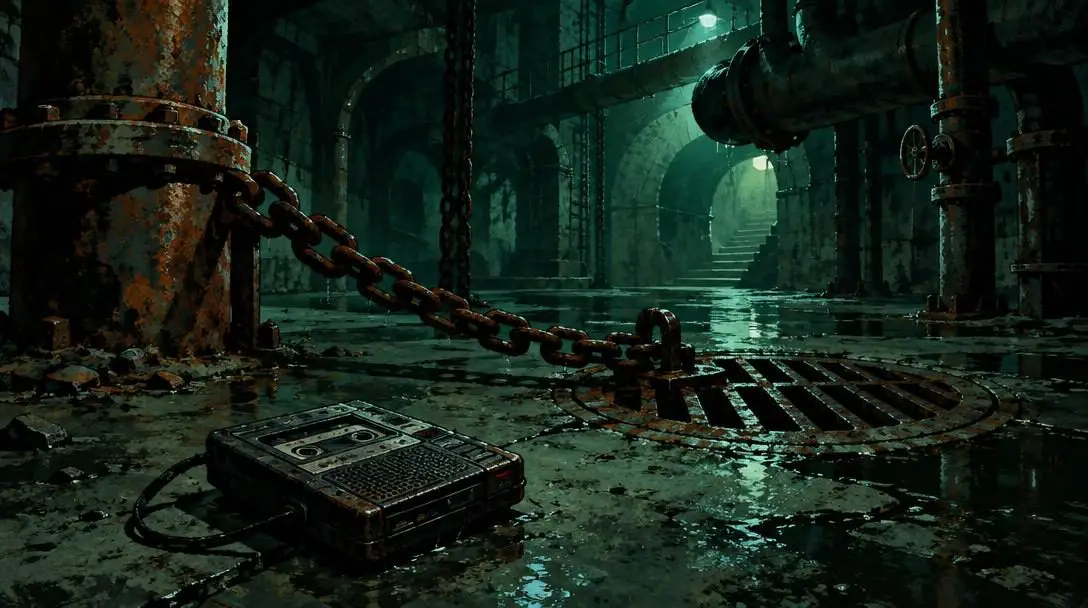
Though subsequent entries in this long-running horror franchise leaned progressively deeper into extreme gore, the original 2004 release remains a masterwork of low-budget puzzle design. Directed on a micro-budget of only $1 million, the film grossed well over $100 million worldwide, cementing its position as one of the most profitable surprise sensations in film history and triggering a sequel within a single year. Starring Cary Elwes alongside Tobin Bell as the calculating moralist known as Jigsaw, the film confines two men to a decaying subterranean bathroom, chaining them by their ankles to opposite pipes with an apparent corpse lying between them.
Surviving Jigsaw's ordeal requires the protagonists to decipher cryptic audio cassettes, search hidden compartments, examine personal possessions, and make unthinkable physical sacrifices before a strict deadline runs out. With its unrelenting narrative tempo, gritty visual aesthetic, and legendary closing plot twist, Saw laid the groundwork for modern lethal-puzzle cinema by establishing rules-based, moralistic challenges as a gripping storytelling engine.
Exam
- Release Year: 2009
- Production Budget: $600,000
- Global Box Office: Under $400,000
- Director: Stuart Hazeldine
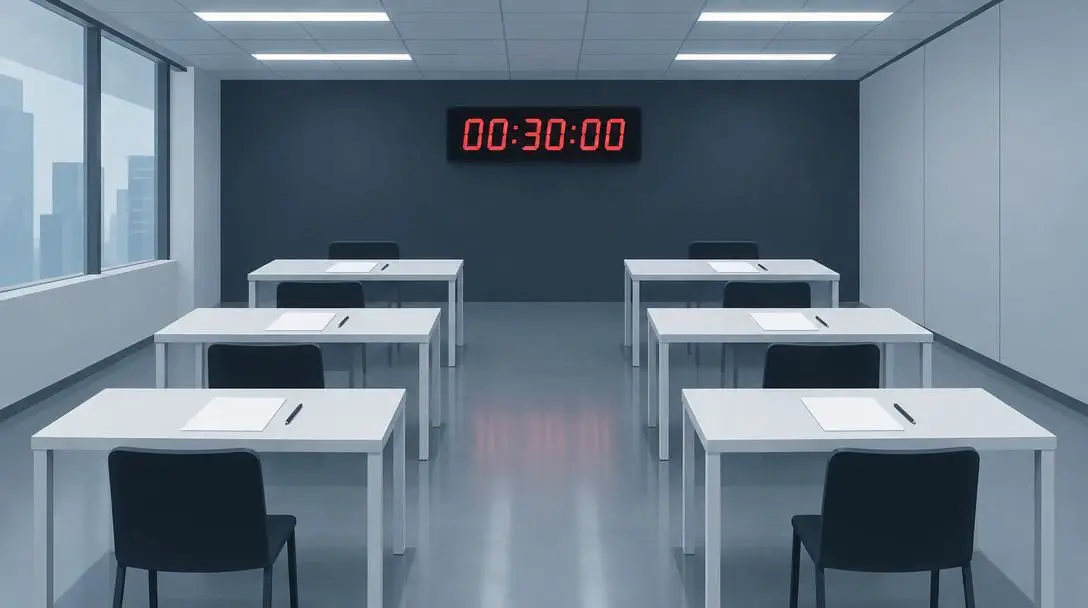
For puzzle fans who favor cerebral tension and conversational deduction over physical violence, the 2009 British thriller Exam provides a pristine single-room mystery. Directed by Stuart Hazeldine, the film tracks eight elite candidates vying for a prestigious, life-changing corporate position at an enigmatic bio-pharmaceutical conglomerate. Guided into a reinforced, windowless assessment chamber supervised by an armed guard, each candidate is seated before a desk containing a single sheet of paper labeled with their candidate number.
The proctor lays down three rigid rules: do not speak to him or the guard, do not spoil their paper, and do not leave the room. When the countdown begins and the candidates turn their papers over, they discover the sheets are completely blank. Featuring an ensemble cast including Adar Beck, Gemma Chan, and Nathalie Cox, the candidates must spend eighty minutes deducing what the question actually is before they can answer it. While the film struggled at the box office during its theatrical debut, it developed an enduring cult following among puzzle enthusiasts due to its razor-sharp dialogue, psychological gamesmanship, and unexpected narrative revelation.
Cube

- Release Year: 1997
- Production Budget: $350,000
- Global Box Office: Nearly $9 million
- Director: Vincenzo Natali
Debuting well over a decade before physical escape rooms entered popular consciousness, the 1997 Canadian independent release Cube stands as the definitive structural blueprint for the confined-labyrinth subgenre. Helmed by director Vincenzo Natali on a shoestring budget of roughly $350,000, the production earned nearly $9 million worldwide, inspired a Japanese remake, and sparked lasting development interest for an American reimagining. The story thrusts a disparate group of strangers—possessing specialized backgrounds in mathematics, architecture, medicine, and escape tactics—into an enigmatic structure consisting of thousands of interconnected cubic rooms.
Many of these rooms contain lethal, automated booby traps activated by motion, heat, or sound. To advance toward potential freedom without falling victim to acid spray, wire nets, or flame bursts, the prisoners must apply spatial reasoning, prime-number sequences, and Cartesian coordinate mathematics inscribed on the room portals. Cube serves as a foundational precursor to modern trap films, highlighting how cold industrial geometry and sheer mental deduction can carry an entire feature film.
No Escape (Follow Me)
- Release Year: 2020
- Global Box Office: A few million dollars
- Key Cast: Keegan Allen, Holland Roden, Denzel Whitaker
- Director: Will Wernick
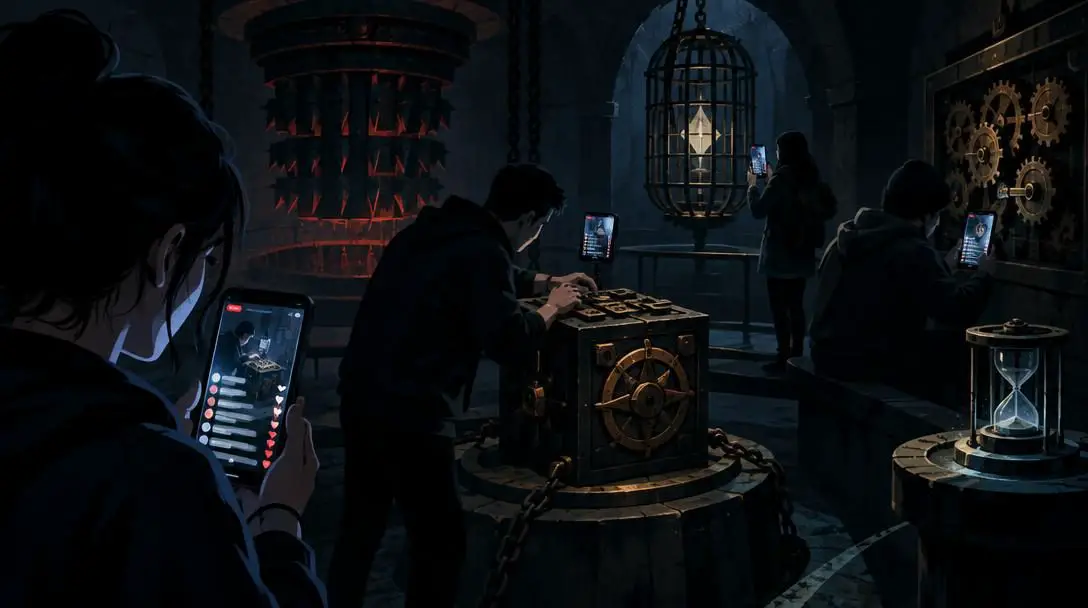
Premiering during the 2020 global pandemic under the dual titles No Escape and Follow Me, this contemporary thriller directed by Will Wernick bridges escape room tropes with influencer-era internet culture. The story follows Cole Turner, played by Keegan Allen, a brazen social media vlogger who travels to Moscow with his girlfriend, played by Holland Roden, and close friends, including Denzel Whitaker, to celebrate the tenth anniversary of his successful live-stream channel. Seeking extreme content that will shock his millions of online followers, the group books an underground, hyper-personalized escape room designed exclusively for high-paying thrill-seekers.

Upon entering the facility, the lighthearted travel vlog swiftly spirals into a claustrophobic nightmare as the rooms reveal mechanical torture apparatuses, water-filling chambers, and psychological terror tactics broadcast live to an audience of spectators. Produced on a minimal budget, the film generated a modest box office return of several million dollars globally. While critical reception was divided, the picture remains a fascinating cultural artifact that explores how viral livestream culture and immersive puzzle attractions can collide into lethal panic.
At a glance: Comparing the top escape room movies
Each of these standout titles approaches the puzzle-box premise with different storytelling tools, budgets, and degrees of psychological tension versus physical horror. The table below outlines how they compare on key production and narrative details.
| Film Title | Release Year | Estimated Budget | Primary Narrative Setting | Puzzle Focus |
|---|---|---|---|---|
| Cube | 1997 | $350,000 | Endless interlocking modular cubes | Prime numbers and spatial deduction |
| Saw | 2004 | $1,000,000 | Industrial subterranean bathroom | Moral dilemmas and mechanical locks |
| Exam | 2009 | $600,000 | Corporate assessment boardroom | Linguistic logic and lateral thinking |
| Escape Room | 2019 | $9,000,000 | Thematic survival chambers | Physical clues and psychological triggers |
| No Escape (Follow Me) | 2020 | Minimal budget | Underground Moscow facility | Extreme mechanical traps and livestreaming |
The core architecture of an escape room film
A successful escape room film relies on distinct structural storytelling mechanisms that pull viewers directly into the puzzle alongside the protagonists. Understanding these narrative foundations helps illustrate why these movies resonate so strongly with mystery fans.
- The tempting catalyst: Characters rarely find themselves locked in these chambers entirely by force at the opening. Instead, scripts lure them in through lucrative financial jackpots, elite job opportunities, social media stunts, or the deceptive promise of a harmless recreational party game.
- The environment as an active antagonist: In this genre, the physical architecture acts as a living character. Props, light fixtures, architectural oddities, and inscribed numbers carry critical narrative meaning, requiring sharp visual framing from the director.
- Interlocking puzzle design: Progress must occur systematically. Overcoming an initial cipher yields a key, unlocks an audio recording, or exposes a hidden hatch, leading directly to the next escalating challenge.
- The relentless ticking clock: High-stakes deduction requires urgency. Whether imposed by digital LED timers, slowly rising water levels, closing walls, or an unseen captor's voice, the ticking clock prevents passive observation and forces risky decisions.
- Interpersonal breakdown: External environmental pressure inevitably exposes hidden character flaws. Selfish instincts, conflicting theories, and historical betrayals cause the team to fracture, often proving more dangerous than the room's mechanical traps.
How to host an escape room movie night
Transforming an ordinary movie viewing into an interactive, mystery-themed gathering allows guests to tap into the analytical mindset celebrated by these films. Following a deliberate plan ensures an engaging evening for casual viewers and hardcore puzzle fans alike.
- Curate the tone for your audience: Choose your featured film based on your group's comfort with horror elements. For cerebral, dialogue-driven deduction, select Exam. If your audience enjoys tactile traps with genre horror, queue up Saw or Cube.
- Introduce an entry cipher: Build anticipation before hitting play by greeting your guests with a physical envelope containing a word cipher, numeric riddle, or lockbox. Hiding the television remote or the evening's snacks inside the puzzle sets an immersive mood immediately.
- Set up a clue-tracking station: Distribute pocket notebooks or set up a communal whiteboard adjacent to the screen. Encourage viewers to write down background ciphers, character inconsistencies, and visual anomalies as the camera pans across the environment.
- Schedule tactical mid-film intermissions: Pause the movie the moment a major puzzle chamber is revealed or just prior to a crucial decision point. Allow three to five minutes for guests to debate solutions, share noticed clues, and predict how the characters will survive.
- Debrief the narrative logic: After the credits roll, open the floor for a post-screening critique. Evaluate whether the puzzles were fairly constructed for the audience to deduce or if the screenwriters relied on unearned leaps of logic to advance the plot.
Common mistakes when picking escape room thrillers
Because the locked-room premise is cheap to shoot and broadly appealing, the market is crowded with titles of wildly inconsistent quality. Navigating the genre requires avoiding several regular missteps.
- Getting tricked by copycat titles: Low-budget distributors regularly release direct-to-video films with titles identical to mainstream hits. Double-check release years and cast lists to ensure you are watching the intended 2019 theatrical release of Escape Room rather than its 2018 namesake.
- Expecting realistic safety standards: Real-world commercial escape games operate under strict local building codes and fire safety regulations. Demanding that cinematic rooms conform to real-world commercial logic will spoil the theatrical thrill of exaggerated environmental danger.
- Dismissing low-budget indie projects: Assuming high production budgets equal better puzzles is a common error. Films like Cube ($350,000 budget) and Exam ($600,000 budget) consistently outperform big-budget studio projects in terms of conceptual ingenuity and sheer narrative tension.
- Ignoring tone and graphic content: The umbrella of locked-room cinema includes everything from bloodless corporate mysteries to visceral body horror. Failing to check the graphic intensity before screening can ruin the evening for viewers sensitive to gore.
Frequently asked questions
What was the original title of the 2019 movie Escape Room?
During its initial development and production phase, the 2019 film directed by Adam Robitel was titled The Maze before being rebranded to Escape Room ahead of its theatrical release.
Are escape room movies suitable for viewers who dislike graphic gore?
Yes. While movies like Saw feature severe physical trauma, films such as Exam rely entirely on intellectual gamesmanship, dialogue, and psychological deduction without graphic violence, making them ideal for gore-averse audiences.
Did the 1997 movie Cube inspire modern escape rooms?
While Cube was created as an independent science-fiction horror film long before the commercial escape room industry emerged, its modular design, sequential trapped rooms, and mathematical puzzles served as a major cultural influence on the locked-room genre.
Is there a direct sequel to the 2019 film Escape Room?
Yes. Following the massive box office success of the 2019 film, which earned over $155 million on a $9 million budget, the studio released a direct sequel titled Escape Room: Tournament of Champions.
Why did the film No Escape release under two different titles?
The 2020 film starring Keegan Allen and Holland Roden was marketed and distributed internationally under the title Follow Me, while being released in the United States and selected digital platforms as No Escape.
The bottom line
Escape room cinema captures a unique intersection of visceral survival horror, classical locked-room mystery, and interactive spectator deduction. By transporting characters—and by extension, the audience—into high-stakes environments governed by unforgiving mechanical rules, these films turn logic puzzles into pulse-pounding entertainment. Whether you are revisiting the mathematical terror of 1997's Cube, parsing the subtle corporate ciphers of Exam, or marveling at the blockbuster spectacles of 2019's Escape Room, the genre proves that few premises deliver more concentrated suspense than a ticking clock, a locked door, and an unsolved riddle.