
5 Essential Music Theory Concepts Every Beginner Musicians Should Learn

Music is universally celebrated as a profoundly creative and expressive art form, yet beneath every evocative song lies an equally powerful logical architecture known as music theory. Many aspiring players approach music as an entirely intuitive or emotional pursuit, assuming that deliberate analysis might dampen their artistic spontaneity. In reality, theoretical principles provide the structural framework that supports every sound we hear, turning raw inspiration into coherent, expressive art.
In its purest sense, music theory functions as the grammar and vocabulary of musical sound. Just as written and spoken languages rely on words, punctuation, and syntactical rules to express thoughts with clarity, music utilizes theoretical conventions to organize sound across time. By understanding foundational building blocks such as harmony, melody, rhythm, and form, beginner musicians can communicate musical concepts with precision, collaborate smoothly with other performers, and unlock new dimensions of artistic freedom.
Key takeaways
- Music theory acts as the grammar and vocabulary of music, providing the structural system needed to organize harmony, melody, and rhythm.
- The musical alphabet uses only seven letters—A through G—which repeat cyclically to label every natural note across an instrument.
- A solid grasp of rhythm and beat counting provides the essential pulse that transforms isolated pitches into cohesive, timed music.
- Foundational harmony rests on intervals, basic three-note chords, and key signatures that define the tonal landscape of an entire piece.
- Approaching theory through hands-on instrument practice, active listening, and ear training ensures that rules enhance creativity rather than restrict it.
At a glance: Core music theory pillars
Understanding how the primary elements of music theory interact helps beginners see how individual notes assemble into complete compositions. The table below outlines how these five foundational concepts function, their musical roles, and their key structural elements.
| Concept | Primary musical role | Core definition | Common varieties or components |
|---|---|---|---|
| The musical alphabet | Note identification | The foundational naming system for pitches | Seven cyclical letters: A, B, C, D, E, F, and G |
| Basic rhythm | Temporal framework | The organized pattern of sound and silence | Beats, steady pulse, and tempo counting |
| Basic chords | Harmonic support | Groups of three or more notes played simultaneously | Major, minor, diminished, and augmented qualities |
| Key signatures | Tonal roadmap | Symbols at the start of a score dictating usable notes | Sharps and flats establishing tonal centers |
| Intervals | Melodic and harmonic distance | The measured distance between two distinct pitches | Major, minor, perfect, augmented, and diminished |
The five essential music theory concepts
To navigate the expansive landscape of music without feeling overwhelmed, beginners should concentrate on the core elements present in virtually every musical tradition. Mastering these five pillars builds a lasting framework for lifelong musical development.
The musical alphabet
The starting point of all practical music theory is the musical alphabet. While standard written English relies on twenty-six letters, the language of music uses only the first seven letters: A, B, C, D, E, F, and G. Every natural note produced by an acoustic instrument or the human voice corresponds to one of these seven fundamental designations.
Because the musical alphabet contains only seven letters, it operates as a continuous, repeating cycle. Once you ascend past the note G, the sequence loops directly back to A; conversely, descending below A brings you back down to G. These letter names form the baseline vocabulary that musicians use to read sheet music, discuss musical arrangements, and construct scales, melodies, and chords. Learning to identify these notes instantaneously across your instrument bridges the gap between abstract music theory and tactile performance.
Basic rhythm
If pitch gives music its color, basic rhythm provides its vital pulse. Rhythm is defined as the deliberate pattern of sound and silence moving across time. Even the most intricate, expressive notes will feel disjointed and confusing to an audience if they lack rhythmic clarity and temporal balance.
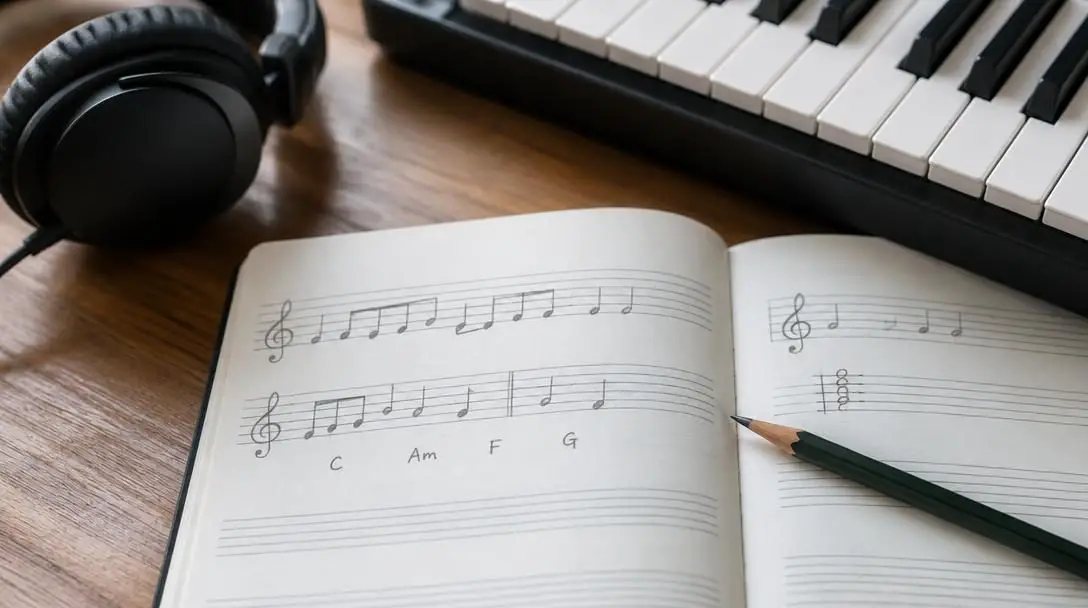
At the center of rhythmic literacy is the ability to count beats. The beat represents the steady, underlying pulse that drives a piece of music forward—it is the physical sensation that prompts listeners to tap their feet or nod their heads in time with a song. By learning how to count these beats evenly, beginner musicians learn to hold notes for their intended durations, honor rests, and synchronize their playing when performing alongside other musicians.
Rhythm is the foundation of music, organizing sounds and silences into a coherent temporal experience that binds performers together.
Basic chords
While a single note produces a melodic pitch, basic chords supply the harmonic depth that supports melodies. A chord is technically defined as a collection of three or more musical notes played simultaneously. Across nearly every genre—from classical symphonies to modern popular music—chords form the foundational harmonic backbone that guides a song's emotional tone.
Chords are divided into different structural classifications, most notably major, minor, diminished, and augmented varieties. Each chord type carries an unmistakable sonic personality; for example, major chords generally sound bright and stable, whereas minor chords introduce a darker, more melancholic mood. Learning how three notes combine into a cohesive harmonic unit enables beginners to create rich accompaniments and write compelling chord progressions.
Key signatures
Before an instrumentalist plays a single note from a written score, they must consult the key signatures displayed at the beginning of the staff. A key signature consists of a designated grouping of symbols placed at the start of a piece of music to indicate exactly which notes should be utilized throughout the composition.
By establishing the overarching collection of notes right away, key signatures eliminate the tedious need to write out individual accidental symbols before every single note on the page. While decoding key signatures can feel intimidating for beginners at first, mastering them provides an immediate musical roadmap. Recognizing a key signature instantly tells a performer which notes belong to the primary scale, making melody interpretation and chord identification substantially easier.
Intervals
To fully grasp how melodies and harmonies interact, musicians study intervals, which measure the exact distance between two musical pitches. Intervals serve as the microscopic connective tissue of music; just as words are constructed from precise arrangements of letters, musical phrases are shaped by moving across specific distances between notes.
Intervals can occur successively as part of a linear melody, or simultaneously to produce harmony. Theoretical classifications divide intervals into categories such as major, minor, perfect, augmented, and diminished distances. By developing a keen awareness of intervals, beginner musicians gain the ability to anticipate how two notes will blend together, calculate scale formulas, and transcribe melodies purely by ear.

Step-by-step method to practice foundational theory
Theoretical knowledge delivers the greatest benefit when it is applied directly to an instrument rather than studied merely on paper. This structured five-step routine will help you internalize the fundamental concepts smoothly.
- Recite and map the musical alphabet: Practice speaking the seven-letter sequence forward and backward without hesitation. Sit at your instrument and locate every iteration of A through G, linking the abstract letter name directly to a physical key, fret, or fingering position.
- Count beats against an external pulse: Turn on a metronome or tap your foot at a moderate, steady tempo. Practice counting beats aloud in regular repeating groupings, clapping on the beats and remaining silent on the rests to internalize the interplay between sound and silence.
- Assemble basic three-note triads: Select a starting note using your knowledge of the alphabet, add two complementary notes to form a three-note grouping, and sound them together. Listen closely to the resonance, then practice shifting between major and minor qualities.
- Analyze key signatures before reading notes: Whenever you open a piece of sheet music, examine the symbols situated at the far left edge of the staff. Identify the designated pitches before placing your hands on the instrument, ensuring your note choices conform to the piece's framework.
- Measure and sing pitch intervals: Pick any two notes on your instrument. Calculate the distance between them, determine whether the relationship represents a major, minor, perfect, augmented, or diminished interval, and play them first sequentially as a melodic line and then together as a harmony.
Common beginner mistakes to avoid
Progress in music theory often stalls not because the concepts are overly complex, but because beginners develop counterproductive study habits. Watching for these typical pitfalls will save valuable practice time and prevent frustration.
- Forgetting the alphabet's cyclic design: Beginners often stumble when moving beyond G, forgetting that the scale immediately restarts at A. This mental block complicates sight-reading and fretboard navigation.
- Ignoring the steady rhythmic pulse: Concentrating exclusively on pressing the correct keys while neglecting tempo produces an erratic performance. Rhythm is foundational; without steady counting, music loses its structure.
- Jumping directly to complex chord shapes: Attempting intricate, extended chords before mastering basic three-note major and minor triads leads to physical tension and theoretical confusion.
- Bypassing the key signature: Diving into sheet music without noting the key signature symbols results in played mistakes, as accidental alterations apply to the entire piece unless otherwise marked.
- Evaluating notes in isolation: Treating notes as detached entities rather than evaluating the intervals between them prevents beginners from recognizing the recurring melodic patterns that make learning songs fast and intuitive.
Advancing your study: Form, ear training, and artistic freedom
Once you are comfortable working with the alphabet, rhythm, simple chords, key signatures, and intervals, you are thoroughly prepared to explore higher-level musical architecture. These foundational principles provide the springboard for more nuanced artistic pursuits.
One natural next step is studying musical form, which describes how complete compositions are structured over time. Form analyzes the way melodies, harmonies, and rhythms are organized into larger thematic sections, ranging from familiar verse-chorus arrangements in modern songwriting to intricate multi-movement designs in classical works. Because you already understand the grammar of individual musical phrases, analyzing how those phrases assemble into complete musical stories becomes clear and engaging.
Simultaneously, you can expand into active listening and ear training. Now that you understand the formal categories of intervals and chords—such as major, minor, perfect, augmented, and diminished—you can challenge yourself to identify these elements by ear in your favorite recordings. Aurally dissecting songs bridges the gap between intellectual comprehension and spontaneous creative instinct.
Frequently asked questions
Why does the musical alphabet stop at G instead of continuing to Z?
The musical alphabet stops at G because musical pitches repeat in cycles known as octaves. After moving through seven natural note names—A, B, C, D, E, F, and G—the next pitch vibrates at exactly double the frequency of the initial A, creating a sound that feels identical in character but higher in pitch. Repeating those seven letters provides a clear, manageable naming system for all instruments.
How many notes are required to make a chord?
In classical music theory, a chord requires a minimum of three distinct notes sounded simultaneously. While playing two notes together creates an interval that can imply harmony, it takes three notes to establish a complete triad, which outlines specific qualities such as major, minor, augmented, or diminished.
Do I need to learn to read sheet music to understand music theory?
While reading standard musical notation on a staff makes learning concepts like key signatures and intervals much more visual and standardized, the core ideas of music theory can also be understood and applied through instrument-specific diagrams, tablature, and direct ear training.
What is the difference between rhythm and beat?
The beat is the continuous, unvarying pulse that underlies a piece of music, much like the steady ticking of a clock. Rhythm, on the other hand, is the actual pattern of varied note durations and silences that plays over that steady beat.
Will learning music theory restrict my musical creativity?
No, music theory is descriptive rather than prescriptive. It does not dictate what you are forbidden to play; instead, it offers a logical language explaining why certain combinations of notes produce specific emotional responses, giving you more creative choices rather than fewer.
The bottom line
Music theory is not an obstacle designed to restrain creative intuition; it is the common language that allows musicians to turn raw creative impulses into articulate, powerful art. By dedicating time to master the musical alphabet, steady rhythmic counting, basic triad construction, key signatures, and intervals, you build a dependable foundation that supports every future performance and composition. As these five core concepts become second nature, the mechanical effort of playing fades away, leaving you with complete artistic freedom to communicate, collaborate, and express yourself through music.