
5 Most Catastropic Crashes From Airplane Faults

When analyzing aviation disasters, public perception frequently gravitates toward extreme weather patterns or critical pilot errors. While human factors and harsh environmental conditions account for a large portion of airline emergencies, equipment faults remain a persistent hazard in modern aviation. Historical data indicates that approximately 20 to 25 percent of aviation accidents stem directly from mechanical errors caused by an underlying fault in the aircraft. While mechanical malfunctions do not always lead to loss of life, in-flight failures of primary control or propulsion systems can be utterly catastrophic.
Unlike ground vehicles, an airplane cannot pull over to the side of the road when a mechanical breakdown occurs. Aircraft operate in an unforgiving environment where physical margins are razor-thin, relying on continuous aerodynamic balance and the smooth interaction of millions of specialized parts. When a primary flight surface jams, an engine breaks apart, or an automated system gives conflicting inputs, the aircraft can quickly become physically impossible to fly, no matter how skilled the crew might be.
Key takeaways
- Mechanical errors and component faults directly cause between 20 and 25 percent of all aviation accidents.
- Primary failure modes include structural metal fatigue, uncontained engine malfunctions, and flight control actuator anomalies.
- Catastrophic crashes often stem from a breakdown in routine maintenance, deferred repairs, or undetected prior incidents.
- Modern aviation safety relies on redundant system architecture, non-destructive testing, and rigorous inspection cycles to prevent single-point failures.
Five Infamous Crashes Caused by Mechanical Faults
Throughout modern aviation history, several high-profile disasters have underscored the devastating consequences of maintenance shortcomings and mechanical degradation. The following five incidents demonstrate how equipment failures converted routine flights into unrecoverable emergencies.
| Flight / Incident | Aircraft Model | Date | Fatalities | Primary Mechanical Issue |
|---|---|---|---|---|
| The Death of Roberto Clemente | Douglas DC-7CF | December 31, 1972 | 5 | Engine failure caused by unaddressed prior damage and improper maintenance |
| American Airlines Flight 1 | Boeing 707 | March 1, 1962 | 95 | Autopilot malfunction disrupting the rudder control system |
| Aeroflot Flight 8641 | Yakovlev Yak-42 | June 28, 1982 | 132 | Jackscrew failure driven by unchecked metal fatigue |
| Finnish Air Force DC-3 | Douglas DC-3 | October 3, 1978 | 15 | Engine failure caused by a fatigue-cracked exhaust valve |
| USAir Flight 427 | Boeing 737-3B7 | September 8, 1994 | 132 | Uncommanded rudder reversal during wake turbulence encounter |
The Death of Roberto Clemente (1972)

- Date: December 31, 1972
- Aircraft: Douglas DC-7CF
- Departure: San Juan, Puerto Rico
- Fatalities: 5 (all on board)
On New Year's Eve in 1972, baseball icon Roberto Clemente boarded a chartered Douglas DC-7CF in San Juan, Puerto Rico, bound for Managua, Nicaragua. Clemente had spent time coaching the Puerto Rican national baseball team in Managua and was personally accompanying an emergency relief shipment to help survivors of a devastating earthquake. Tragically, the aircraft had not received proper maintenance prior to the flight.
Immediately after liftoff, the aircraft's number two engine suffered a complete failure. The flight crew attempted to execute an emergency return to the airfield in Puerto Rico, but the heavy plane began losing altitude at an unmanageable rate. In a desperate maneuver to survive, the pilot attempted an emergency ditching into the ocean, but the impact destroyed the aircraft, killing all five people on board. An investigation revealed a disturbing operational failure: the pilot had not been informed that earlier that same month, improper maintenance on that specific airframe had already caused a minor crash.
American Airlines Flight 1 (1962)

- Date: March 1, 1962
- Aircraft: Boeing 707
- Departure: New York International Airport (now JFK)
- Fatalities: 95 (all on board)
American Airlines Flight 1 was an anticipated cross-country departure from New York to Los Angeles International Airport. The aircraft was a Boeing 707, at the time one of the premier additions to the American Airlines fleet. The crew completed standard preflight inspections without detecting any operational red flags, and the initial takeoff roll proceeded smoothly.
Trouble began seconds after the plane left the runway. As the pilot initiated a standard turn to establish a westbound heading, the aircraft suddenly and violently banked beyond normal limits, rolled inverted, and entered an unrecoverable vertical dive. The jet slammed into the Pumpkin Patch Channel of Jamaica Bay. All 95 passengers and crew members died in the crash, including Olympic sailing champion Emelyn Whiton and several prominent business executives. Investigators cleared the flight crew of any error, determining that a faulty autopilot system disrupted the rudder mechanism, triggering extreme control deflections caused by improper maintenance procedures during servicing.
Aeroflot Flight 8641 (1982)

- Date: June 28, 1982
- Origin: Leningrad, Russia
- Destination: Kyiv, Ukraine
- Fatalities: 132 (all on board)
Aeroflot Flight 8641 carried more than 120 passengers on a scheduled domestic flight between Leningrad and Kyiv. Pre-departure checks identified no mechanical issues, and the flight pushed back only a single minute behind schedule to accommodate a late-boarding traveler. The climb and cruise phases were completely uneventful as the jet crossed into Ukrainian airspace.
The flight turned deadly during its descent toward Kyiv. The autopilot unexpectedly drove the nose downward into an aggressive dive. As the plane plunged, the automated system abruptly disconnected. The flight crew hauled back on their control yokes to arrest the high-speed descent, but their manual inputs produced no response from the control surfaces. The aircraft struck the ground at nearly 500 miles per hour, killing all 132 occupants. Investigators traced the disaster to catastrophic failure of the horizontal stabilizer jackscrew, which had completely stripped and seized due to metal fatigue that went undetected during sub-standard maintenance inspections.
When high-load control components fail mid-flight, physical flight control can slip beyond human recovery regardless of pilot skill.
Finnish Air Force DC-3 (1978)

- Date: October 3, 1978
- Aircraft: Douglas DC-3
- Departure: Kuopio Airport, Finland
- Fatalities: 15 (all on board)
A Douglas DC-3 transport operated by the Finnish Air Force departed Utti Airport on October 3, 1978, carrying prominent business figures and politicians traveling to an official conference organized by the Finnish Defence Forces. The aircraft made a scheduled intermediate stop at Kuopio Airport before beginning the final leg to Helsinki.
Moments after rotating off the Kuopio runway, one of the plane's radial engines abruptly lost all power. The flight crew immediately banked the aircraft in an attempt to circle back toward the runway for an emergency landing. However, burdened by strong local winds and deprived of power from the dead engine, the twin-engine transport could not sustain altitude. The DC-3 stalled and crashed into nearby terrain, killing all 15 occupants. Post-accident teardowns revealed that an internal engine exhaust valve fractured under metal fatigue, starving the cylinder bank and triggering immediate, asymmetric power failure at the most vulnerable phase of flight.
USAir Flight 427 (1994)

- Date: September 8, 1994
- Aircraft: Boeing 737-3B7
- Route: Chicago, IL to Palm Beach, FL (via Pittsburgh)
- Fatalities: 132 (all on board)
USAir Flight 427 departed Chicago's O'Hare International Airport en route to Palm Beach, Florida, carrying 132 passengers and crew members, with a scheduled intermediate stop in Pittsburgh, Pennsylvania. Captain Peter Germano and his first officer were preparing the aircraft for its arrival into Pittsburgh when the jet encountered mild clear-air turbulence from the wake of an aircraft ahead.
Captain Germano applied rudder pedal input to counteract the sudden buffeting. Instead of dampening the yaw, the rudder power control unit jammed and reversed direction, deflecting the rudder to its physical travel limit opposite the pilot's input. This uncommanded rudder reversal forced the Boeing 737 into a violent roll and an unrecoverable aerodynamic stall. The jet plunged out of the sky and slammed into a wooded ravine near Aliquippa, Pennsylvania, at 300 miles per hour, leaving no survivors. The resulting investigation prompted one of the most comprehensive redesigns of flight control systems in commercial aviation history.

How Critical Aircraft Systems Suffer Failures
Appreciating how mechanical anomalies escalate into crashes requires understanding how modern aircraft balance aerodynamic forces with mechanical actuation. Airplanes depend on four vital engineering domains:
- Primary flight controls: Ailerons, elevators, and rudders modify the aerodynamic contour of wings and tail surfaces to control roll, pitch, and yaw. If an actuator jams or detaches, aerodynamic forces can pin that surface into an extreme deflection, overwhelming other control inputs.
- Mechanical actuation mechanisms: Because airflow at high speeds generates tons of pressure across control surfaces, pilots cannot maneuver modern airliners through muscle power alone. Hydraulic actuators, electrical servos, and large mechanical jackscrews—threaded steel shafts that adjust the horizontal stabilizer—bridge the gap. If a jackscrew strips its threads, the tailplane can lock at an angle that forces the nose into the ground.
- Avionics and autopilot systems: Flight guidance computers rely on pitot-static and gyro sensor data to guide the aircraft. If an internal sensor fails, or if faulty software commands an excessive control movement, the autopilot can aggressively destabilize the airframe before pilots can diagnose and disable the system.
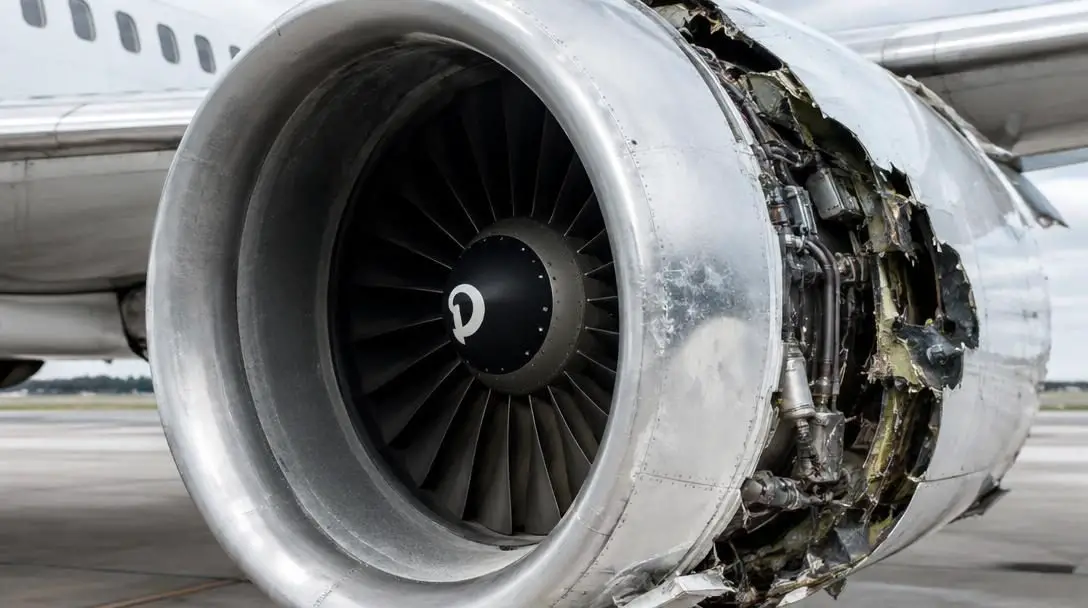
- Powerplants and propulsion: Turbine and piston engines undergo massive thermal cycling and mechanical stress. Even microscopic flaws, such as a micro-fissure in an exhaust valve or a cracked turbine blade root, can trigger sudden power loss or uncontained engine failures that tear through control cables and hydraulic lines.
Systematic Maintenance Protocols to Prevent Catastrophe
Preventing mechanical wear from turning into an in-flight crisis requires continuous, standardized inspection and repair regimes. Commercial and military aviation programs follow a structured set of technical safeguards to catch defects before an aircraft leaves the ground.
- Conduct thorough preflight walk-arounds: Flight crews and ground technicians inspect the exterior of the airframe before departure, checking for fluid leaks, verifying the physical freedom of all control surfaces, and looking for structural tears or tire wear.
- Enforce phased maintenance checks: Aircraft undergo time-based and cycle-based overhauls (typically categorized from A to D checks). During these intervals, technicians disassemble assemblies, flush hydraulics, and lubricate high-friction components like jackscrews.
- Deploy Non-Destructive Testing (NDT): Because metal fatigue develops deep within alloy matrices, technicians utilize ultrasonic scanning, eddy-current probes, and X-ray imaging to find invisible micro-fissures in high-load engine components and wing spars.
- Maintain airtight logbooks: Mechanics log every replacement, repair, and unexpected flight anomaly. Documenting prior incidents prevents uninspected structural trauma from lingering inside the aircraft across subsequent flight cycles.
- Drill abnormal event response: Pilots undergo regular simulator training to rehearse immediate mechanical isolation protocols, such as disengaging rogue flight directors, shutting down runaway engines, and flying through asymmetric thrust emergencies.
Operational Pitfalls in Mechanical Care and Automation
Catastrophic mechanical failures rarely happen without early warning signs. They are usually the cumulative result of small oversights, deferred maintenance, or undue operational pressures. Aviation safety investigators have highlighted several common mistakes that leave aircraft vulnerable to failure:
- Inadequate lubrication: Heavy mechanical linkages like jackscrews and trim actuators endure massive friction loads. Skipping scheduled grease intervals or using mismatched lubricants causes rapid thread abrasion, metal flaking, and eventual mechanical seizure.
- Ignoring past incident logs: Failing to perform comprehensive inspections following a minor tailstrike, hard landing, or engine hiccup allows hidden internal fatigue cracks to spread unnoticed.
- Deferring critical repairs: While Minimum Equipment Lists allow certain non-safety components to remain inoperative temporarily, pressure to keep planes on schedule can lead maintenance operators to improperly defer repairs on essential flight control or engine assemblies.
- Complacency toward automation: Over-relying on flight management systems can dull situational awareness. When an autopilot encounters an internal mechanical malfunction, a delayed recognition by the flight crew can turn a recoverable trim error into a high-speed dive.
- Superficial engine inspections: High-bypass turbofans and radial piston engines experience severe thermal stress. Omitting borescopic or metallurgical checks on internal exhaust valves and turbine disks allows fatigue fissures to progress to complete separation during high-thrust takeoffs.
Frequently asked questions
What percentage of plane crashes are caused by mechanical failure?
Historical aviation data indicates that roughly 20 to 25 percent of all aviation accidents are caused directly by mechanical malfunctions, equipment faults, or structural failures.
What caused the crash that killed Roberto Clemente?
Roberto Clemente's Douglas DC-7CF suffered a total failure of its number two engine immediately after departure from San Juan, Puerto Rico. The aircraft had not received proper maintenance and had suffered a prior crash earlier that month that was never disclosed to the pilot.
How can a jackscrew failure bring down an airliner?
A jackscrew is a heavy-duty threaded steel rod that physically tilts the horizontal stabilizer to trim the aircraft's pitch. If inadequate lubrication or metal fatigue causes the screw's threads to strip, aerodynamic pressure pushes the stabilizer to its extreme limit, forcing the aircraft into an uncontrollable dive.
What is an uncommanded rudder reversal?
An uncommanded rudder reversal occurs when the rudder power control unit malfunctions, forcing the rudder to deflect in the opposite direction of the pilot's pedal inputs. This unexpected behavior caused the fatal crash of USAir Flight 427 in 1994.
How do maintenance crews detect metal fatigue before parts break?
Aviation technicians use Non-Destructive Testing (NDT) techniques, including eddy-current testing, ultrasonic scanning, magnetic particle inspections, and industrial X-rays, to detect internal micro-fractures in structural components before they are visible to the naked eye.
The bottom line
Modern commercial aviation remains the safest mass transit mode in history, largely because of the bitter engineering lessons drawn from past mechanical tragedies. Crashes like American Airlines Flight 1 and USAir Flight 427 forced aeronautical engineers to fundamentally rethink aircraft control mechanisms, prompting mandatory secondary hydraulic channels, dual-concentric servo valves, and triple-redundant flight control computers.
Yet even the most advanced engineering cannot safeguard an airframe if maintenance standards slip. As mechanical systems operate under immense aerodynamic and thermal loads, strict adherence to scheduled lubrication, non-destructive fatigue evaluations, and rigorous logbook tracking remains the true front line of aviation safety. Without meticulous, proactive care on the ground, the mechanical systems that keep aircraft aloft can become the very points of failure that bring them down.