5 Revision Tips for Biology: How To Remember Diagrams, Technical Terminology, and Biological Processes

Preparing for biology examinations frequently leaves students feeling overwhelmed, and it is entirely normal to view exam season as the most demanding phase of academic life. Biology presents a uniquely difficult learning curve because it requires learners to master three distinct formats of information simultaneously: spatial illustrations, a specialized linguistic lexicon, and dynamic chronological systems.
A diagram in biology is rarely a static picture; it is a functional map of life. When study sessions rely exclusively on casual reading and passive review, intricate cellular pathways, overlapping root words, and chemical cycles quickly blur together. Implementing deliberate, active revision techniques can convert dense curricular material into durable, instantly accessible understanding.
Key takeaways
- Biology demands simultaneous fluency in anatomical diagrams, root-based terminology, and multi-step physiological processes.
- Active handwriting and unassisted diagram sketching create spatial memory traces that typed notes cannot match.
- Portable binder-ring flashcards allow you to turn idle daily transitions into micro-study sessions.
- Explaining biological mechanisms out loud to peers, pets, or household objects reveals hidden gaps in comprehension.
- Past tests, quizzes, and homework assignments serve as the most accurate blueprint for your instructor's upcoming exam.
The Triple Challenge: Diagrams, Terminology, and Processes
To revise biology successfully, you must first recognize why standard study habits often fall short. Most school subjects focus heavily either on quantitative problem solving or on text-based analysis. Biology blends both worlds while adding heavy visual and chronological components that overwhelm short-term memory.
A diagram in biology is rarely just an illustration; it is a functional map of life.
First, visual structures—ranging from the internal components of a single cell to organ systems—require you to grasp both physical positions and dynamic operational relationships. Second, the technical vocabulary of life sciences is vast. Terms frequently share similar Latin and Greek roots, prefixes, and suffixes, which makes them extraordinarily easy to mix up under time constraints. Third, biological mechanisms operate as sequential chains of events. Whether tracking biochemical transformations in cellular respiration or tracing hormone regulation, you must understand exact molecular inputs, shifts, and outputs in strict chronological order.
Five Core Biology Revision Strategies
Rather than reviewing textbooks passively, high-performing students rely on revision strategies that match how the human brain encodes, organizes, and retrieves complex information. The five techniques detailed below work in tandem to transform abstract facts into stable recall.
| Revision strategy | Primary learning format | Key cognitive mechanism | Best applied to |
|---|---|---|---|
| Memory tricks and mnemonics | Verbal and auditory | Associative cognitive hooks | Complex terminology and sequence lists |
| Handwritten retrieval | Tactile and spatial | Motor encoding and mental mapping | Anatomical structures and cellular diagrams |
| Binder-ring flashcards | Visual and textual | Spaced active recall | Prefixes, suffixes, and technical terms |
| Explanatory teaching | Auditory and communicative | The Protégé Effect and error spotting | Multi-step biological pathways |
| Prior coursework analysis | Analytical and diagnostic | Pattern recognition of testing styles | Midterms, unit reviews, and cumulative finals |
1. Memory Tricks and Mnemonic Frameworks
Dense biological terminology can feel dry, but memory tricks convert academic facts into formats that your brain naturally retains. By transforming scientific names into lively rhymes, mapping multi-stage sequences into short poems, or relying on acronyms to outline diagram components, you build clear cognitive anchors. Environmental consistency reinforces these associations. Revising your notes in the exact same location every day—such as a designated library carrel or a dedicated home desk—signals to your brain that it is time to concentrate. Following up a rigorous study session with a short rest or nap helps your brain transfer newly encoded details directly into long-term retention.
2. Handwritten Retrieval and Memory Drawing
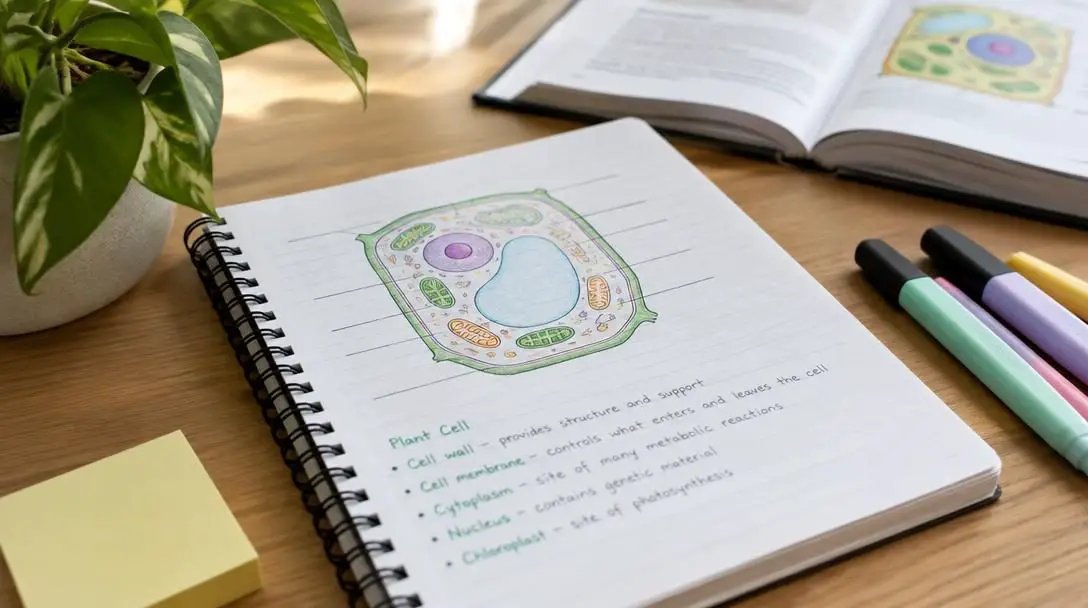
Typing lecture notes on a laptop has become widespread, but choosing to write by hand provides irreplaceable spatial advantages. Physically drafting words and structural outlines logs concepts as visual and motor coordinates, making them vastly easier to retrieve during an exam. This method shows its greatest strength when you sketch diagrams entirely from memory. You can begin with foundational figures, such as the basic makeup of a cell, and advance toward intricate metabolic pathways like the Krebs Cycle. Repeating the physical motion of sketching lines, membranes, and labels locks structural relationships deep into memory.
3. Portable Binder-Ring Flashcards
Flashcards provide a rapid, lightweight mechanism for reinforcing technical definitions and physiological steps, but their true strength lies in continuous use over time. A common pitfall is assembling cards during the final days before an exam, which eliminates their spaced-repetition value. By punching a hole through the corner of each flashcard and securing the set onto a metal binder ring, you create a portable study deck that will not scatter in your bag. You can easily pull out the ring during unexpected moments of downtime, such as waiting in line for coffee or sitting through a quiet interval between classes.
4. The Explanatory Teaching Technique
Explaining a topic out loud forces you to organize fragmented thoughts into a cohesive narrative. If you can articulately guide another person through an anatomical layout or a metabolic cascade, answering standard exam prompts becomes far simpler. Organizing a study group where members alternate acting as the instructor is an outstanding way to expose hidden gaps in understanding. However, you do not strictly require a human audience to harvest these benefits. Placing an inanimate stand-in like a rubber ducky on your desk or walking your family cat through each biochemical phase highlights precisely which transitions you know well and which steps remain fuzzy.
5. Prior Coursework as an Exam Blueprint
Instructors rarely invent entirely new question patterns from scratch when writing midterm or final exams. Instead, past homework assignments, weekly quizzes, and unit assessments serve as an authentic blueprint for your upcoming test. Rather than setting aside previous work once you receive your score, comb back through every marked sheet. Locate every question where you lost points, verify the correct answers, and write out explanations detailing why those solutions are correct. This diagnostic habit eliminates test anxiety by familiarizing you with your teacher's phrasing preferences and core topics.
Step-by-Step Implementation Guide
Executing all five techniques at once can feel daunting without a clear workflow. Follow this structured roadmap to integrate each revision tip smoothly across your study cycle.

- Establish a fixed study zone: Select a single, dedicated desk at home or a quiet library nook that you use exclusively for revising biology notes to trigger an automatic focus state.
- Build binder-ring flashcards immediately: Write new definitions and process steps on cards as soon as they are introduced in class, punch a corner hole, and snap them onto your ring.
- Handwrite concepts and mnemonics: Use a notebook to compose rhymes for complex words, short poems for sequence stages, and acronyms for anatomical structures instead of typing them.
- Draw biological diagrams from memory: Close your textbook, take a blank sheet of paper, and sketch biological structures from scratch—starting with simple cell anatomy before attempting complex pathways like the Krebs Cycle.
- Teach the mechanisms out loud: Review multi-stage systems by lecturing to a study partner, a rubber ducky, or a household pet, taking note of any moments where your explanation stumbles.
- Build a past-work correction sheet: Gather every past quiz, worksheet, and unit test, identify your errors, and rewrite full justifications for the correct answers.
- Rest to consolidate memory: Finish your study session with a brief rest or short nap to support memory consolidation and prevent mental fatigue.
Common Revision Mistakes to Sidestep
Even the most dedicated students can undermine their preparation by falling into inefficient learning routines. Watching out for these common missteps will keep your biology revision sessions focused and productive.
- Over-relying on digital note-taking: Typing transcripts of lectures may feel fast, but it bypasses the motor and spatial mapping that handwriting provides, weakening visual recall during exams.
- Engaging in passive re-reading: Simply looking over diagrams or skimming chapters gives a misleading sensation of mastery; without forcing yourself to retrieve labels from memory, recall often collapses under testing pressure.
- Delaying flashcard creation: Waiting until the week of the test to write flashcards strips away the primary advantage of distributed retrieval over time.
- Constantly shifting study locations: Alternating study sessions between your bed, the kitchen counter, and noisy common areas disrupts the contextual cues your brain uses to sustain high concentration.
- Discarding graded coursework: Putting away corrected quizzes without reviewing them wastes your clearest window into the instructor's assessment patterns and favorite topics.
- Skipping recovery and sleep: Pushing through hours of non-stop cramming without rest compromises the brain's natural ability to move newly studied biological processes into durable long-term storage.
Semester-Long Planning and Archive Management
Turning revision strategies into high scores requires planning beyond single study sessions. Because memory tricks, handwritten sketching, and flashcard reviews rely on regular repetition, designing a predictable weekly schedule early in the semester prevents last-minute panic. Set aside a recurring window each weekend to build flashcards for the week's topics, meet with your study group, and practice unassisted diagram drawing.
Pay close attention to which specific memory formats yield the greatest personal return. You may discover that acronyms work best for sorting multi-phase cellular cycles, whereas teaching concepts out loud to a rubber ducky or pet quickly clears up confusion around technical roots and suffixes. Tailoring your routine around the strategies that feel most effective ensures you remain consistent throughout the term.
Finally, maintain a single, dedicated binder or filing system for all returned tests, lab reports, and assignments. As cumulative finals approach, this organized archive serves as your most valuable revision asset, highlighting historical problem areas and showing you precisely how your instructor evaluates knowledge.
Frequently asked questions
Why is drawing diagrams by hand better than reviewing labeled textbook images?
Reviewing pre-labeled textbook diagrams relies on passive recognition, which creates a false sense of confidence. Sketching and labeling structures from a blank page forces your brain to recall spatial relationships, dimensions, and interactions without visual aids, mirroring the demands of an exam.
How early in the term should I begin making flashcards?
Flashcards should be assembled immediately as new terminology and cycles are introduced in class. Keeping them on a binder ring from week one allows you to review terms in short pockets of spare time throughout the entire semester rather than cramming them at the end.
Can explaining biology concepts to an inanimate object really help me study?
Yes. The cognitive benefit of teaching comes from organizing internal thoughts into verbal language and identifying where your explanation breaks down. Speaking out loud to an inanimate object like a rubber ducky highlights missing links in your understanding just as well as speaking to a human listener.
How does taking a nap after revising improve my recall of biological processes?
A brief nap or rest period gives the brain an opportunity to stabilize newly encoded information. During rest, neural pathways reactivate and transfer facts from temporary short-term holding zones into stable, long-term memory reserves.
What is the best way to utilize old homework assignments and quizzes?
Do not simply check your score and file assignments away. Create a correction sheet where you re-examine every lost point, research the correct response, and write out an explanation detailing why that solution is accurate to mirror your instructor's testing style.
The bottom line
Biology revision does not have to be a stressful cycle of frantic cramming and confusing terminology. By recognizing that biology tests a mixture of visual diagrams, complex language, and chronological mechanisms, you can apply study techniques specifically targeted to each challenge. Combining handwritten memory drawings, portable binder-ring cards, verbal explanations, past-exam blueprints, and proper rest will transform overwhelming study materials into lasting, confident recall on test day.