
5 Surprising Facts About the History of Music
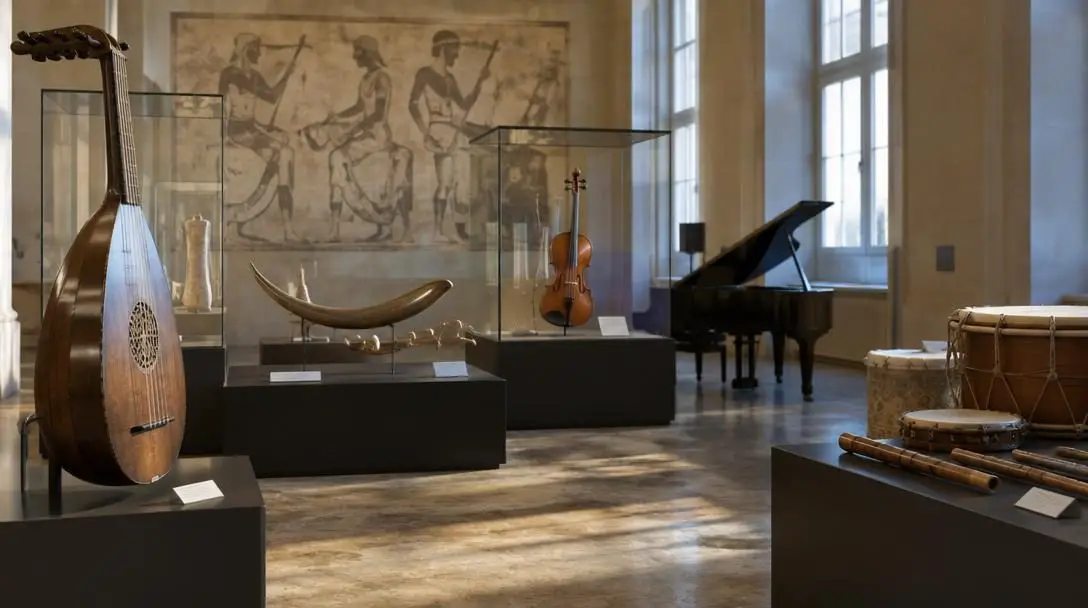
Music has been an essential part of human culture for thousands of years, evolving in tandem with human society from prehistoric communities to the modern digital era. Long before recorded history, human groups integrated sound into daily routines, survival signals, rituals, and communal interactions. As civilizations organized and developed new technologies, musical expression expanded from basic survival vocalizations into structured spiritual practices, formal written systems, early acoustic experiments, and complex creative industries.
Exploring this expansive timeline reveals that many modern assumptions about the origins and development of music are mistaken. Key historical shifts illustrate how human innovation, belief systems, and cultural movements have continuously transformed what we listen to and how we capture sound.
Key takeaways
- Music long predates written language, with archaeological roots extending back roughly 50,000 years to the Paleolithic era.
- Monophonic Gregorian chants established standardized liturgical systems that served as an essential precursor to Renaissance polyphony.
- The earliest recorded musical compositions attributed to a known composer were authored by a 12th-century German nun, Hildegard von Bingen.
- The world's first captured sound recording was not a musical performance, but an 1860 spoken-word reading of a French poem made with the phonautograph.
- The Beatles fundamentally transformed the modern music industry by pioneering studio recording techniques, integrating diverse genres, and asserting independent business control.
Five surprising milestones in musical history
The historical arc of music contains critical turning points that challenge modern perspectives on how traditions began and genres matured. These five milestones trace the path of sonic expression across millennia.
Paleolithic Music

- Time period: Circa 50,000 years ago
- Era: Paleolithic era
- Earliest instruments: Bone flutes, animal skin drums, animal gut strings
- Primary function: Vocal communication, emotional expression, and ritual signaling
Long before humans began recording words on stone, clay, or paper, music was already deeply woven into everyday life. Archaeological findings indicate that early humans used vocalizations and primitive instruments as an essential communication system. Modulating pitch, rhythm, and volume allowed communities to convey urgent messages and express shared emotions across distances. Early instrument craft relied directly on available biological resources: artisans hollowed out animal bones to make flutes, stretched hides across frames to construct resonance drums, and strung animal gut across wooden bases to generate vibrating pitches.
Gregorian Chants
- Origin: Medieval Europe
- Codifier: Pope Gregory I
- Musical texture: Monophonic, unaccompanied vocal music
- Language: Latin
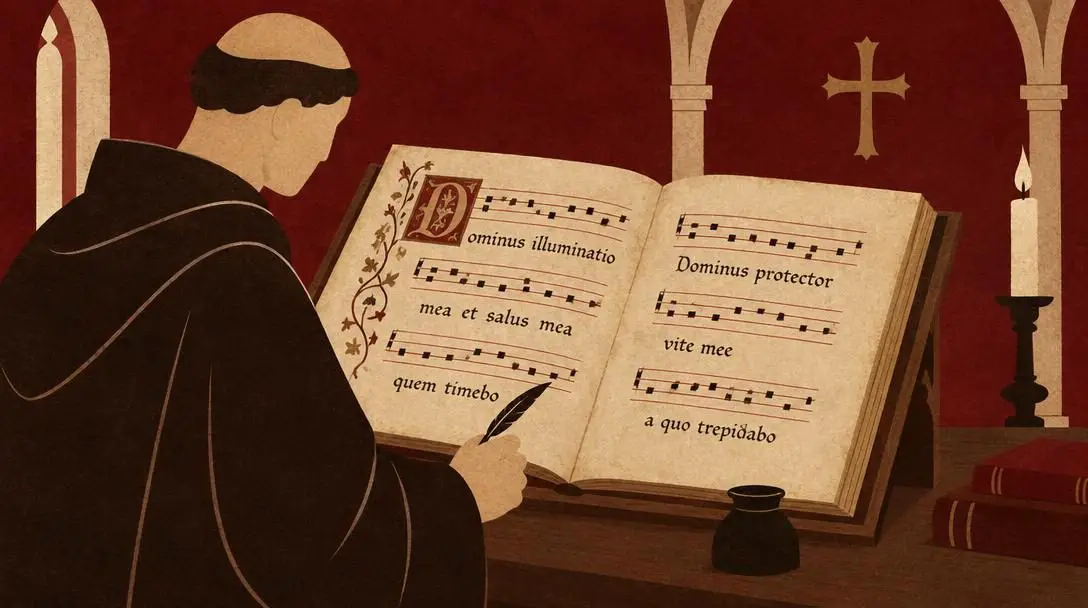
During the medieval era, music became an indispensable component of institutional worship across European monasteries and cathedrals. Gregorian chants are defined by their unadorned, single-line melodies sung without instrumental accompaniment. Traditionally performed by male choirs during religious ceremonies, these chants were organized and codified under Pope Gregory I to ensure uniform liturgical observance across disparate regions. Because the melodic structure was strictly monophonic, entire assemblies could chant in unison, creating an orderly sonic atmosphere that eventually laid the structural groundwork for multi-part polyphonic harmonies during the Renaissance.
Hildegard von Bingen
- Lifespan: 12th century
- Origin: Germany
- Vocation: Nun, mystic, philosopher, writer, and composer
- Major work: Symphonia armonie celestium revelationum (77 chants and antiphons)
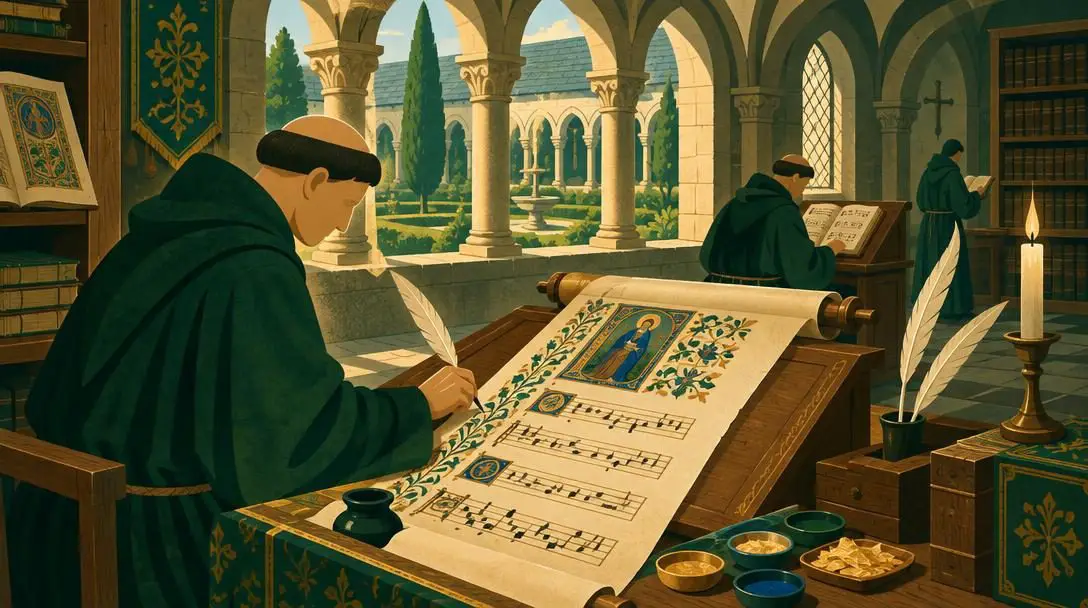
Although historical accounts often focus on male church leaders, the earliest documented individual composer in recorded history was a woman. Hildegard von Bingen was a German nun whose broad intellectual contributions spanned mysticism, philosophy, and creative writing. Her musical legacy rests on her ethereal monophonic chants, which were written specifically for women's choirs in sacred ceremonies. Her premier collection, the Symphonia armonie celestium revelationum, contains 77 distinct antiphons and chants composed over several decades, marking an extraordinary artistic achievement that remains celebrated for its soaring vocal range and expressive melodic design.
Hildegard von Bingen established a foundational catalog of 77 sacred compositions that proved early written music was shaped profoundly by women.
Édouard-Léon Scott de Martinville
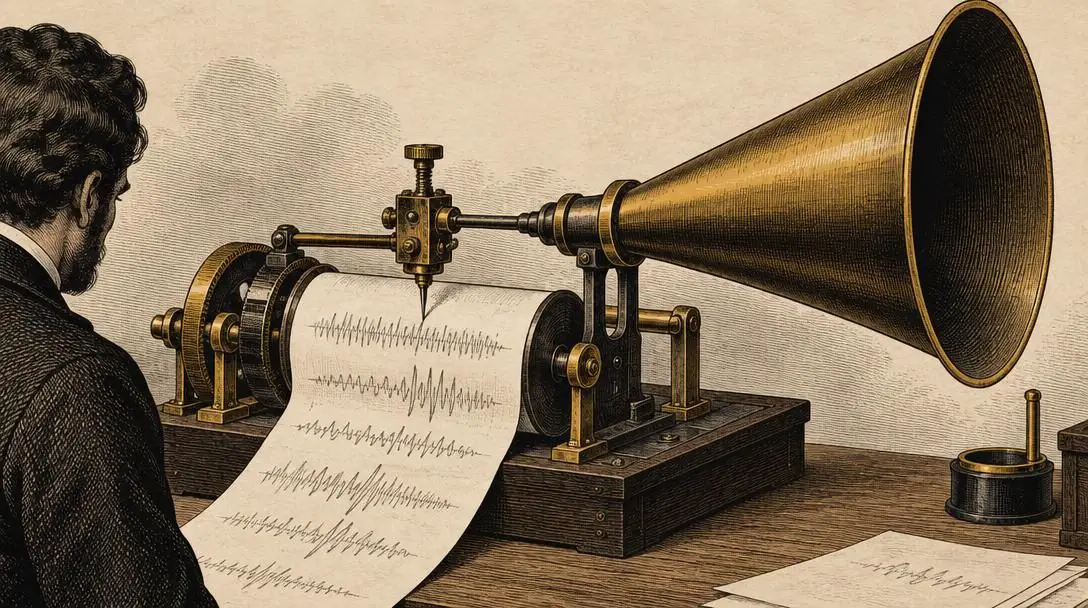
- Date of invention: 1860
- Origin: France
- Device: Phonautograph
- First captured audio: Spoken reading of a French poem
The dawn of mechanical audio capture did not begin with commercial songs, but with a scientific inquiry into acoustic physics. In 1860, French inventor Édouard-Léon Scott de Martinville created the phonautograph, a machine engineered to translate sound vibrations into visible physical waves. By channeling sound through an acoustic horn toward a stylus, the device etched waveforms directly onto soot-covered paper. Scott de Martinville utilized this device to capture a spoken performance of a French poem. Although the phonautograph was originally designed to study acoustics rather than reproduce sound, modern researchers later retrieved and played back the audio, establishing it as the earliest verified sound recording in history.
The Beatles
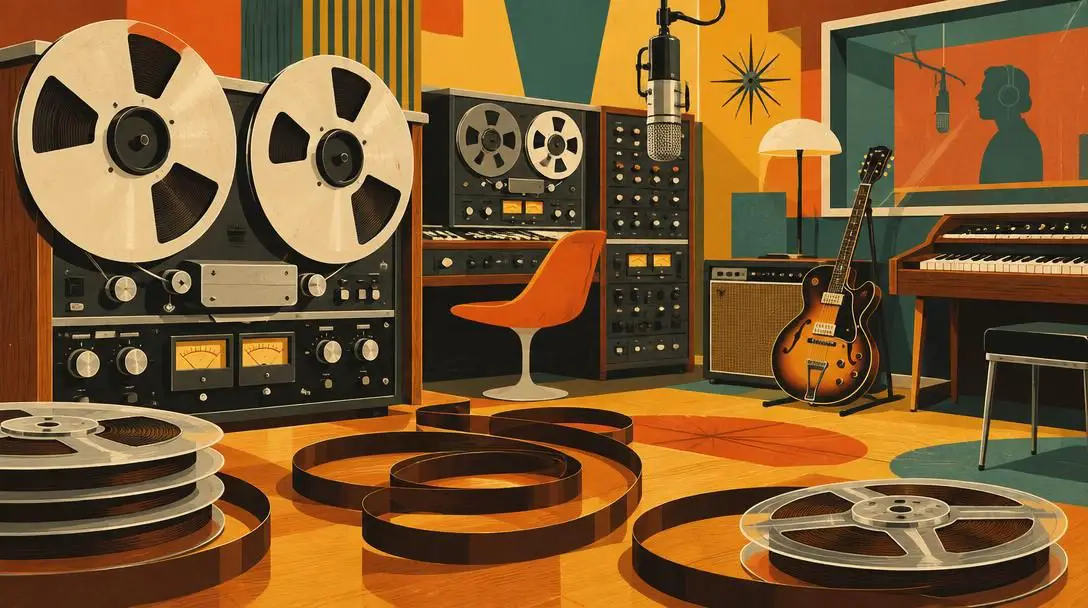
- Origin: Liverpool, England
- Formed: Early 1960s
- Key studio innovations: Tape loops, backward recording, multi-genre arrangements
- Industry impact: Self-production, songwriting control, and founding an independent record label
Formed in Liverpool in the early 1960s, The Beatles grew into an international musical phenomenon that transformed creative recording and commercial distribution. Beyond writing popular rock and roll melodies, the band expanded the boundaries of popular music by integrating classical instrumentation, Indian classical modalities, and folk traditions into single albums. Inside the recording studio, they treated magnetic audio tape as an instrument, utilizing physical tape loops to generate hypnotic rhythms and employing backward recording to produce unfamiliar, psychedelic textures. Furthermore, they challenged existing record company dominance by authoring their own songs, asserting control over production decisions, and forming their own corporate record label.
At a glance: Comparing key milestones across music history
| Milestone / Subject | Historical Era | Primary Format | Key Contribution |
|---|---|---|---|
| Paleolithic Music | Prehistory (~50,000 years ago) | Vocalizations, bone flutes, skin drums | Provided pre-verbal communication and emotional signaling |
| Gregorian Chants | Medieval Europe | Unaccompanied Latin vocal chant | Standardized church liturgy; served as precursor to polyphony |
| Hildegard von Bingen | 12th Century | Sacred monophonic choir compositions | Created the first cataloged musical compositions in history |
| Scott de Martinville | 1860 (19th Century) | Phonautographic stylus tracings on paper | Achieved the world's first physical audio recording |
| The Beatles | 1960s (20th Century) | Multitrack studio tape recordings | Pioneered studio tape manipulation and artist-run business models |
How musical evolution works: Mechanics and institutions
Musical development rarely occurs in isolation. It relies on the continuous interaction between human anatomy, material resources, institutional structures, and technological breakthroughs. Examining these foundational mechanisms reveals how raw sound evolved into complex artistic traditions.
Acoustic physics and material craft provided the starting point for early instrument makers. By testing natural resonance, prehistoric artisans discovered that hollowed avian and mammal bones acted as acoustic chambers when pierced with fingering holes. Stretching animal skins over hollow wood created tunable percussion instruments governed by surface tension, while drying animal intestines yielded flexible gut strings that could produce specific pitches under tension. These discoveries formed the acoustic blueprint for modern woodwind, percussive, and string instruments.
Codification and organizational systems were required when musical traditions grew too complex to be maintained solely through oral memory. Gregorian chants succeeded across Europe because Pope Gregory I organized and codified the repertoire. Monophonic structures—where every singer follows the same melodic contour without competing counterpoints—allowed distant communities to rehearse and maintain uniform musical rituals. This systematic codification paved the way for pitch notation, standard meter, and eventual multi-part counterpoint.
Sacred spaces and institutional preservation provided the stability, funding, and dedicated spaces needed to compose and preserve music. In the 12th century, monastic life afforded Hildegard von Bingen the physical quiet, scribal materials, and vocal choirs necessary to write and transcribe complex liturgical works. Churches and monasteries served as the acoustic testing grounds and archival centers of their day.

Mechanical capture and the physical preservation of waves fundamentally altered music in the 19th century by severing sound from fleeting live performances. Édouard-Léon Scott de Martinville's phonautograph established that acoustic sound waves could be mechanically transcribed into visual data. This conceptual shift—treating sound as a permanent physical trace rather than a transient event—laid the groundwork for all mechanical, magnetic, and digital playback technologies that followed.
Studio experimentation and creative sound engineering transformed recorded music during the mid-20th century. With bands like The Beatles, the studio ceased being a passive tool for capturing an existing stage routine. By physically cutting magnetic tape into loops and running audio tracks in reverse through mixing consoles, recording engineers and artists turned the studio itself into a primary compositional instrument.
Step-by-step: How to explore historical music traditions
Listeners seeking a deeper understanding of musical history can build their knowledge by following a structured, chronological path of listening and analysis.
- Examine early monophonic chant: Begin by listening to traditional Gregorian chants performed by male vocal ensembles. Notice the complete absence of harmonic accompaniment and observe how the Latin phrasing governs the rhythmic flow.
- Analyze Hildegard von Bingen's works: Listen to selections from Hildegard's Symphonia armonie celestium revelationum performed by female choirs. Compare her broad, expressive melodic leaps to the more restrained contours of standard Gregorian chant.
- Contrast monophony with early polyphony: Move forward chronologically into Renaissance polyphony. Track how independent melodic lines weave around one another, observing how the strict melodic codification established in earlier centuries enabled composers to build stable multi-part chords.
- Study historical sound restoration: Research archival audio recoveries, specifically the digital reconstruction of Édouard-Léon Scott de Martinville's 1860 phonautograph paper tracings. Listen to how researchers extracted the spoken French poem from soot-covered paper waves.
- Deconstruct modern studio layering: Select landmark recordings by The Beatles from the late 1960s. Listen specifically for non-vocal elements: isolated tape loops, reversed guitar or drum passages, and the unexpected integration of classical string quartets alongside rock instrumentation.
Common misconceptions in music history
Because musical history spans tens of thousands of years, popular accounts frequently rely on oversimplifications. Avoiding these common analytical errors will help you better understand the true progression of musical traditions.
- Assuming music started with written language: Many believe musical history began when civilizations first developed notation systems. In reality, complex instrumental and vocal traditions flourished at least 50,000 years ago during the Paleolithic era, utilizing bone flutes and skin drums.
- Dismissing monophonic music as primitive: Modern ears accustomed to rich harmonic backings often regard monophonic chant as simplistic. In practice, monophony requires rigorous vocal control, precise unison intonation, and an acute understanding of modal melody and resonance.
- Overlooking women's foundational roles: Traditional surveys frequently omit early female figures. Hildegard von Bingen's 12th-century catalog of 77 sacred works demonstrates that women were pioneering complex written musical compositions at the very foundation of Western classical music.
- Assuming the first sound recording was a musical hit: Popular myth often assumes sound recording began with a hit song. However, Édouard-Léon Scott de Martinville's initial successful recording with the phonautograph in 1860 was a spoken reading of a French poem intended strictly for scientific analysis.
- Viewing mid-century pop groups solely as stage performers: Bands like The Beatles are often remembered solely for their celebrity or songwriting hooks, which overlooks their structural transformation of studio technology, genre integration, and independent business operations.
Frequently asked questions
How do archaeologists know music existed 50,000 years ago?
Archaeologists have uncovered physical artifacts from the Paleolithic era, including flutes carved from animal bones, remnants of drums made from animal hides, and evidence of gut-stringed instruments, confirming active musical toolmaking prior to written history.
What makes Gregorian chant different from modern choir music?
Gregorian chant is entirely monophonic and unaccompanied, meaning all vocalists sing a single melodic line in unison without chords, harmonic counter-melodies, or instrumental backing.
Why is Hildegard von Bingen historically significant in music?
Living in the 12th century, Hildegard von Bingen is recognized as the first named composer in recorded history whose musical catalog—including her 77-piece collection Symphonia armonie celestium revelationum—has survived to modern times.
Could Édouard-Léon Scott de Martinville listen to his own 1860 recording?
No. Scott de Martinville invented the phonautograph to transcribe sound waves visually onto paper for scientific study. The recorded spoken reading of a French poem was not played back as audible sound until modern digital researchers reconstructed it decades later.
How did The Beatles change recording technology in the 1960s?
The Beatles pushed beyond conventional live studio recordings by manipulating magnetic tape directly, employing continuous tape loops for hypnotic effects, using backward recording techniques, and blending rock, folk, and classical genres.
The bottom line
Music is not a static art form invented by any single civilization, but an evolving human behavior that predates the written word. From ancient Paleolithic communities signaling through bone flutes to medieval nuns cataloging liturgical chants, each era has stretched the physical and cultural materials at hand. As mechanical devices like the phonautograph gave way to magnetic tape manipulation and digital audio workstations, music continuously mirrored the technological advancements of its time. Exploring these milestones reminds us that whether carved from bone, written on parchment, etched onto paper, or looped on magnetic tape, music remains one of humanity's most durable and innovative forms of expression.