5 Tips and Tricks to Solve Word Scramble Puzzles Faster
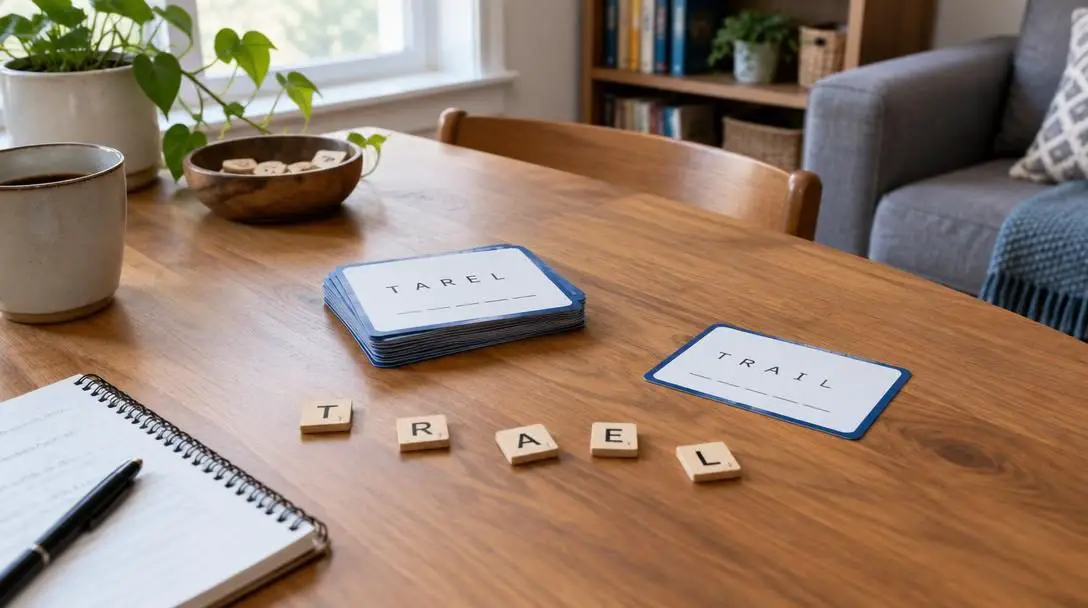
Word scramble puzzles offer an engaging way to exercise the brain, sharpen cognitive agility, and expand everyday vocabulary. At their core, these challenges require you to take an arbitrary sequence of randomized letters and rearrange them into a coherent word or phrase. Despite the simplicity of the underlying concept, solvers of all skill levels frequently encounter frustrating mental blocks when visual noise obscures familiar linguistic arrangements.
These puzzles appear across numerous mediums, serving as standalone brainteasers in daily newspapers and puzzle books, or functioning as vital clues within larger crosswords and word searches. Staring blankly at a chaotic jumble in hopes that an answer will spontaneously materialize rarely works. Transitioning from random guessing to an organized, methodical approach allows you to cut through visual confusion and reveal the hidden solution with speed and precision.
Key takeaways
- Anchoring the first and last letters narrows word length and eliminates improbable letter pairings.
- Isolating common prefixes and suffixes strips away modifiers to reveal the underlying root word.
- Assembling letters into familiar phonetic groupings bypasses visual clutter by focusing on sound.
- Using external context and thematic hints from surrounding puzzles points directly toward target answers.
- Approaching difficult anagrams with flexible experimentation and timed breaks prevents fixation on dead ends.
The Mechanics of Letter Jumbles and Cognitive Processing
To solve anagrams and scramble games rapidly, it helps to understand why the human brain gets tripped up by them in the first place. English spelling relies heavily on conventional letter pairings, positional rules, and morphological structures. When you read normally, your brain processes words in chunks rather than sounding out each character one by one. Jumbled puzzles disrupt this automatic recognition by presenting valid characters in completely unnatural arrangements.
When working memory is flooded with an unstructured cluster of characters, attempting to test every possible permutation mathematically leads to rapid cognitive overload. A six-letter scramble, for instance, has 720 theoretical arrangements. Your mind cannot brute-force every combination without grinding to an exhausted halt. Effective solvers succeed because they stop treating letters as independent, isolated tokens. Instead, they quickly search for standard linguistic building blocks, phonics, and structural boundaries that reduce hundreds of potential combinations down to a manageable few.
Moving from random guessing to systematic problem-solving allows you to work through complex letter jumbles with speed and accuracy.
Core Strategies at a Glance
| Strategy | Target Linguistic Pattern | Primary Benefit | Ideal Puzzle Scenario |
|---|---|---|---|
| First and Last Letters | Positional boundaries | Constrains word length and rules out illegal consonant clusters | Short- to medium-length words with obvious start/end consonants |
| Prefixes and Suffixes | Morphological units | Exposes the central root word by eliminating common affixes | Longer words containing recurrent endings like -able or prefixes like un- |
| Phonetic Groupings | Sound blends and digraphs | Transforms raw visual letters into recognizable, pronounceable syllables | Complex scrambles with multi-letter vowel or consonant blends |
| Context Clues | Semantic associations | Bypasses anagramming by predicting vocabulary from external prompts | Scrambles embedded inside crosswords, riddles, or themed games |
| Active Experimentation | Iterative permutations | Breaks visual fixation and refreshes mental working memory | Dense, stubborn letter pools where initial patterns fail to appear |
Five Core Strategies to Decode Scrambled Letters
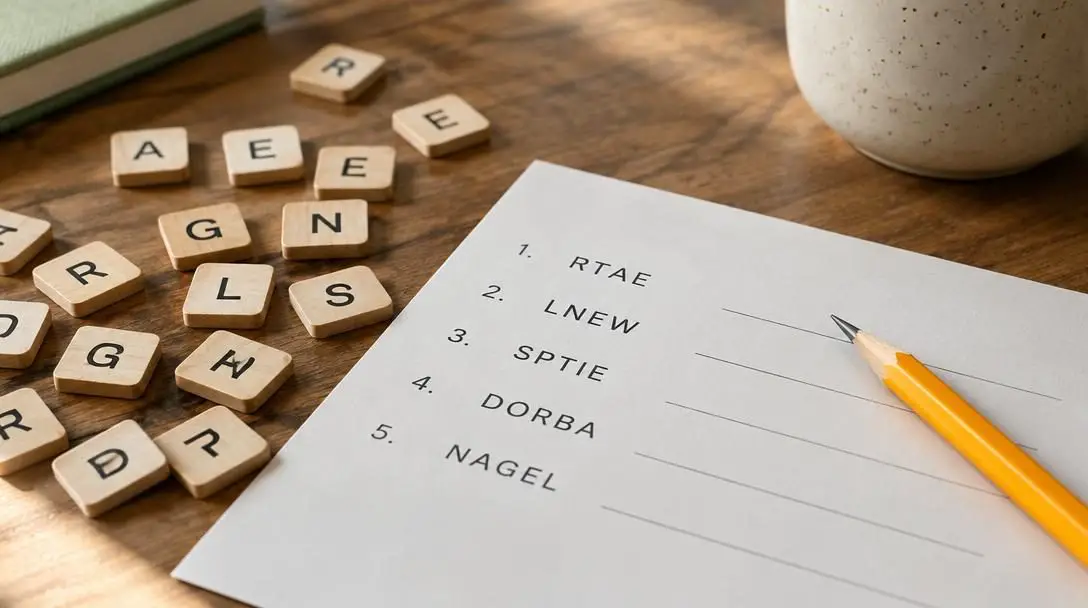
Rather than relying on luck, applying targeted linguistic techniques eliminates uncertainty. The following five strategies leverage structural rules to dismantle jumbles efficiently.
Start With the First and Last Letters
The outer boundaries of a word provide vital structural clues about its identity. The first and last letters dictate the cadence, length, and phonetic profile of a term, making them the most reliable anchors to test right away. When looking at your letter pool, isolate characters that naturally serve as strong starting letters or dependable terminators.
Once you anchor an initial consonant or pair and secure an ending letter, you dramatically restrict what can occur in the middle. For example, if you place a letter like "s" or "t" at the beginning and lock an "e" or "d" at the end, your working memory only needs to solve the remaining internal gap. If an initial placement fails to yield a recognizable word, rotate a different candidate into the terminal slots and evaluate the remaining characters again.
Look For Prefixes and Suffixes
A substantial portion of the English lexicon relies on affixes added to foundational root words. Prefixes and suffixes are recognizable letter packages attached to the start or end of a base term to alter its grammatical role or meaning. Searching for these recurring units allows you to peel away entire chunks of the puzzle instantly.
Scan your scrambled pool for standard beginning modifiers such as "un-", which turns a word like "happy" into "unhappy". Likewise, check for common endings like "-able", which transforms "read" into "readable". When you locate the letters needed for these segments, physically or mentally set them aside. This leaves behind a much shorter, simpler collection of letters that reveals the underlying root word with far less effort.
Group the Letters by Sound
When letters are jumbled out of order, visual clutter can mislead your visual processing centers. Overcome this obstacle by grouping letters by sound, linking consonants and vowels that routinely team up to generate standard English phonemes. Transitioning from visual inspection to phonetic modeling activates different cognitive pathways, helping words snap into focus.
Consider how certain letters blend together naturally. Characters such as "h", "o", and "w" frequently group to produce the familiar "ow" sound. Clustering letters into phonetic units allows you to treat multiple characters as a single syllable rather than juggling disjointed pieces. This technique is particularly potent when tackling lengthy words or multi-word phrases featuring compound sounds.
Use Context Clues
Word scramble puzzles rarely exist in a total vacuum. Often, they function as part of an overarching activity such as a crossword puzzle, a word search, or a thematic newspaper brainteaser. In these environments, context clues provide immense leverage, giving you semantic details that point directly toward the intended vocabulary.
Surrounding hints, category headers, and intersecting grid answers provide structural boundaries and thematic constraints. For instance, if an accompanying clue describes "a small, furry animal with a bushy tail" alongside a scrambled set of characters like "rsoqiu", you do not need to decipher the anagram purely by trial and error. The definition guides you straight to the concept of a squirrel, allowing you to confirm the letter inventory against the solution immediately.
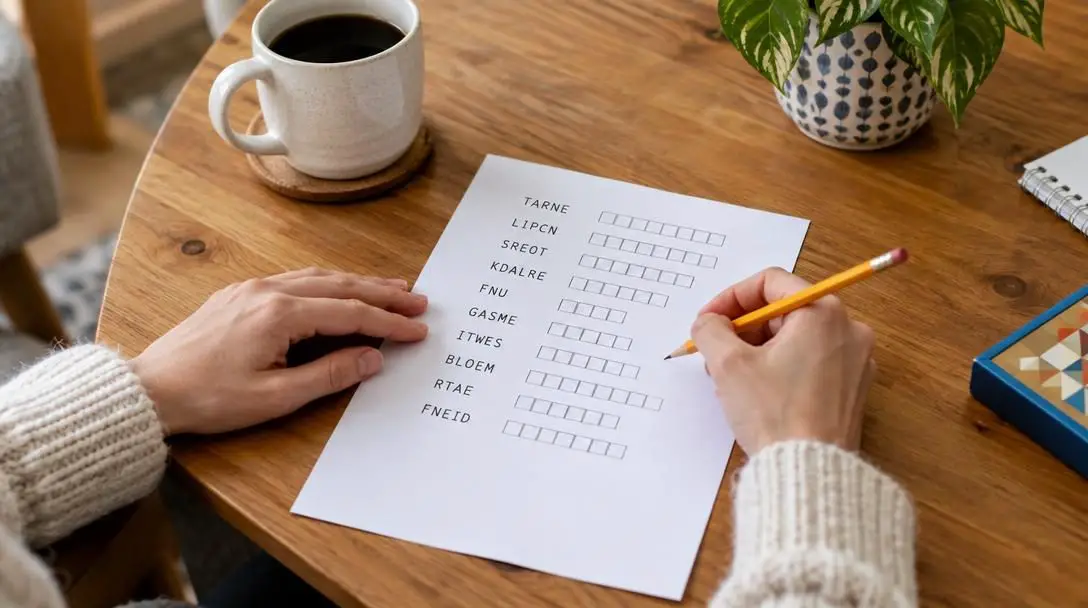
Don't Be Afraid to Experiment
Mental rigidity is the biggest barrier to solving word scrambles. Solvers frequently get stuck fixating on a specific syllable or non-existent word fragment, unable to unsee an incorrect arrangement. To succeed, don't be afraid to experiment by actively moving characters around into fresh physical or mental combinations.
Rarely will a difficult scramble reveal itself on your very first try. Write the letters down in an entirely new circle or physical layout to interrupt stubborn visual patterns. When progress completely halts, step away from the puzzle entirely. Taking a brief break allows your mind to release incorrect combinations so you can return with fresh eyes and spot possibilities that were invisible during your previous attempt.
A Systematic Step-by-Step Solving Routine
Executing an organized sequence of checks keeps you calm and methodical whenever you face a difficult anagram. Use this step-by-step checklist to work through complex puzzles without spinning your wheels.
- Assess the full pool of characters: Count the total number of characters present, note any duplicate letters, and separate your vowels from your consonants to evaluate your raw materials.
- Search the perimeter of the word: Identify candidates for the starting and ending positions, testing reliable edge consonants that establish clear boundaries for the middle letters.
- Scan for meaningful word components: Look for letters that assemble into common prefixes like "un-" or suffixes like "-able", setting those components aside to expose the underlying base.
- Form phonetic clusters: Pair consonants with compatible vowels to identify standard sounds, such as joining "h", "o", and "w" into a single syllable unit.
- Incorporate any external information: Cross-reference the scramble with any broader puzzle hints, category titles, or grid definitions that narrow the thematic field.
- Rearrange and sketch combinations: Shuffle remaining tiles or sketch letters into new sequences, actively testing alternative consonant-vowel combinations on paper.
- Step away if progress stalls: Take a short mental break whenever you find yourself repeatedly looping through the same invalid word guesses.
Common Mistakes That Slow Solvers Down
Speed in puzzle solving is as much about avoiding wasteful habits as it is about applying clever tricks. Sidestepping these frequent traps will keep your solving sessions productive and frustration-free.
- Fixating on a single incorrect arrangement: Letting your attention freeze on an invalid letter combination prevents you from exploring viable alternatives.
- Neglecting word boundaries: Failing to test likely first and last letters results in aimless trial-and-error throughout the entire body of the word.
- Ignoring morphological parts: Trying to solve a long, complex word as one single unit rather than peeling off obvious prefixes and suffixes creates unnecessary mental strain.
- Overlooking phonetic pairings: Treating letters as detached symbols instead of natural sound blends makes decoding longer words far more cumbersome.
- Dismissing external context: Overlooking surrounding clues, cross-references, or thematic headers forces you to solve puzzles blind without helpful semantic guardrails.
- Refusing to take breaks: Grinding through mental fatigue leads to diminishing returns, whereas stepping away clears your working memory for a fresh look.
Frequently asked questions
How do vowels help when solving a word scramble?
Separating vowels from consonants gives you immediate insight into the word's structural architecture. Because almost every English syllable requires a vowel sound, counting your vowels helps determine how many syllables the word contains and where phonetic blends must occur.
What should I do if a scrambled word has no obvious prefixes or suffixes?
When affixes are absent, focus your efforts on identifying standard phonetic groupings and securing the first and last letters. Group letters that make distinct sounds, like combining "h", "o", and "w", and test different starting consonants to fill in the inner gaps.
Why does rearranging letters in a circle help?
English speakers are conditioned to read horizontally from left to right. When letters are presented in a line, the brain instinctively tries to read them as an existing word. Arranging letters in a circle removes linear bias and allows your eyes to jump freely between characters without getting locked into bad guesses.
How can context clues solve an anagram without unscrambling every letter?
In mixed-format games like crosswords, semantic clues point toward specific definitions or categories. If a clue describes a bushy-tailed animal and you have the jumble "rsoqiu", the description leads you to "squirrel" immediately, turning the scramble into a simple verification step rather than a cold puzzle.
When is the right time to take a break from a stubborn puzzle?
You should step away the moment you find your thoughts cycling through the exact same invalid combinations repeatedly. A short break interrupts cognitive fixation, allowing you to return with fresh eyes and notice obvious patterns you previously missed.
The Bottom Line
Word scrambles are far more than tests of raw vocabulary; they are exercises in pattern recognition, cognitive flexibility, and structured problem-solving. When you stop relying on random guesses and instead use dependable techniques—locking the outer boundaries, isolating affixes, assembling phonetic sounds, leveraging external context, and experimenting without fear—you bypass mental fatigue and solve puzzles with greater speed.
Each of these strategies strengthens the others. Recognizing a common suffix like "-able" immediately clarifies which consonants remain for the root, while context clues point directly toward the phonemes you should assemble. By integrating this systematic routine into your daily puzzle-solving practice, you will turn chaotic letter jumbles into predictable linguistic puzzles you can conquer with confidence.