5 Unique Country Flags Featuring an Animal

Every national flag serves as a sovereign emblem of history, collective identity, and political philosophy. While many nations project their heritage through simple geometric bands, astronomical bodies, or religious crosses, a select group of countries entrusts its national narrative to the animal kingdom. Far from mere decorative emblems, the creatures stitched onto these banners act as sophisticated heraldic texts that distill foundational myths, military vigilance, and spiritual heritage into immediate visual forms.
Whether depicting fierce apex predators native to local biomes or mythical beasts drawn from ancient folklore, animal-bearing flags communicate how sovereign societies understand their origins and proclaim their ideals to the world. Examining the banners of Bhutan, Albania, Mexico, Zimbabwe, and Wales reveals the extraordinary range of cultural storytelling achieved when nations look to fauna to express their sovereign soul.
Key takeaways
- Animal flag emblems range from biologically grounded native raptors to legendary mythological dragons.
- A creature's heraldic posture signals whether a state projects vigilant national defense, spiritual harmony, or historical independence.
- Many modern animal banners rely on ancestral emblems that predate their statutory adoption by hundreds of years.
- The background divisions and colors beneath an animal emblem provide essential contextual meaning that balances the creature's symbolism.
At a glance: Five sovereign animal flags compared
While every flag utilizes distinct artistic conventions, comparing their primary creatures, background fields, adoption milestones, and foundational meanings highlights the vast diversity of global vexillology.
| Country | Animal featured | Background design | Official adoption | Primary symbolic meaning |
|---|---|---|---|---|
| Bhutan | White dragon (Druk) | Diagonally split yellow and orange | 1969 | Purity, vigilance, and the balance of religion and civility |
| Albania | Two-headed black eagle | Solid red field | 1912 | Honor for historic freedom fighters and national independence |
| Mexico | Golden eagle with rattlesnake | Vertical tricolor of green, white, and red | 1968 | Aztec solar lore, divine victory, and sovereign struggle |
| Zimbabwe | Zimbabwe Bird (Bateleur eagle carving) | Horizontal stripes with white hoist triangle | 1980 | Ancient stone masonry heritage and divine communication |
| Wales | Red dragon | Horizontal split of green and white | 1959 | Centuries of indigenous cultural survival and royal lineage |
Five unique country flags featuring animal symbols
Each of the following sovereign banners integrates its focal creature in an entirely different heraldic configuration, drawing from centuries of royal pedigree, archaeological wonder, or foundational folklore.
Bhutan

- Designer: Mayum Choying Wangmo Dorji
- Adoption year: 1969
- Featured creature: White dragon
- Background: Yellow and orange diagonal split
The national flag of Bhutan features one of the most intricate heraldic designs flown anywhere in the world today. Centered prominently over a vibrant canvas split diagonally from the lower hoist to the upper fly sits a striking, detailed white dragon. Designed by Mayum Choying Wangmo Dorji, the layout was purposefully balanced so that the mythical beast rests across both the yellow and orange triangles in equal proportion. This careful spatial arrangement signifies the essential harmony between religion and civility that defines Bhutanese governance.
The dragon itself is rendered in pure white, a deliberate aesthetic choice emphasizing purity of heart, mind, and deed. While the warm saffron and orange tones evoke cultural warmth and spiritual contemplation, the dragon's posture and facial expression are overtly fierce. Depicted with flared scales and an alert disposition, the dragon demonstrates that the people of Bhutan stand perpetually vigilant against external threats, ready to safeguard national integrity at a moment's notice.
Albania

- Original designer: Sadik Kaceli
- Adoption year: 1912
- Featured creature: Symmetrical two-headed eagle
- Background: Solid crimson red
Albania presents an uncompromising, high-contrast visual statement. While multiple states and historic empires throughout history have incorporated raptors into their civic imagery, Albania is the only modern sovereign nation to feature a double-headed eagle on its official state banner. Positioned directly in the center of a rich, unadorned red field, the jet-black raptor features balanced wings and mirrored profiles facing outward toward both horizons.
The origins of the banner reach back to the mid-15th century, when it was drafted by Sadik Kaceli for use among the Albanian nobility. While the emblem fell out of widespread public display across intervening centuries, it was dramatically revived during the national awakening against the rule of the Ottoman Empire. Insurgents utilized the double-headed raptor as an uncompromising rallying point for ethnic solidarity. When sovereignty was finally achieved, the historic standard was officially adopted in 1912, standing today as a permanent monument to the freedom fighters who secured the nation's independence.

Mexico
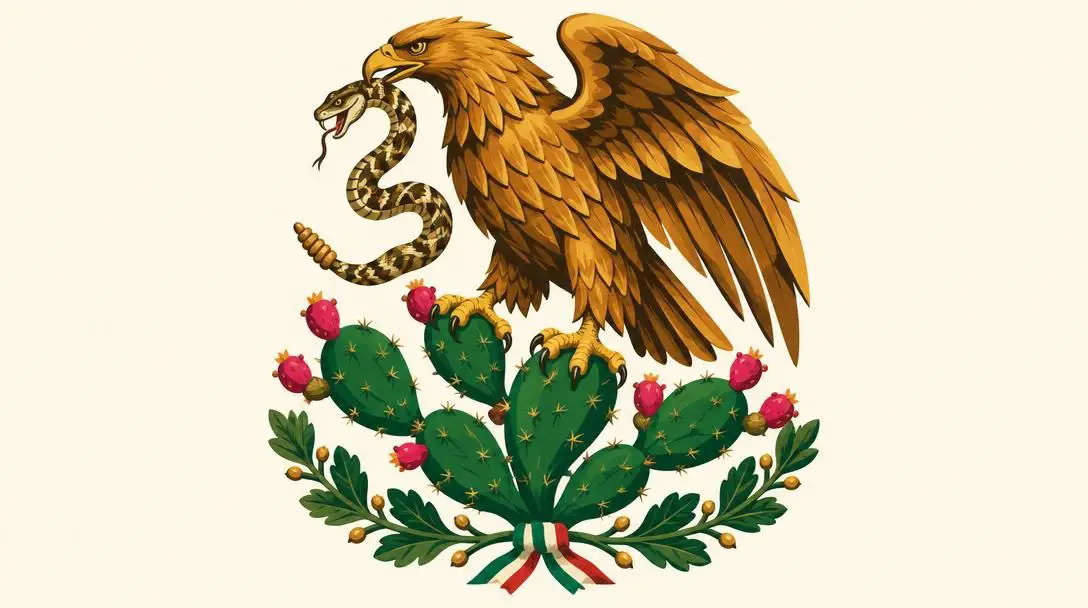
- Adoption year: 1968
- Featured creature: Golden eagle gripping a rattlesnake
- Background: Vertical tricolor of green, white, and red
- Core association: Aztec solar lore and Huitzilopochtli
Mexico's national standard contains one of the most dynamic heraldic scenes ever captured on cloth. Set against a clean vertical tricolor, the central white band hosts a gripping narrative tableau: an eagle perches atop a blooming nopal cactus, clutching a writhing rattlesnake with its sharp beak and extended talon. Although the present statutory version was codified in late 1968, its aesthetic and thematic origins stretch deep into pre-Columbian antiquity.
The dramatic conflict between raptor and serpent is grounded directly in the founding mythology of the Aztec civilization. According to lore, the sun god Huitzilopochtli instructed nomadic priests to establish their permanent imperial capital where they observed an eagle perched upon a cactus while devouring a serpent. The eagle directly channels the power and radiance of the Sun, while the surrounding colors anchor modern civic ideals: green symbolizes victory, white marks national unity, and red honors the sacrifice of fallen soldiers who perished in the struggle for self-determination.
Far from being simple decorative pieces of cloth, national banners are carefully constructed visual texts where every creature embodies the collective spirit of a sovereign people.
Zimbabwe
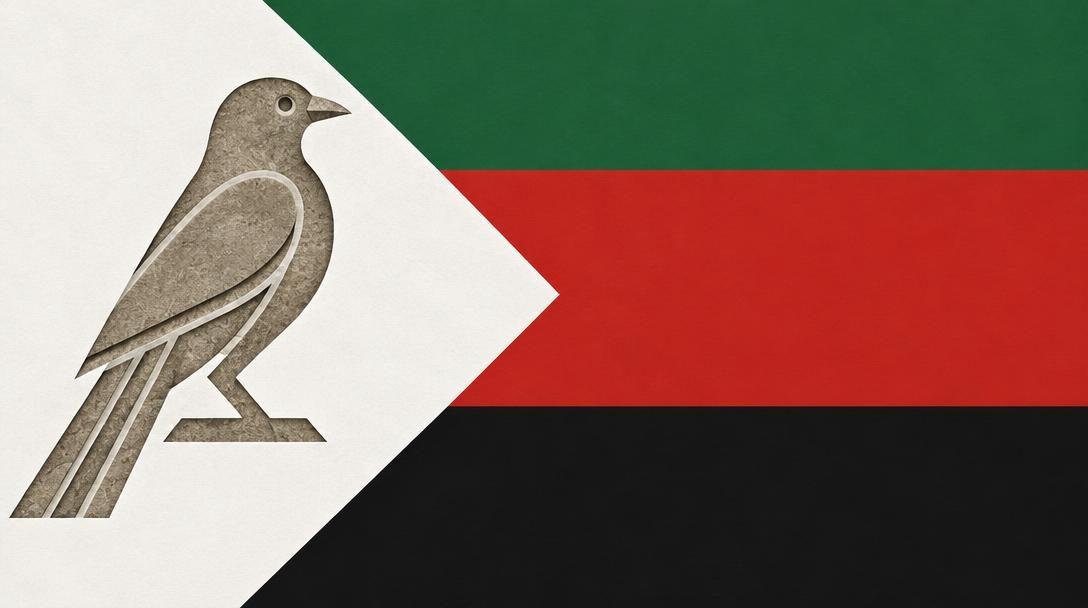
- Adoption year: 1980
- Featured creature: Carved stone Zimbabwe Bird
- Background: Horizontal green, red, and black stripes with a white hoist chevron
- Biological inspiration: Bateleur eagle
In contrast to the martial combat displayed on Mexican or Albanian banners, Zimbabwe takes a tranquil and archaeological approach to avian heraldry. Positioned inside an isosceles white triangle along the hoist of the flag sits a stylized depiction of the celebrated Zimbabwe Bird. Rather than depicting a living, hunting predator, the emblem faithfully reproduces ancient soapstone statues unearthed from the historic monumental ruins of Great Zimbabwe.
Though centuries of oral history surround these artifacts, vexillologists and cultural historians widely identify the figure as a representation of the bateleur eagle, an indigenous raptor revered in traditional regional spiritual systems as an emissary and messenger of God. Officially adopted upon independence in 1980, the Zimbabwe Bird acts as a vital historic bridge, connecting modern statehood directly to the monumental stone-masonry civilization that flourished long before European colonization. The tranquil bird remains a fixture across civic life, stamped on national currency and embedded within administrative seals.
Wales
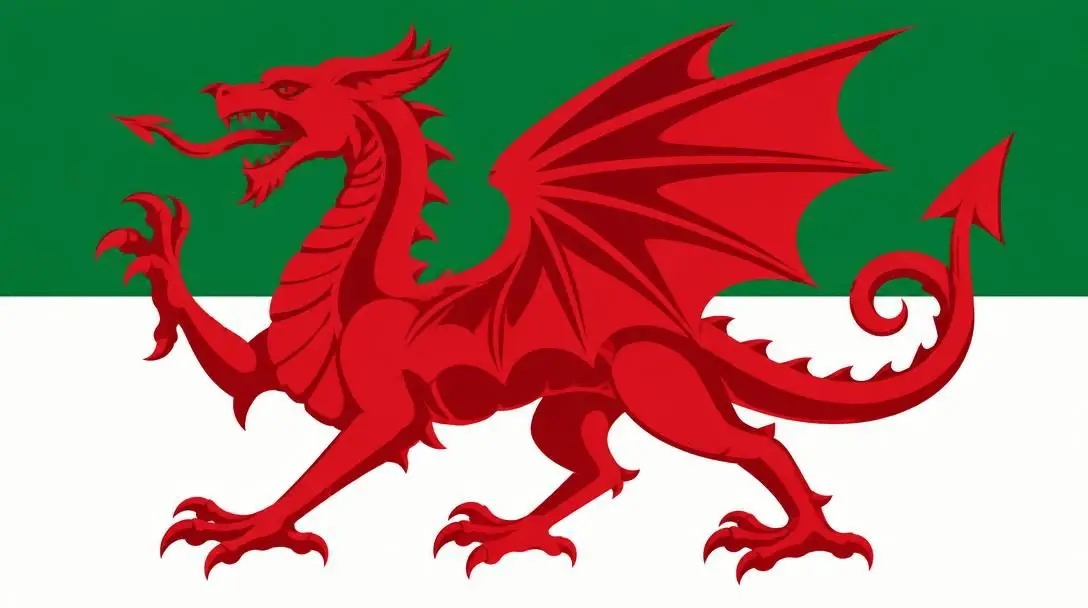
- Royal association: King Cadwaladr
- Adoption year: 1959
- Featured creature: Red dragon (Y Ddraig Goch)
- Background: Horizontal split of green and white
Wales closes the catalog by anchoring its sovereign identity in the realm of mythical beasts. The vivid red dragon, depicted striding forward across a horizontally divided field of green and white, possesses an unbroken lineage stretching back through centuries of insular history. The creature was originally deployed in the seventh century as the personal emblem of King Cadwaladr. By the ninth century, it had transformed into a broad rallying symbol for national autonomy, venerated by the population as a supernatural protector and heraldic messenger.
Wales emerged as a unified country in 1056, though formal administrative recognition evolved gradually across the mid-16th century. Throughout subsequent eras of political union, the dragon remained the undeniable soul of Welsh heraldry. It was finally codified into its modern national design in 1959. Today, the dragon's striding posture and arched wings embody more than a millennium of resilience, cultural preservation, and continuous heritage.
How animal symbols function on national flags
The inclusion of an animal on a sovereign banner is never an accidental creative choice. Instead, vexillological creatures fulfill three specific operational functions that communicate a nation's collective identity to the international community.

First, animals telegraph admired behavioral attributes. Humans universally recognize certain characteristics in the animal kingdom. When Albania and Mexico display eagles, they evoke the apex mastery, acute vision, and striking power associated with top aerial predators. When Bhutan and Wales deploy dragons, they tap into legendary power, primeval origins, and impenetrable protection that no mortal adversary can match.
Second, animal icons serve as direct bridges connecting ancient mythologies to modern civic sovereignty. The Mexican eagle devouring a snake is not an ordinary nature scene; it visually validates the ancient Aztec prophecy that gave rise to Tenochtitlan. In Zimbabwe, placing a soapstone carving from Great Zimbabwe on the banner establishes an unbroken line between ancient ancestral builders and the modern independent republic.
Third, an animal's heraldic posture declares a state's defensive and diplomatic mindset. Creatures captured in aggressive action—such as the biting eagle of Mexico or the ready-to-defend dragon of Bhutan—send an unambiguous message of sovereign readiness and border defense. In contrast, creatures styled as static archaeological treasures or divine messengers, such as the Zimbabwe Bird, project spiritual harmony, peace, and cultural preservation.
Steps for reading and interpreting flag emblems
Unpacking the full narrative encoded within an animal-bearing banner requires a structured analytical process. Researchers and vexillology enthusiasts can decode any national device by following five systematic steps:
- Analyze the background canvas: Examine the geometry and colors beneath the creature. Check whether the field is solid like Albania's red, split diagonally like Bhutan's field, or arranged in stripes like Mexico and Zimbabwe. Background colors often establish values such as sacrifice, purity, or geographical unity.
- Identify the creature and its biological origin: Determine whether the subject is a living species or a mythological beast. If it is a real animal, like the bateleur eagle behind the Zimbabwe Bird, examine its regional ecological habits. If it is mythical, like the dragons of Wales and Bhutan, trace the folklore behind its earliest recording.
- Assess heraldic posture and interaction: Look closely at what the animal is doing. Is it engaged in active physical combat, such as Mexico's eagle biting a snake? Is it balanced across background borders like Bhutan's dragon? The pose indicates whether the flag emphasizes defensive readiness, reconciliation, or equilibrium.
- Trace the adoption timeline versus cultural origin: Compare the statutory adoption date with the earliest documented appearance of the emblem. Flags like Albania's (designed in the 15th century, adopted in 1912) and Wales's (used since the seventh century, adopted in 1959) demonstrate that legal adoption often comes centuries after cultural acceptance.
- Examine widespread civic application: Inspect whether the creature appears on official items outside the flag, such as passports, state coinage, military medals, or coats of arms. Persistent cross-institution usage confirms that the animal serves as an indisputable pillar of state identity.
Common misconceptions about animal flags
General audiences often misinterpret flags featuring animals by applying superficial heraldic assumptions. Avoiding these common mistakes provides a clearer understanding of global vexillology:
- Assuming emblems are modern inventions: It is easy to assume that because a flag was officially adopted in the 20th century—such as Mexico in 1968 or Zimbabwe in 1980—its animal device was recently conceived. In reality, these devices draw on indigenous Aztec religious lore and ancient Great Zimbabwe stone masonry dating back centuries.
- Viewing all animal motifs as declarations of aggression: While the raptors of Albania and Mexico and the dragon of Bhutan display fierce defensive vigilance, animals can equally project peace. The Zimbabwe Bird represents an ancient spiritual messenger rather than a martial combatant.
- Ignoring background color context: Observers frequently focus exclusively on the foreground creature while disregarding the canvas underneath. Bhutan's white dragon relies on its equal placement across yellow and orange fields to convey the union of religion and secular civility, while Mexico's eagle sits on white to underscore national unity.
- Confusing statutory adoption with cultural emergence: Wales was recognized as a country as early as 1056, yet its flag was codified in 1959. Assuming the emblem began in the mid-20th century erases more than a thousand years of cultural affinity linking the red dragon back to King Cadwaladr.
- Treating all double-headed raptors identically: While double-headed eagles appeared in several historic dynasties, Albania is entirely unique among modern sovereign nations in employing a symmetrical, black double-headed raptor on a plain red field to commemorate its anti-Ottoman liberation fighters.
Frequently asked questions
Which country has the only two-headed eagle on its national flag?
Albania is the only modern sovereign country in the world that features a two-headed eagle on its official national flag. The black, symmetrical raptor was originally designed by Sadik Kaceli in the 15th century and serves to honor Albanian freedom fighters.
Why is the dragon on Bhutan's flag colored white?
The dragon on the flag of Bhutan is rendered in pure white to emphasize purity of character and deed, while its alert and fierce disposition simultaneously demonstrates that the citizenry remains vigilant in defending the nation.
What does the snake in the Mexican flag's emblem represent?
The rattlesnake held in the eagle's beak and talon is part of an ancient Aztec founding prophecy dedicated to Huitzilopochtli, the god of victory. The scene marks the sacred spot where the Aztec people were instructed to found their capital city.
What real animal inspired the stone carving on Zimbabwe's flag?
Cultural historians and vexillologists generally agree that the stone-carved Zimbabwe Bird was modeled after the bateleur eagle, an indigenous raptor traditionally revered in regional belief systems as a divine messenger of God.
When did the red dragon become associated with Wales?
The red dragon was first used as a royal symbol in the seventh century by King Cadwaladr. Over the following two centuries, it evolved into a widespread national emblem of independence before receiving modern official codification in 1959.
The bottom line
National flags featuring animals provide a captivating window into the soul of heraldry. Rather than relying solely on geometric patterns, countries like Bhutan, Albania, Mexico, Zimbabwe, and Wales utilize living fauna and legendary creatures to immortalize their ancestral roots, military tenacity, and spiritual values. By examining the anatomy, posture, and historic lineages of these magnificent emblems, we gain a far deeper appreciation for how sovereign nations tell their most defining stories to the world.