Crossword Puzzle Addiction: How to Know When You’ve Crossed the Line

Crossword puzzles have long held an esteemed position in daily culture, evolving from a traditional print feature in morning newspapers and paperback anthologies into an ubiquitous digital pastime. Today, millions of solvers across generations reach for word grids on smartphones, tablets, and desktop computers at any hour of the day. For most people, settling into a crossword alongside a morning cup of coffee or using it to wind down before sleep is a calming ritual that sharpens vocabulary, bolsters cognitive agility, and offers a brief respite from everyday tension.
Because word games carry a stellar reputation for exercising memory and problem-solving skills, it is easy to overlook when casual leisure curdles into a compulsive reliance. Unlike chemical dependencies or high-stakes gambling, an excessive puzzle habit disguises itself behind an aura of wholesome intellectual self-improvement. However, when the compulsion to fill every blank square begins displacing critical life duties, straining interpersonal bonds, and masking underlying emotional stress, an unassuming mental exercise transforms into a disruptive behavioral addiction.
Key takeaways
- The intellectually enriching reputation of crosswords often obscures the emergence of an unhealthy, compulsive behavioral habit.
- Solving triggers miniature neurological reward loops of accomplishment that can quickly become an avoidance tactic for real-world discomfort.
- Core warning signs include abandoned obligations, irritability when separated from puzzles, and persistent solving late into the night.
- Establishing firm time boundaries, accepting incomplete grids, and discovering alternative relaxation habits are essential for restoring balance.
- Professional therapy or support groups can help uncover the emotional triggers driving compulsive puzzle solving.
The Psychology of the Grid: How Casual Play Becomes Compulsive
Behavioral addiction operates through reinforcement loops, and crosswords are engineered to provide reliable psychological gratification. Every grid presents an orderly, clearly delineated challenge with an absolute resolution. When an individual cracks a difficult clue, remembers an obscure synonym, or pencils in the final letter of a complex theme, the brain receives an immediate jolt of satisfaction. This feeling of victory acts as a micro-reward, prompting the player to seek out the next puzzle to replicate that fleeting sensation of competence.
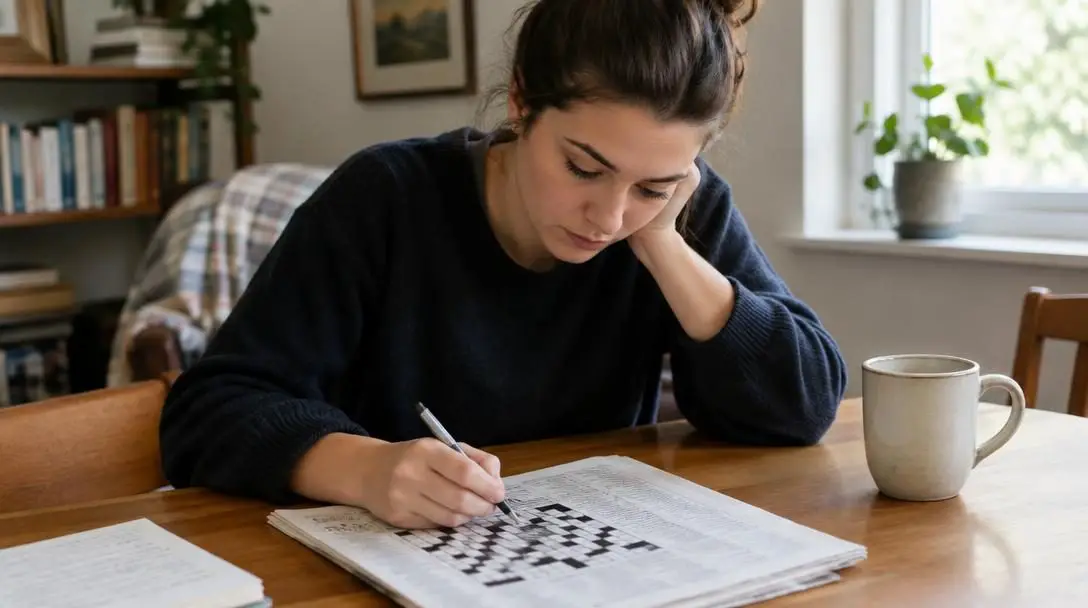
Problems arise when this natural reward cycle evolves into an emotional coping mechanism. When confronted with difficult personal conversations, escalating professional demands, or mundane domestic chores, a person may retreat into a puzzle under the self-justifying rationalization that they are engaging in a constructive, educational exercise. Over time, solving ceases to be a relaxed leisure choice and becomes an active defense against stress, boredom, or negative emotions.
When an individual turns to crosswords to escape emotional distress, the pursuit shifts from seeking leisure to avoiding discomfort.
As psychological dependence deepens, the solver's relationship with the activity fundamentally changes. Enthusiasts may feel that an entire day is ruined or incomplete if they fail to solve their usual roster of grids. When unexpected obstacles emerge—such as internet outages, misplaced puzzle books, or urgent family requests—the dependent individual does not merely feel mild disappointment. Instead, they exhibit palpable distress, restlessness, and emotional volatility, signaling that the puzzle has taken over the role of primary emotional regulator.
Recognizing the Core Signs of Crossword Puzzle Addiction
Because working through word clues feels productive, recognizing problematic usage requires an honest assessment of behavioral shifts and lifestyle disruptions. Compulsion manifests across several key areas of daily living.
Neglecting Essential Daily Responsibilities
The clearest sign that a pastime has crossed into problematic territory is the systematic abandonment of regular obligations. Solvers dealing with an escalating habit may postpone urgent job assignments, ignore household cleaning, neglect family meals, or let critical financial bills sit unpaid while they remain consumed by clues. When completing rows and columns consistently takes precedence over basic adult responsibilities, the hobby is functioning as an impediment rather than an asset.
Agitation and Irritability When Separated from Puzzles
A healthy hobby can easily be set aside when external circumstances dictate. Conversely, an individual struggling with compulsive solving displays pronounced emotional agitation when access to puzzles is blocked. If you feel sudden waves of anxiety, anger, or short-tempered irritability when technical glitches strike, when travel interrupts your access, or when loved ones ask for your undivided attention, the habit has developed into an emotional crutch.
Excessive Time Commitments and Sleep Deprivation
Losing track of time occasionally is normal, but spending uninterrupted hours immersed in puzzle after puzzle is a hallmark of compulsive behavior. Sufferers regularly find themselves solving late into the night, sacrificing vital restorative sleep just to finish "one more grid." When full afternoons vanish without awareness and the internal clock is continuously overridden by the urge to solve, boundaries have completely broken down.
Enduring Tangible Negative Consequences
A recreational pursuit becomes toxic when a person continues engaging in it despite mounting personal and interpersonal costs. When partners express feelings of abandonment, coworkers notice a decline in performance, or social friendships wither due to endless hours spent behind a screen or book, persisting in the behavior demonstrates a loss of voluntary control. Ignoring tangible damage to your livelihood and relationships indicates that the compulsion is driving your choices.
| Dimension | Casual Puzzle Solving | Compulsive Puzzle Solving |
|---|---|---|
| Primary Motivation | Intellectual curiosity, relaxation, and entertainment | Emotional avoidance, compulsive closure, and stress escapism |
| Response to Interruption | Easily pauses or sets the grid aside for later | Experiences restlessness, anger, or acute irritability |
| Time Awareness | Sticks to planned breaks; solves within fixed periods | Loses hours, sacrifices sleep, and solves into late night |
| Daily Obligations | Completed promptly prior to or following recreational time | Delayed, avoided, or neglected in favor of finishing clues |
| Relationship Impact | Shared with others or enjoyed without social friction | Sparks conflict, isolation, and defensive concealment |
Practical Strategies to Regain Control
Regaining agency over your time does not necessarily demand a lifetime ban on word games. Instead, recovery centers on constructing disciplined structures, managing emotional impulses, and re-engaging with the broader physical world.
- Establish rigid, measurable daily boundaries: Decide in advance exactly how much time you will allocate to puzzle solving each day. Rather than relying on mental estimates, use a dedicated kitchen timer or an automated app restrictor. Commit unconditionally to setting the puzzle aside the exact moment the timer sounds, regardless of how many clues remain uncracked.
- Practice leaving grids intentionally incomplete: Compulsive solvers are often tormented by an intense urge for complete closure. Build psychological tolerance by intentionally walking away from a half-finished puzzle once or twice a week. Learning that an unfinished grid does not cause real harm helps defuse perfectionistic impulses.
- Perform mindful emotional check-ins: Before opening an application or lifting a pencil, pause for sixty seconds. Ask yourself what emotional state you are experiencing in that exact moment. If you recognize sensations of loneliness, work stress, anxiety, or boredom, identify whether solving is being deployed as an emotional anaesthetic.
- Diversify leisure and physical activities: When one pursuit occupies all available recreational space, it quickly becomes an unhealthy obsession. Actively incorporate activities that engage your body and social faculties differently, such as outdoor walking, preparing meals from scratch, swimming, or team sports.
- Engage external support systems: If self-directed boundaries repeatedly fail, seek external accountability. Confide honestly in a trusted family member or partner, or consult a licensed therapist who specializes in behavioral patterns and non-substance compulsions.
Frequent Pitfalls to Avoid in Habit Modification
Attempting to recalibrate a compulsive habit can trigger counterproductive reactions if approached without careful planning. Solvers striving to regain balance should watch out for several prevalent traps:
- Enforcing sudden, total deprivation without healthy substitutes: Abruptly severing all puzzle solving without establishing alternative stress-relief mechanisms leaves an emotional vacuum. When inevitable life stressors strike, an individual devoid of alternative coping techniques often relapses with escalated intensity.
- Using cognitive benefits as an ongoing rationalization: Continuously defending hours of daily play by citing enhanced memory, vocabulary building, or dementia prevention serves as a shield against accountability. No educational merit offsets the abandonment of real-world duties.
- Hiding the true extent of engagement: Secretive behaviors—such as toggling screens rapidly when a family member enters the room, solving in restrooms, or concealing paper puzzle books—foster isolation and prevent honest recovery.
- Disregarding the root emotional triggers: Attempting to control only the clock without uncovering why you feel driven to escape into grids leaves the underlying vulnerability unresolved. True balance requires treating both the schedule and the internal emotional state.
Frequently asked questions
Can crossword puzzles truly be clinically addictive?
Yes. While crosswords do not introduce foreign chemical substances into the body, they engage the exact same neurological reward pathways seen in other behavioral compulsions. When solving consistently serves as an escape from reality, produces withdrawal-like irritability when restricted, and interferes with major life functions, it fits the recognized criteria of a behavioral addiction.
How much time spent on crosswords is considered excessive?
Excess is defined more by life disruption than an arbitrary minute count. While spending multiple hours daily is a strong warning sign, an hour a day can also be problematic if it consistently causes you to skip meals, delay chores, miss work deadlines, or disregard family commitments.
Why do digital crosswords seem harder to put down than newspaper grids?
Digital puzzle platforms incorporate modern engagement mechanics, including push notifications, automated completion timers, archive libraries containing thousands of past grids, and digital solving streaks. These design elements eliminate natural endpoints, making it far easier to transition endlessly from one puzzle to the next.
Do I have to quit crosswords forever to recover?
Total abstinence is not always necessary. Many individuals successfully re-establish a healthy relationship with crosswords by placing strict external time limits, abandoning daily streak metrics, and learning to leave grids unfinished without distress. However, if boundary attempts repeatedly collapse, a temporary or permanent hiatus may be warranted.
How can I tell if I am solving for fun or solving out of avoidance?
Pay close attention to how you feel immediately before you start. If you are deliberately sitting down during earned downtime feeling relaxed, it is likely healthy leisure. If you find yourself reaching for a puzzle immediately after an argument, when facing an intimidating work deadline, or when feeling anxious or lonely, you are likely using the grid to avoid unpleasant emotions.
The Bottom Line
Crossword puzzles remain a brilliant, enriching pastime when maintained in proper proportion. They cultivate linguistic curiosity, reward lateral thinking, and provide satisfying intellectual challenges. Yet, no matter how cerebral or respectable an activity appears on the surface, it should never overshadow your actual life, responsibilities, and personal relationships.
If you recognize that your daily routine has warped around solving grids, take proactive measures today. Introduce firm time constraints, practice tolerating unfinished puzzles, nurture diverse leisure pursuits, and seek guidance from professionals or supportive peers if needed. By dismantling the compulsion and restoring intentional boundaries, you can ensure that word puzzles remain what they were always meant to be: an enjoyable, harmless diversion rather than an all-consuming escape.