Structuring Your Storyline With Climactic Plot Twists

Crafting a compelling narrative hinges on keeping an audience invested from the opening scene to the final resolution. Incorporating a climactic plot twist—a sudden and unexpected turn of events that completely alters what the audience thought they understood—stands as one of the most potent techniques in a storyteller's repertoire. When executed with precision, these dramatic pivot points force readers to re-evaluate every clue, interaction, and motivation presented throughout the narrative.
The universal appeal of a climactic reversal is rooted in human psychology. Readers naturally predict patterns, continuously building expectations based on genre conventions and character behavior. Delivering a climactic twist satisfies the audience's craving for surprise while answering central story questions in an intellectually rewarding way. However, mastering this storytelling device requires balancing sudden revelation with absolute inevitability.
Key takeaways
- A climactic plot twist redefines the central conflict at the peak of dramatic tension, requiring an audience to re-examine the entire narrative.
- Surprise must always be balanced with inevitability, ensuring the revelation emerges organically from established story logic rather than arbitrary shock value.
- Effective twists rely on strong world-building, deep character motivations, and carefully layered foreshadowing that supports dual interpretations.
- Relying on unearned information gaps or last-minute external interventions destroys reader trust and weakens emotional payoff.
- Not every story requires a sudden reversal, and writers must evaluate whether a twist serves the emotional core of the project.
The Anatomy of Narrative Climaxes and Plot Reversals
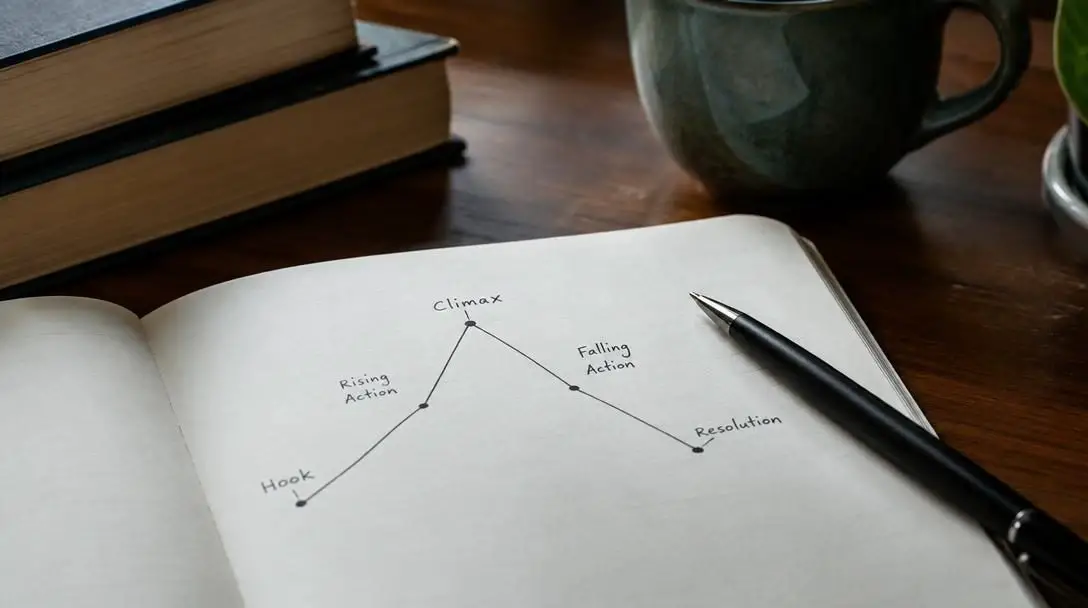
In traditional narrative architecture, the climax represents the summit of dramatic conflict. It marks the decisive moment where opposing forces collide, characters make irrevocable choices, and the driving dramatic question must be answered. When a twist is positioned directly inside this climactic window, the stakes multiply exponentially. The confrontation ceases to be a simple contest of who wins or loses; instead, it calls into question the very premise of the conflict.
A climactic reversal operates on a different scale than smaller complications that occur earlier in a book or script. Early complications raise stakes, adjust tactics, or temporarily disrupt a character's plan, but a climactic twist initiates a profound paradigm shift. It redefines character identities, casts prior actions in an entirely new light, and fundamentally redirects the final resolution.
A well-constructed twist invites immediate re-examination, prompting readers to trace the invisible narrative thread back to the opening page.
This dynamic creates a rare dual reading experience. During the first encounter, the audience experiences suspense, anticipation, and emotional immersion. Once the revelation lands, the entire architecture transforms upon reflection. Readers can look backward, marveling at how carefully planted breadcrumbs were hidden in plain sight all along.
| Pivot Type | Story Placement | Primary Narrative Function | Reader Impact |
|---|---|---|---|
| Early Complication | Act One to early Act Two | Raises immediate stakes and forces protagonists to adapt their initial tactics. | Increases curiosity and tests character resourcefulness. |
| Mid-Point Shift | Center of the narrative | Changes the context of the mission from reactive defense to proactive pursuit. | Deepens engagement and raises emotional investment. |
| Climactic Plot Twist | Peak of dramatic conflict | Completely shatters surface assumptions and reframes the overarching conflict. | Delivers cathartic shock followed by retroactive clarity. |
The Three Primary Forms of Climactic Twists
Climactic twists generally manifest in three distinct formats, each serving a unique role in altering the audience's understanding of the narrative.
The Major Revelation
The major revelation uncovers a fundamental truth about the world, the environment, or the circumstances surrounding the conflict. In this structure, the protagonist and audience discover that the rules governing their journey are entirely different from what was initially accepted. This revelation does not merely introduce a new obstacle; it invalidates previous assumptions and redefines what victory looks like.
Unexpected Character Development
This twist exposes a character's hidden identity, genuine loyalty, or true moral allegiance. Rather than an arbitrary personality swap, unexpected character development reveals an underlying motivation that was carefully concealed beneath a plausible facade. When an ally is revealed as an orchestrator, or a presumed antagonist is exposed as a protector, the protagonist must immediately renegotiate their emotional and strategic footing.
The Game-Changing Surprise Event
A surprise event introduces an unforeseen occurrence that instantly derails the anticipated course of the confrontation. Unlike random accidents, this event must emerge directly from simmering tensions or previously established background conditions. It forces both the protagonist and the antagonist to react instantaneously, stripping away their prepared plans and testing their raw instincts under extreme pressure.
Foundational Architecture: Groundwork, Tension, and Believability
A climactic twist cannot succeed as an isolated stunt. It functions as the keystone of the entire narrative arch, meaning every supporting beam must be firmly set beforehand. Before plotting any dramatic shift, a writer must build an unshakeable foundation: well-rounded characters with distinct voices, tangible goals, compelling motivations, and an internally consistent setting.
Once this groundwork exists, dramatic tension serves as the fuel that makes the climax hit with force. Readers must feel that something monumental is gathering just beyond view, even if they cannot identify its shape. Tension is cultivated through disciplined pacing, escalating character confrontations, and subtle foreshadowing. Without this continuous build-up, a surprise revelation falls flat, producing momentary bewilderment instead of genuine emotional release.
Crucially, the narrative must preserve absolute believability within its own established boundaries. If a twist violates the internal logic of the world or discards character psychology simply to pull off a momentary surprise, the audience disengages. The mechanics of the revelation must honor the rules established in earlier chapters, ensuring the turn feels earned rather than contrived.

How to Structure a Twist-Driven Plot
Engineering a storyline around a climactic reveal requires meticulous backward-and-forward planning during both outlining and revision. Following a deliberate progression guarantees that the surprise remains structurally sound.
- Establish the foundational baseline: Outline the surface story first by defining your protagonist's objective, the opposing force, and the core rules of your setting. The baseline story must remain fully coherent and compelling on its own merits before any twists are factored into the equation.
- Determine the core revelation: Pinpoint the exact nature of the surprise—whether it is a hidden truth about the world, a concealed character allegiance, or a sudden event—and clarify the exact emotional reaction you intend to provoke at that pivotal moment.
- Engineer the alternative interpretation: Build dual-purpose narrative evidence. For every clue provided, ensure there is an immediate, plausible explanation that misdirects the audience, paired with a deeper, genuine meaning that clicks into place once the truth comes out.
- Layer in subtle foreshadowing: Distribute behavioral quirks, off-hand dialogue, and environmental details throughout the narrative. These elements should read as ordinary background texture on a first pass, yet transform into undeniable evidence upon second inspection.
- Ramp up the dramatic tension: Accelerate narrative pacing, introduce ticking clocks, and tighten interpersonal conflict as the narrative hurtles toward the climax. Keeping the reader focused on immediate conflicts prevents them from unravelling the overarching mystery prematurely.
- Deliver the climactic revelation: Trigger the twist at the precise moment of maximum dramatic pressure. Allow the immediate consequences to ripple outward, dissolving old strategies and forcing an urgent confrontation under the newly revealed reality.
- Tie up the structural aftermath: Allow characters and readers adequate space to process the shock. The resolution must reflect the altered world left in the wake of the twist, avoiding any unearned return to the original status quo.
Common Narrative Pitfalls to Avoid
Writing climactic twists carries inherent risks. A miscalculated reveal can alienate an audience, turning an exciting story into an exercise in frustration. Writers should remain vigilant against several frequent stumbling blocks:
- Relying on cheap tricks and unearned surprises: Withholding vital information solely by lying to the audience or distorting viewpoint characters without narrative justification damages credibility. The thrill of a twist should come from clever misinterpretation, not deceit.
- Invoking a deus ex machina: Introducing an unheralded, all-powerful outside force to resolve the climax breaks the fundamental contract between storyteller and reader. Every solution and conflict must stem from components already woven into the story world.
- Neglecting character motivation: A character cannot turn into someone else purely to shock the audience. If an established mentor transforms into a ruthless adversary, that transformation must stem from deep-seated, historically consistent psychological logic.
- Sacrificing the primary narrative: Focusing so obsessively on the final surprise that the journey leading up to it becomes hollow or meandering weakens the entire work. The story must remain thoroughly entertaining from scene to scene on its own terms.
- Ignoring internal believability: Forcing an event that breaks the physical or social rules of your fictional world destroys immersion. The climax must always adhere strictly to the boundaries established in the narrative.
- Overcomplicating the narrative threads: Stringing multiple twists back-to-back causes storytelling fatigue. When major revelations arrive too frequently, audiences detach emotionally because nothing feels stable or authentic.
Evaluating Whether Your Narrative Needs a Twist
Recognizing how to construct a climactic twist does not mean every project requires one. Some of the most enduring stories in literature and cinema rely on completely linear, transparent stakes where the outcome is driven purely by character conviction. A story built on simple narrative tracks can achieve profound emotional resonance without a single shocking reversal.
When reviewing your work, weigh the benefits of a climactic twist against the power of dramatic irony. In a story driven by dramatic irony, the audience is fully aware of an impending catastrophe or hidden truth while the characters remain oblivious. Watching characters walk toward an inevitable trap often generates far more agonizing suspense than catching the audience completely off guard at the finish line.
Frequently asked questions
What is the difference between a mid-point twist and a climactic plot twist?
A mid-point twist occurs in the middle of a story to shift the protagonist's strategy, raise the stakes, or alter the direction of the journey while leaving the central conflict unresolved. A climactic plot twist happens at the peak of conflict, reinterpreting the central premise right before the story reaches its ultimate resolution.
How can an author hide clues without confusing the audience?
Authors hide clues by utilizing dual-purpose details. Every clue dropped should have an immediate, logical purpose within the surface plot, such as advancing an immediate task or establishing mood, which distracts readers from spotting its secondary, deeper narrative function.
Can an unreliable narrator be used without alienating the reader?
Yes, provided the unreliability stems from genuine psychological, emotional, or situational limits rather than deliberate authorial withholding. If the narrator misinterprets events due to trauma, bias, or limited perspective, the audience will accept the eventual revelation as organic rather than manipulative.
What is the danger of relying on a deus ex machina at the climax?
A deus ex machina introduces an unexpected, external solution or character to resolve an impossible situation at the last second. It robs the protagonist of agency, invalidates previous struggles, and leaves readers feeling cheated out of an earned, hard-fought payoff.
How do you know if a plot twist is earned?
A plot twist is earned when a reader re-examines the story and finds clear, logical evidence supporting the outcome from the earliest chapters. If the outcome makes total sense upon reflection and fits the established psychological traits of the characters, the twist is earned.
The bottom line
A climactic plot twist is far more than a sudden shock; it is an architectural reorientation of your entire narrative. By laying down sturdy character foundations, building unyielding tension, and layering clues that provide authentic dual meaning, you can engineer an ending that thrills and satisfies in equal measure. Use plot twists judiciously, ensure every revelation respects your story's internal logic, and craft an experience that rewards readers on both the first read and every subsequent visit.