UFO Sightings: Exploring the Possibility of Extraterrestrial Life

For decades, the possibility of extraterrestrial life has captured the imaginations of scientists, military personnel, and the general public alike. Unidentified flying objects, or UFOs, remain one of the most persistent mysteries in modern society, generating widespread curiosity whenever unexplained lights or anomalous aerial craft appear in the sky. While a substantial majority of recorded events are resolved through rigorous analysis, a compelling fraction continues to elude clear explanation, keeping the conversation alive across scientific, governmental, and cultural spheres.
To fully grasp the dynamics behind these aerial phenomena, one must examine how reports have evolved from ancient historical chronicles to structured military documentation and modern planetary exploration. Today, discussions about unidentified objects balance the romantic prospect of interstellar visitors against the cold rigor of empirical science, secret defense developments, and the peculiarities of atmospheric physics.
Key takeaways
- The modern era of UFO investigations began in 1947 with the crash at Roswell, New Mexico, following centuries of recorded sky lore dating back to 1440 BC in Egypt.
- Famous personal encounter narratives from the 1960s and 1970s, including the Hill, Pascagoula, and Walton incidents, shifted public interest from distant aerial sightings to claims of direct contact.
- Official inquiries such as the U.S. government's Project Blue Book cataloged over 12,000 reports, resolving the vast majority as ordinary human technology or natural phenomena.
- Scientific initiatives like SETI, mathematical tools like the Drake equation, and exoplanet discoveries like Kepler-452b provide an empirical framework for assessing cosmic life without jumping to unproven conclusions.
Historical Milestones in Aerial Phenomenon Records
Encounters with strange aerial objects are not merely a 20th-century preoccupation. Documented historical lore suggests that mysterious sky displays have occurred across human history, with the earliest known account recorded in 1440 BC in Egypt. For centuries, these events were interpreted through mythological or religious lenses. However, the dawn of global aviation and the tensions of the mid-20th century transformed how people observed, documented, and interpreted unexplained intrusions into the atmosphere.
The modern UFO era erupted in earnest during the post-World War II period. Following the initial wave of post-war sightings, reports multiplied dramatically across the globe. Significantly, a notable proportion of early sightings came from trained observers, including commercial aviators and military pilots, who witnessed objects exhibiting speed, maneuverability, and flight profiles that defied their understanding of aeronautics.
Roswell, New Mexico Incident (1947)

- Year: 1947
- Location: Roswell, New Mexico
- Military explanation: Weather balloon
- Significance: Marked the official dawn of the modern UFO era
In mid-1947, an unidentified object crashed on a ranch near Roswell, New Mexico. While the United States military issued a statement claiming the debris originated from a downed weather balloon, the event quickly sparked intense public speculation. The incident became a cultural touchstone, cementing itself as the foundational event of contemporary ufology. Many people continue to believe that the wreckage was that of a genuine extraterrestrial craft, making Roswell the benchmark against which all subsequent crash claims are measured.
Betty and Barney Hill Case (1961)

- Year: 1961
- Incident type: Alien abduction claim
- Key report: Taken aboard an unknown extraterrestrial spacecraft
The 1961 encounter involving Betty and Barney Hill marked a dramatic shift in how the public engaged with UFO lore. Traveling through rural New England, the couple claimed they were intercepted and abducted by extraterrestrial beings before being brought aboard a foreign craft. This case represented the first widely publicized alien abduction narrative, steering the popular conversation away from distant, shimmering craft in the clouds toward direct, personal human interaction with non-human intelligences.
Pascagoula Abduction Incident (1973)

- Year: 1973
- Location: Pascagoula, Mississippi
- Incident type: Eyewitness abduction claim
In 1973, two shipyard workers in Pascagoula reported a terrifying encounter along the riverbank. They claimed that an unusual craft landed nearby, and strange beings paralyzed them before carrying them into an illuminated interior. The Pascagoula event captured international media headlines, further entrenching the concept of high-strangeness close encounters in the collective consciousness during a decade marked by growing countercultural skepticism toward official explanations.
Travis Walton Encounter (1975)

- Year: 1975
- Incident type: Abduction and temporary disappearance
- Key report: Struck by an aerial beam and boarded onto an alien craft
The 1975 Travis Walton case in Arizona added another dramatic chapter to encounter lore. Walton, a logger working in the Apache-Sitgreaves National Forest, allegedly approached a hovering disc-shaped craft, was struck by a beam of energy, and vanished for several days. He later recounted vivid memories of awakening inside an alien spacecraft surrounded by extraterrestrial entities. Walton's narrative became one of the most thoroughly investigated and debated abduction claims of the late 20th century.
| Case / Incident | Year | Reported Phenomenon | Official or Counter-Explanation |
|---|---|---|---|
| Roswell Crash | 1947 | Debris recovery of an alleged downed flying disc | U.S. military identified the debris as a weather balloon |
| Betty and Barney Hill | 1961 | Automobile interception and subsequent abduction aboard a craft | Attributed by skeptics to psychological stress and misidentification |
| Pascagoula Event | 1973 | Fishermen taken aboard an anomalous craft by alien entities | Anecdotal claim lacking physical corroboration |
| Travis Walton Case | 1975 | Disappearance following contact with an illuminated aerial craft | High-profile personal testimony without reproducible physical evidence |
The Three Dominant Explanatory Hypotheses
When analysts, scientists, and military officials evaluate anomalous aerial sightings, their work generally revolves around three distinct explanatory theories. Each hypothesis brings its own framework of physical evidence, probabilities, and technical limitations.
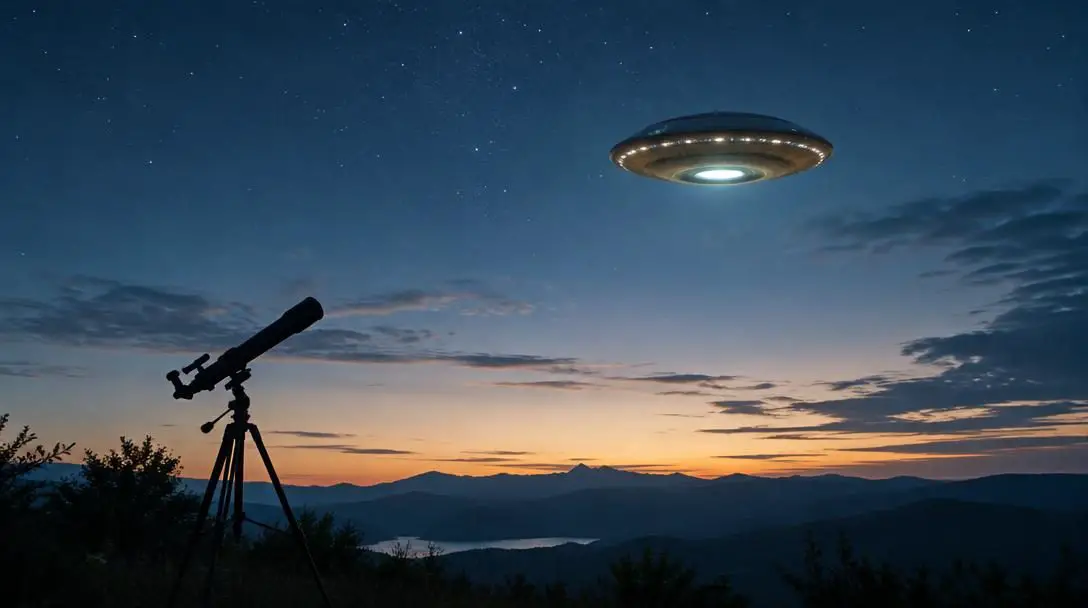
The first and most culturally prevalent concept is the Extraterrestrial Hypothesis. This theory posits that some unidentified aerial objects represent physical hardware piloted or deployed by intelligent species from other solar systems. Proponents argue that given the vast scale of the cosmos, the statistical likelihood of advanced alien civilizations is high, and that Earth may be under ongoing observation. However, despite intense interest, the hypothesis suffers from a total absence of peer-reviewed, reproducible physical material.
The second perspective attributes reports to Human-Made Objects. This is historically the most substantiated hypothesis. Throughout the Cold War and into the modern era, military organizations regularly engineered experimental aircraft, stealth prototypes, high-altitude surveillance balloons, and unmanned aerial vehicles. The United States military has openly acknowledged that secret flight tests were repeatedly mistaken for alien craft by civilian observers and commercial pilots. In the 21st century, the proliferation of private commercial drones and commercial satellite clusters continues to generate reports that mimic unearthly behavior.
The third explanation focuses on Natural Phenomena. The atmosphere is an immensely dynamic medium capable of producing extraordinary visual effects. Unconventional weather anomalies, mirages, plasma discharges, and rare occurrences like ball lightning can move erratically, change colors rapidly, and deceive even experienced observers into believing they are watching an engineered vehicle under intelligent control.
An object being labeled as unidentified simply confirms a lack of immediate data; it does not serve as affirmative proof of interstellar visitation.
Official Government Inquiries and Scientific Skepticism
Due to the national security concerns inherent in unmonitored aircraft operating in sovereign airspace, world governments have regularly launched formal inquiries into unidentified sightings. The most prominent historical effort was Project Blue Book, an extensive investigation conducted by the United States Air Force.
Despite the conclusions of Project Blue Book, a profound divide emerged between government findings and public trust. A significant contingent of enthusiasts and civilian researchers grew convinced that state authorities were withholding physical evidence of extraterrestrial visitors. This belief in coordinated governmental concealment fueled conspiracy theories that endure today. Concurrently, the scientific community maintains a position of rigorous empirical skepticism. Because extraordinary claims require extraordinary evidence, scientists demand verifiable, tangible artifacts rather than visual impressions or personal testimony before accepting extraterrestrial visitation as fact.
Scientific Exploration: SETI, the Drake Equation, and Kepler-452b
While mainstream science remains skeptical of UFO claims on Earth, it actively pursues the search for extraterrestrial intelligence across the broader cosmos. Rather than scanning local clouds for fast-moving lights, astrophysicists utilize deep-space instruments to detect signatures of life and technological civilizations.
A primary pillar of this endeavor is the Search for Extraterrestrial Intelligence (SETI). SETI scientists utilize radio telescopes and observational arrays to listen for non-natural radio transmissions, laser pulses, or other technosignatures originating from deep space. By methodically sweeping star systems, SETI treats the search for life as an astronomical discipline rather than an aerial chase.
Theoretical groundwork for this search was established in 1961 by astronomer Frank Drake through the formulation of the Drake equation. This mathematical framework estimates the total number of active, communicative civilizations within the Milky Way galaxy by multiplying several variables:
- The rate of star formation in our galaxy.
- The fraction of stars that host planetary systems.
- The average number of planets per star that could potentially support life.
- The fraction of habitable worlds where biological life actually develops.
- The fraction of life-bearing planets that evolve intelligent species.
- The fraction of intelligent civilizations that develop detectable communications technology.
- The length of time such civilizations release detectable signals into space.
As astronomical instruments have grown more sophisticated, certain variables in Drake's equation have transformed from wild guesses into measurable data. The study of exoplanets has yielded remarkable breakthroughs in this area.
Kepler-452b
- Discovery year: 2015
- Discovering organization: NASA
- Key characteristic: Located in its parent star's habitable zone
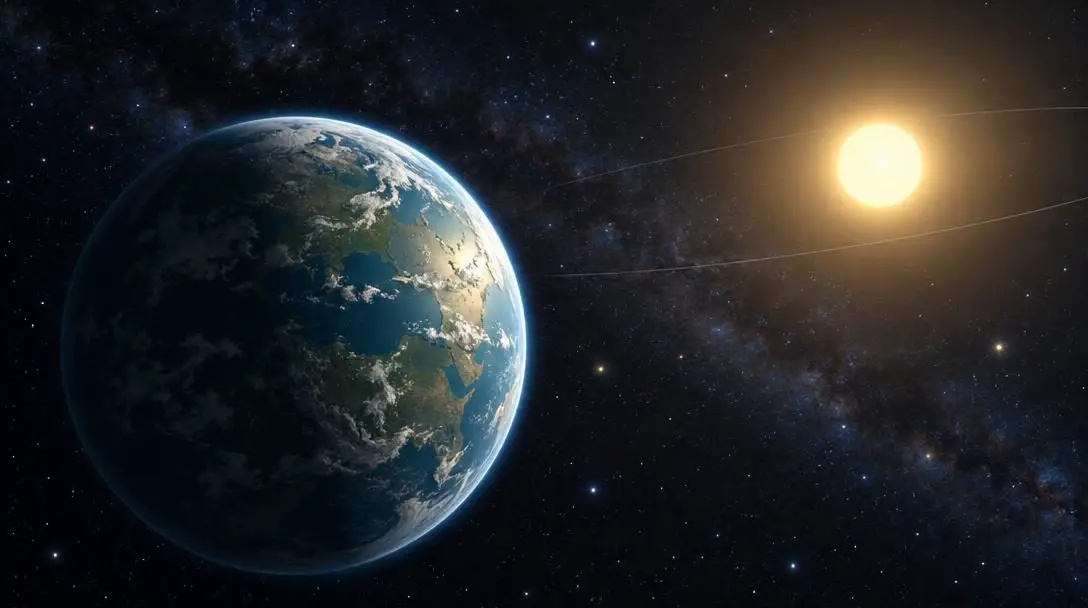
In 2015, NASA announced the detection of Kepler-452b, an exoplanet orbiting within the habitable zone of a sun-like star. The habitable zone represents the precise orbital band where surface temperatures allow liquid water to pool, creating the chemical prerequisite for life as we know it. Discoveries like Kepler-452b demonstrate that potentially hospitable worlds are common in the galaxy, providing a strong scientific basis for continuing the search for alien biology far beyond Earth's atmosphere.
Popular Culture and the Media Feedback Loop
The cultural appetite for UFO narratives cannot be separated from the media that reflects and amplifies it. The 1950s and 1960s represented a golden age for science fiction cinema, producing landmark films such as The Day the Earth Stood Still, which mirrored Cold War anxieties through the prism of extraterrestrial intervention.
In later decades, television programs like The X-Files popularized government cover-up motifs and normalized the iconography of alien abductions and secret crash-retrieval teams. Decades of movies, paperback novels, and sensationalized documentaries have created a powerful cultural feedback loop. When individuals spot unexpected lights in the night sky, their immediate mental vocabulary is already preloaded with imagery from popular culture, often leading them to perceive an alien spacecraft where only an ordinary weather satellite or weather balloon exists.
Step-by-Step: How to Investigate an Unidentified Sighting
If you observe an aerial phenomenon that seems unexplainable, jumping to sensational conclusions obscures the truth. Approaching the sighting with an objective, methodical mindset ensures that ordinary explanations are ruled out before extraordinary claims are made.
- Record immediate environmental details: Write down the exact date, time, and geographic location. Log specific environmental metrics, including cloud cover, wind direction, horizontal visibility, and your own precise vantage point.
- Gather visual evidence with physical reference points: When using a smartphone or camera, record steady video or high-resolution photos. Ensure stationary physical objects—such as tree lines, buildings, or utility poles—are clearly visible in the frame to help analysts calculate the target's relative bearing, angular speed, and altitude.
- Cross-reference public flight and satellite tracking logs: Consult online air traffic monitoring platforms, drone registries, and satellite pass schedules. Thousands of low-earth-orbit satellites and routine commercial flights can appear highly anomalous when catching late-evening sunlight.
- Evaluate localized meteorological conditions: Analyze weather radar and local reports for atmospheric inversions, reflective ice clouds, or rare electrical occurrences like ball lightning that can mimic metallic hulls or self-propelled lights.
- Document a factual, assumption-free account: While memories are fresh, draft a comprehensive written report. Confine your statements strictly to what was observed optically, omitting subjective feelings, preconceived expectations, or narrative embellishments.
- Compare the event against historical archives: Check your documented data points against established historical collections, such as the case files of Project Blue Book, to identify known phenomena that match the recorded behavior.
Common Mistakes When Evaluating UFO Sightings
Even seasoned researchers and enthusiastic skywatchers frequently make errors when assessing aerial claims. Remaining aware of these cognitive and analytical traps is essential for maintaining scientific integrity.
- Defaulting to the extraterrestrial hypothesis first: An inability to instantly identify an object does not automatically validate the presence of alien visitors. The term "unidentified" merely indicates an absence of sufficient data.
- Underestimating mundane misidentifications: Normal consumer drones, research balloons, and experimental aircraft can perform maneuvers that appear unnatural to the naked eye under adverse lighting or distance.
- Disregarding natural and meteorological factors: Atmospheric illusions, light refraction, and plasma phenomena like ball lightning can exhibit high speeds and sudden direction changes that mimic artificial propulsion.
- Falling victim to deliberate hoaxes: The history of aerial phenomena is riddled with faked photographs, doctored video clips, and staged encounter claims designed to exploit public interest for notoriety or profit.
- Equating personal anecdotes with physical proof: While compelling stories like the Hill, Pascagoula, and Walton incidents offer fascinating personal narratives, science cannot accept unverifiable testimony as definitive proof of extraterrestrial visitation.
- Assuming government secrecy indicates alien evidence: When military institutions withhold information regarding black-budget projects, experimental drones, or radar data, they typically do so to safeguard defense capabilities, not to conceal alien technology.
Frequently asked questions
What was the earliest documented UFO sighting in history?
Historical lore records the earliest known sighting of mysterious aerial phenomena as occurring in 1440 BC in Egypt, long before the advent of modern aviation.
What was the official military explanation for the 1947 Roswell incident?
The United States military stated that the wreckage recovered near Roswell, New Mexico, was simply the debris of a downed weather balloon, although public belief in a crashed alien spacecraft persists.
What did Project Blue Book conclude about UFO sightings?
After examining more than 12,000 reported sightings, Project Blue Book concluded that the vast majority of cases were readily explained by natural atmospheric phenomena or human-made objects such as experimental aircraft and balloons.
How does the Drake equation contribute to the search for extraterrestrial life?
Created by astronomer Frank Drake in 1961, the Drake equation provides a theoretical formula to estimate the number of communicative intelligent civilizations in the Milky Way by evaluating factors like star formation, planetary habitability, and technological longevity.
Why is the discovery of Kepler-452b significant to astrobiology?
Discovered by NASA in 2015, Kepler-452b is an exoplanet orbiting within the habitable zone of its star, confirming that planets with the environmental potential to support life exist throughout our galaxy.
The bottom line
The enduring fascination with UFO sightings sits at the intersection of human curiosity, advanced aeronautics, and cosmic exploration. While historical archives like Project Blue Book show that human-made machines and natural weather phenomena account for almost all anomalous sightings, the search for life beyond Earth remains a vital scientific pursuit. Through initiatives like SETI, mathematical tools like the Drake equation, and the ongoing discovery of habitable exoplanets like Kepler-452b, science continues to systematically explore whether we are alone in the universe. Until physical evidence proves otherwise, separating aerial facts from cultural fiction remains the best way to understand the mysteries of our skies.