10 High-Scoring Words to Keep in Your Back Pocket for Your Next Scrabble Game
Scrabble remains one of the world's most enduring board games, captivating generations of word lovers, casual gamers, and serious competitors alike. At its core, the game challenges players to balance their expansive vocabulary against spatial strategy and the unpredictable luck of the tile bag. By placing interconnected letter tiles crossword-style onto a gridded playing surface, participants aim to accumulate the highest cumulative score before the bag empties and legal moves are exhausted.
Every tile in the Scrabble pool features a distinct point value that reflects how frequently that letter appears in the English language. Common vowels such as A, E, I, O, and U, alongside dependable consonants like L, N, R, S, and T, carry modest values because they fit seamlessly into hundreds of standard combinations. Conversely, rare power tiles like J, Q, X, and Z command substantial point values. Mastering a dedicated lineup of high-scoring vocabulary allows you to transform these otherwise unwieldy consonants into decisive, match-winning plays.
Key takeaways
- Rare consonants like Q, Z, J, and X feature the highest individual base tile values in Scrabble.
- Compact words such as "quay," "cozy," and "zany" allow you to score heavily without waiting for rare seven-letter bingos.
- Combining high-value letters with premium board squares like Triple Letter or Triple Word spaces rapidly multiplies turn totals.
- Hoarding difficult consonants clogs your rack and lowers your per-turn scoring potential.
- Active memorization techniques like syllable segmentation and mental imagery help you retrieve complex words during live play.
High-Scoring Words at a Glance
Before examining the tactical nuances of each term, reviewing their comparative values and tile requirements helps you recognize potential plays on your rack. The table below outlines ten high-yield words that turn difficult letters into substantial points.
| Word | Base Point Value | Letter Length | Primary Premium Tiles |
|---|---|---|---|
| Quixotic | 25 points | 8 letters | Q, X |
| Jacuzzi | 22 points | 7 letters | J, Z, Z |
| Cozy | 20 points | 4 letters | Z |
| Jazzy | 19 points | 5 letters | J, Z, Z |
| Jazzed | 18 points | 6 letters | J, Z, Z |
| Quaff | 17 points | 5 letters | Q |
| Jaunt | 16 points | 5 letters | J |
| Zany | 15 points | 4 letters | Z |
| Quay | 14 points | 4 letters | Q |
| Jive | 13 points | 4 letters | J |
Ten High-Scoring Words to Keep in Your Back Pocket
Success in competitive Scrabble does not require waiting indefinitely for common four-letter words. Memorizing targeted terms built around high-value consonants gives you an immediate scoring edge over your opponents. The following ten words make exceptional additions to your playing vocabulary.
Quixotic
- Base value: 25 points
- Word length: 8 letters
- Definition: An extravagantly chivalrous or romantic attitude
Combining both a Q and an X in a single term makes this eight-letter powerhouse an extraordinary play. For example: He took on the task with quixotic enthusiasm. While executing an eight-letter play requires board space and an existing anchor letter, landing quixotic delivers a commanding point surge that can permanently shift the momentum of the game.
Jacuzzi

- Base value: 22 points
- Word length: 7 letters
- Definition: A brand of hot tub or whirlpool bath
Jacuzzi takes full advantage of the rare J and two Z tiles, generating enormous base scoring potential. For example: We decided to relax in the jacuzzi after our long day of hiking. Because a standard Scrabble set contains only one Z tile, playing this word in tournament or standard play generally requires deploying a blank tile alongside the natural Z.
Cozy
- Base value: 20 points
- Word length: 4 letters
- Definition: Comfortable, inviting, and pleasant
Even short four-letter plays pack a tremendous punch when they pair the 10-point Z with common vowels and a terminal Y. For example: The cabin had a cozy atmosphere that we all enjoyed throughout our stay. Because of its compact length, cozy fits neatly into tight board pockets where longer words cannot go.
Jazzy
- Base value: 19 points
- Word length: 5 letters
- Definition: Stylish, lively and showy
Featuring an 8-point J alongside repeated Zs, jazzy turns what might otherwise be an unwieldy collection of consonants into an enviable score. For example: She wore a jazzy dress for her birthday celebration. It serves as an ideal outlet when your rack contains multiple premium letters that threaten to stall your tile circulation.
Jazzed
- Base value: 18 points
- Word length: 6 letters
- Definition: Filled with enthusiasm and energy
Similar to jazzy, this variation provides outstanding tactical flexibility whenever you hold an E and a D on your rack. For example: We were jazzed to go on our first family vacation together. The common past-tense -ED ending allows jazzed to hook onto preexisting board tiles with minimal friction.
Quaff
- Base value: 17 points
- Word length: 5 letters
- Definition: To drink heartily
Pairing the 10-point Q with a U and double Fs makes this five-letter verb an efficient way to unload difficult tiles without requiring open board real estate. For example: They quaffed their beers while watching the game. Using quaff keeps your tile turnover high while banking reliable double-digit points.
Jaunt
- Base value: 16 points
- Word length: 5 letters
- Definition: A short journey taken for pleasure
This five-letter play gives you a dependable outlet whenever you hold a J alongside common vowels and consonants like A, U, N, and T. For example: We went on a jaunt around town, visiting all the local sights. Because its remaining letters are among the most frequently drawn tiles in the game, jaunt is exceptionally easy to form.
Zany
- Base value: 15 points
- Word length: 4 letters
- Definition: Playful and full of wild ideas or activities
At just four letters long, zany allows you to rapidly cash in the 10-point Z without bogging down your rack. For example: She had a zany personality that kept everyone laughing. Its modest length makes it an ideal candidate for targeting isolated premium letter squares near existing vowels.
Quay

- Base value: 14 points
- Word length: 4 letters
- Definition: A wharf
This concise term is one of the most practical words to know when you draw both a Q and a U but lack the grid space for a lengthy play. For example: We arrived at the quay just in time to board our cruise ship. Holding quay in your active memory prevents the Q tile from lingering on your rack for multiple turns.
Jive
- Base value: 13 points
- Word length: 4 letters
- Definition: To talk or act in a light-hearted and humorous manner
Delivering dependable points by pairing the rare 8-point J with easily accessible vowels and the consonant V, jive resolves difficult draws quickly. For example: She jived her way through the meeting, keeping everyone entertained. It represents a steady, practical play when premium bonus squares are unavailable.
Having an assortment of high-scoring words memorized and ready to deploy turns difficult draws into your most decisive tactical plays.
How Word Scoring and Board Multipliers Work
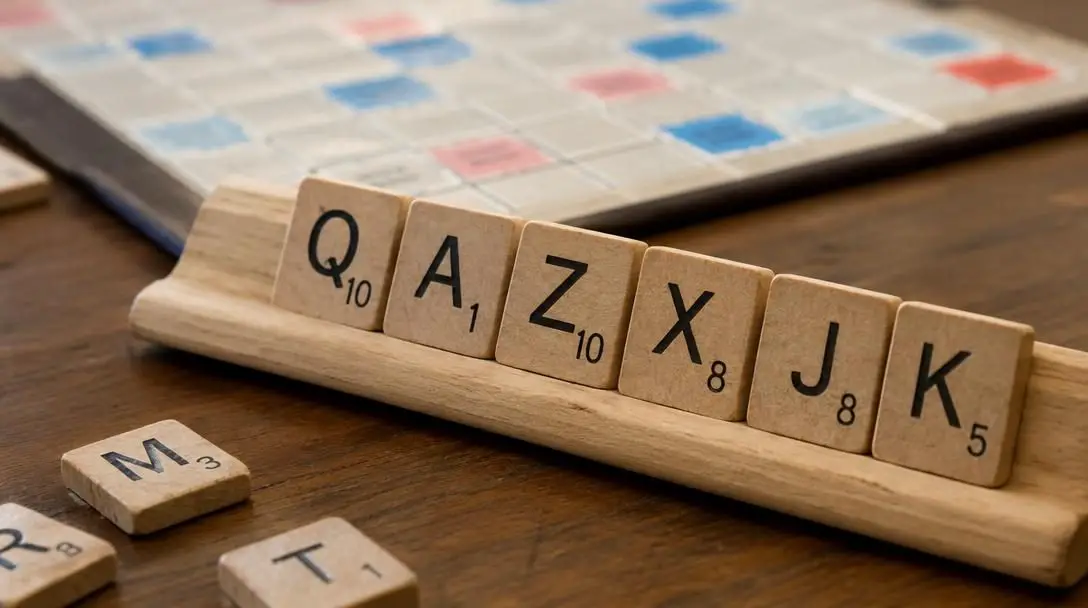
The total value of any move in Scrabble depends on the combination of letter values and the board layout. Every individual tile has an assigned face value. When you form a word, the basic points are determined by adding together the numbers printed on each tile used in that word. Letters like J and X carry 8 points each, Q and Z are worth 10 points each, and letters like K carry 5 points, whereas common vowels are worth only 1 point each.
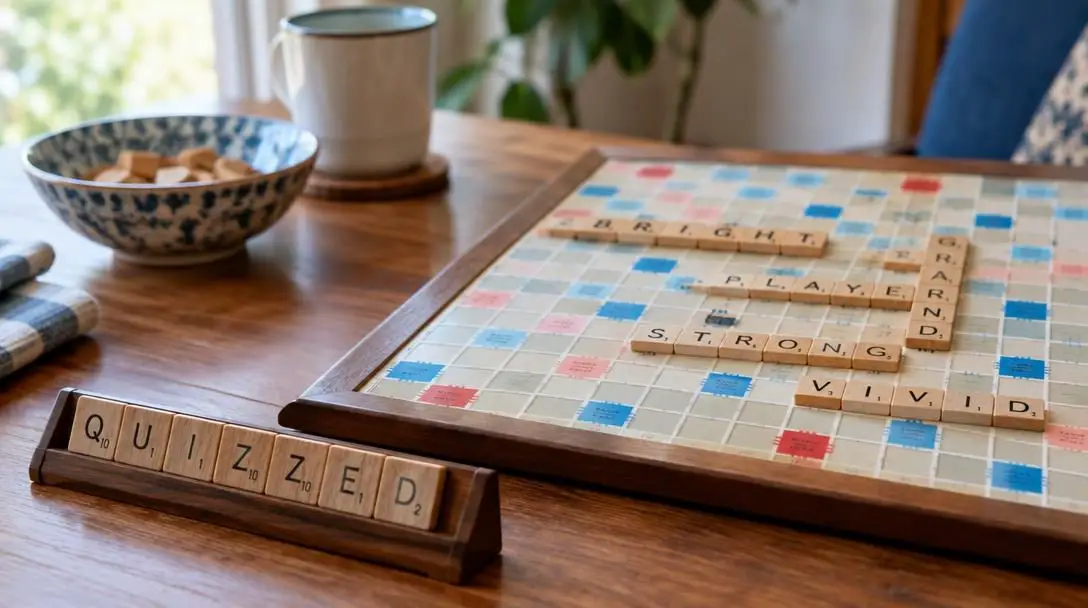
However, the true scoring power of high-value words emerges when you align them with the premium squares scattered across the grid. These designated colored spaces modify tile and word values in distinct ways:
- Double Letter Score (DLS): Multiplies the face value of the specific tile placed on that square by two.
- Triple Letter Score (TLS): Multiplies the face value of the specific tile placed on that square by three. Placing a 10-point letter like Q or Z on a Triple Letter space immediately generates 30 points from that single tile alone.
- Double Word Score (DWS): Doubles the combined sum of the entire word covering the square.
- Triple Word Score (TWS): Triples the combined sum of the entire word covering the square, easily shifting the competitive momentum of a match.
When playing words that form perpendicular connections to existing board letters, players also score points for the newly created intersecting words. This means placing a letter like Z or J on a premium square can score in two different directions at the same time, turning a modest four-letter play into a game-defining turn.
Practical Steps for Memorizing High-Scoring Words
Knowing that complex words exist is only beneficial if you can retrieve them under time pressure during a match. Memorizing these target terms ensures that you can spot scoring formations immediately on your rack without needing to pause or second-guess the spelling. You can employ several reliable techniques to lock these terms into your memory:
- Break the word down into smaller parts: Segment difficult words into smaller clusters or individual syllables. Focusing on discrete components prevents your mind from feeling overwhelmed by unusual consonant arrangements.
- Write out the words several times: Writing out and pronouncing the word multiple times reinforces its spelling and meaning. Physical repetition builds muscle memory alongside mental recall, making it natural to spot these formations when scanning your tiles.
- Use mental visualization: Associate each term with a memorable mental picture. For instance, visualize yourself relaxing in a hot tub to remember jacuzzi, or picture a ship tied securely to a wharf to recall quay. Strong mental images trigger rapid retrieval during competitive play.
Tactical Mistakes to Avoid When Holding Power Tiles
Even seasoned players often fall into predictable tactical traps when high-point tiles appear on their rack. Being aware of these common pitfalls protects your lead and keeps your gameplay clean and efficient:
- Holding high-value tiles too long: Hoarding rare tiles like Q, Z, or J while waiting for the perfect board setup to play quixotic or jacuzzi clogs your rack and depresses your average turn score. If a grand play cannot be executed promptly, play shorter options like quay, cozy, or zany to keep your tiles circulating.
- Ignoring board openings for opponents: Placing a high-scoring word without inspecting the surrounding grid can be catastrophic. Dropping a lucrative word adjacent to an uncovered Triple Word Score square gives your opponent an easy pathway to surpass your score on their next turn.
- Mismanaging vowels: High-scoring words that contain Q or J often demand multiple vowels. Expending all your vowels at once to complete a word like jaunt or quaff can leave you stranded with an unworkable rack of consonants.
- Rushing without checking hooks: Missing an opportunity to attach your word to existing letters already on the board leaves free points behind. Always verify whether adding an S, D, or other letter can form parallel words.
Advanced Scrabble Strategies to Explore Next
Once you have added these ten terms to your active vocabulary, continuing to expand your strategic foundation will sharpen your competitive execution across all phases of the game:
- Master two-letter words: Short two-letter combinations are the foundation of expert Scrabble. They enable tight parallel plays that allow you to drop power tiles into cramped sections of the board while scoring in two directions.
- Practice Q-without-U words: While words like quay and quaff are indispensable, you will not always hold a U when drawing the Q. Learning valid terms that do not require a U ensures that drawing the Q never stalls your game.
- Study rack management: Maintaining a healthy balance of vowels and consonants ensures that you can continually construct smooth, high-yielding plays turn after turn.
- Develop defensive play awareness: Knowing when to open the board for expansive scoring and when to close off lanes to protect a lead is what separates casual players from tournament champions.
Frequently asked questions
How many points are J, Q, X, and Z worth in Scrabble?
In standard Scrabble, the letter J and the letter X are worth 8 points each, while the letter Q and the letter Z are worth 10 points each. Vowels are worth 1 point each, and letters like K are worth 5 points.
What is the highest-scoring base word on this list?
Quixotic is the highest-scoring base word on this list, boasting a base value of 25 points across its eight letters thanks to the rare combination of both a Q and an X.
Why is it often better to play short words like cozy or zany instead of holding out for larger words?
Holding onto rare tiles like Q or Z while waiting for long words clogs your rack and limits your scoring options on intermediate turns. Playing concise words like cozy or zany lets you bank premium points immediately while keeping your rack balanced.
How does a Triple Letter Score affect a letter like Q or Z?
Placing a 10-point tile such as Q or Z directly onto a Triple Letter Score square multiplies the tile's face value by three, yielding an immediate 30 points from that single letter before adding the rest of the word.
Can a single word score in two directions at once?
Yes. When a newly placed tile touches an existing word on the board to form an intersecting cross-word, you score points for both the primary word and the perpendicular word created during the same turn.
The bottom line
Mastering high-scoring Scrabble vocabulary is one of the most effective ways to elevate your overall game. Rare letters like Q, Z, and J carry high point values for a reason: they are difficult to combine into everyday language. By keeping words like quixotic, jacuzzi, cozy, and quay in your back pocket, you eliminate the hesitation that often accompanies rare tile draws. Paired with careful board awareness, disciplined vowel management, and strategic use of multiplier squares, these words will give you a decisive edge during your next game night.