
5 Key Qwirkle Strategy Tips
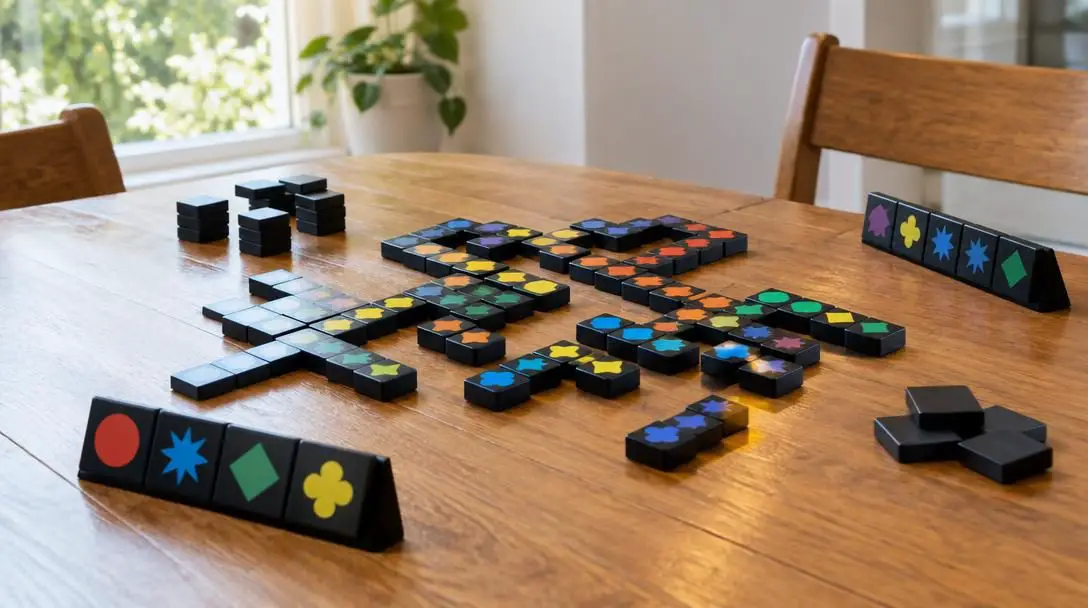
Qwirkle is widely loved as a tabletop game that brings family and friends together for an engaging, approachable game night. The core premise is deceptively straightforward: players draw wooden tiles and take turns placing them onto a communal grid to match colors and shapes, competing to tally the highest final score. Because the baseline rules can be learned in a matter of minutes, many participants approach the game casually, focusing only on finding an open spot on the board where a tile in their hand matches an adjacent piece.
Relying solely on surface-level tile matching, however, quickly reveals the limits of casual play. Without deliberate strategy, players frequently leave themselves vulnerable to counterattacks, hand their rivals high-scoring opportunities, and settle for mediocre turns that drag down their cumulative score. By mastering board architecture, tracking tile distribution, and balancing aggressive scoring against proactive defense, you can transform Qwirkle from a game of chance into a deeply satisfying contest of foresight and tactical control.
Key takeaways
- Target multi-row parallel placements on every turn to consistently surpass the ideal scoring benchmark of at least seven points.
- Track the fixed distribution of three identical copies per tile combination to deduce which lines are safe and which are permanently dead.
- Purge duplicate matching tiles immediately through early plays or bag exchanges to keep your hand flexible and open to six-tile Qwirkle setups.
- Pivot to defensive blocking by using two tiles to choke off adjacent spaces when an opponent threatens a double-digit score.
- Train your eyes to scan for matching shapes rather than colors to uncover hidden four-tile runs that opponents routinely overlook.
The Mechanics and Math of Competitive Qwirkle Scoring
To consistently outperform experienced players, you must understand the underlying scoring framework and tile economy. In Qwirkle, every tile placed into a valid line scores one point for itself and one point for every other tile already present in that line. When a placed tile simultaneously connects to two intersecting lines—such as a horizontal sequence of shapes and a vertical sequence of colors—it scores points in both directions. Capitalizing on these multi-directional intersections forms the foundation of high-level scoring.
Competitive success is defined by strict scoring thresholds. As a rule of thumb, you should aim to score at least seven points per turn to maintain a winning pace. When you restrict your vision to basic, single-line extensions, you will often find yourself earning a score of four max, slowly conceding the match to more efficient opponents. The ultimate single-line prize is the Qwirkle: completing a line of six unique shapes of the same color, or six unique colors of the same shape. A completed Qwirkle yields twelve points—six points for the individual tiles plus a six-point completion bonus.
5 Core Strategies for Dominating the Board
Moving from a beginner to an advanced strategist requires shifting your perspective from the tiles in your rack to the broader board ecosystem. Implementing these five foundational strategies will immediately improve your scoring efficiency and table defense.
Score on Two Rows
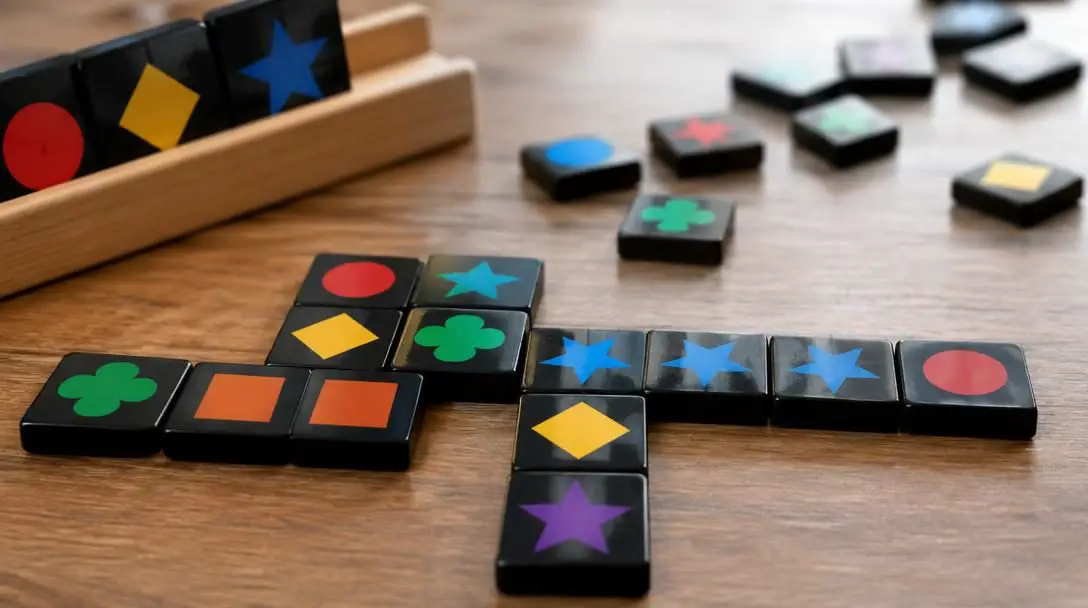
Placing tiles along a single axis will rarely yield the points necessary to build a commanding lead. Instead, advanced players look for parallel plays that allow a single placement to score across two distinct rows simultaneously. By identifying an open corridor where your tile satisfies the constraints of both a vertical column and a horizontal row, you effectively double the point value of your turn. Prioritizing these dual-axis connections elevates your turn-by-turn average well beyond the standard four-point ceiling. If you scan the layout and cannot find a way to score across two lines or reach your scoring benchmark, exchanging your tiles at the bag is often mathematically superior to playing a low-value tile that sets up your opponents.
Count Tiles as You Go
Tile tracking is one of the most powerful analytical skills you can develop in Qwirkle. The game contains exactly three copies of each unique color and shape combination. Because this distribution is completely static, every tile laid on the table provides direct information about what remains in the draw bag and behind your opponents' racks. By around the 10th round of play, numerous threesomes will be fully displayed across the grid. Once you verify that all three copies of a specific tile are visible, that combo is permanently played out. This knowledge prevents you from leaving dangerous five-tile lines open when the completing tile is mathematically impossible to draw, while helping you shut down rows your rivals are actively waiting to finish.
Get Rid of Identical Tiles
Holding duplicate copies of the exact same tile severely restricts your tactical options. The rules strictly prohibit placing identical tiles within the same line, meaning duplicate pieces cannot be played together in a single sequence. Retaining identical tiles clogs your hand flexibility, leaves you susceptible to dead turns, and reduces the likelihood of drawing synergistic pieces. You should eliminate identical tiles as quickly as possible by playing one off—even for modest points—or by conducting a tile exchange. A healthy hand should instead focus on mixed combos, such as several different colors sharing an identical shape, which positions you to engineer a massive 12-point Qwirkle.
Block High Score Plays
While maintaining an aggressive offensive scoring rate of at least seven points per turn is ideal, defense takes absolute priority when a rival threatens a breakthrough. Allowing an opponent to finish a five-tile line into a twelve-point Qwirkle erases multiple turns of steady scoring in an instant. When you spot an opponent setting up a major row, you must abandon your offensive target and execute a block. You can shut down these threats by using two tiles to build into and fill the open space adjacent to the high-scoring row, choking off their lane of progress. Even if your blocking turn yields minimal points, the net point differential keeps you ahead by denying your opponent a double-digit windfall.
Prioritize Shapes
The human visual processing system naturally notices color contrasts before abstract geometric contours. Consequently, casual players almost universally scan the board searching for matching colors, frequently missing powerful shape-based connections. By deliberately training yourself to prioritize shapes over colors, you will spot scoring avenues that your opponents completely overlook. Scanning specifically for runs of four tiles sharing the same shape enables you to identify vulnerable near-Qwirkles. Stealing these setups allows you to complete the sequence for a full twelve points while capitalizing on your rivals' visual blind spots.
"Deliberately training your eyes to prioritize shapes over colors reveals high-scoring board corridors that your opponents routinely overlook."
Strategic Overview of Core Qwirkle Tactics
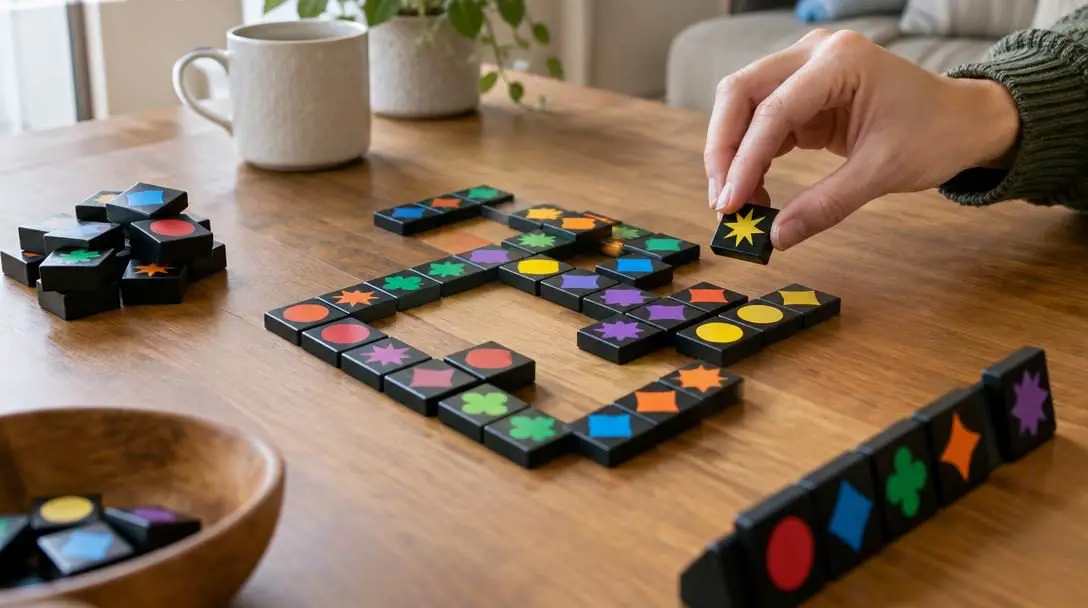
Balancing offensive execution with defensive denial is essential to mastering the flow of each match. The table below outlines how each core tactical concept contributes to your overall board control.
| Strategy Focus | Primary Objective | Ideal Game Phase | Typical Scoring Impact |
|---|---|---|---|
| Score on Two Rows | Maximize single-turn output via parallel plays | Continuous throughout match | Bypasses 4-point maximum ceiling |
| Count Tiles as You Go | Track depleted combinations to evaluate board safety | Mid-to-late game (Round 10+) | Informs low-risk board navigation |
| Purge Identical Tiles | Restore hand synergy and eliminate dead weight | Early-to-mid game | Unlocks 12-point Qwirkle setups |
| Block High Score Plays | Choke off lanes next to active five-tile rows | Situational response to threats | Prevents double-digit rival windfalls |
| Prioritize Shapes | Exploit opponent visual blind spots in row building | Continuous throughout match | Accelerates rapid 12-point completions |
Step-by-Step Routine for Executing High-Value Turns
Adopting a structured checklist before committing any tile to the table prevents impulsive mistakes and ensures you balance scoring with spatial control.
- Evaluate hand composition immediately upon drawing, checking for identical duplicates that must be discarded or played off to restore flexibility.
- Scan the open grid for parallel intersections where a single tile or cluster can score along two rows at once.
- Shift your visual search specifically toward shape alignments, looking for existing lines of four tiles in the same shape that are primed for completion.
- Examine the board defensively to detect whether an opponent is poised to complete a five-tile sequence on their upcoming turn.
- Verify tile counts against the physical board to see if the missing pieces required for critical lines have already appeared three times.
- Position two tiles to fill the space adjacent to a high-scoring row if an opponent must be blocked from completing a massive play.
- Calculate whether your offensive path reaches the minimum benchmark of at least seven points; if the turn nets a score of four max with no defensive utility, exchange tiles at the bag.
Common Strategic Pitfalls to Avoid
Many intermediate players stall their progress because they cling to habits that feel productive on the surface but actively undermine their long-term win rate. Watching out for these common errors will keep your game sharp:
- Settling for basic, single-row placements that yield a score of four max instead of hunting for parallel plays.
- Hoarding identical tiles across multiple turns in the false hope that an opportunity to play them simultaneously will materialize.
- Tunnel-visioning on bright color chains while completely ignoring powerful shape-matching opportunities across the grid.
- Tunneling exclusively on your own score while ignoring an opponent who is actively setting up an uncontested twelve-point Qwirkle.
- Failing to track tile frequency, causing you to fear or defend against combinations that have already been played out of the bag.
- Refusing to sacrifice a turn to swap tiles, resulting in multiple consecutive low-yield turns that ruin your scoring momentum.
Navigating Table Dynamics and Competitive Evolution
As you incorporate tile counting, defensive positioning, and dual-axis scoring into your regular play, you will notice the entire pace of your matches begin to shift. You will spend less time reacting to the tiles you draw and more time anticipating how your placements shape the options available to everyone else at the table. At this stage, you face a strategic choice regarding how you manage your table presence.
You can choose to keep your tactical methods quiet, leaving friends and family wondering how you manage to pull off commanding leads game after game. However, if you play with the same group regularly, your techniques will naturally rub off on your opponents over time. As other players observe you consistently blocking their five-tile lines, hunting down shape combinations, and manufacturing multi-row scores, they will inevitably begin adopting those same tactics. This natural evolution transforms casual tabletop sessions into deep, highly engaging tactical battles where every single tile placement carries genuine consequence.
Frequently asked questions
How many points is a Qwirkle worth?
A completed Qwirkle is worth twelve points. It consists of a completed six-tile line sharing a single attribute (either six different shapes of one color, or six different colors of one shape). You score six points for the individual tiles in the line plus an additional six-point bonus for completing the row.
What is a good average score per turn in Qwirkle?
A solid scoring benchmark is to aim for at least seven points per turn. Relying on simple single-line placements often leaves you with a score of four max, which is insufficient to outpace skilled opponents.
How many copies of each tile are in the game?
There are exactly three copies of each unique color and shape combination in the Qwirkle bag. Once you count three identical copies of a specific tile on the board, that combination is completely played out.
How do you block an opponent from scoring a Qwirkle?
You can block an opponent by placing two tiles to occupy the space directly next to their high-scoring row. This disrupts their path and prevents them from playing the finishing tile into that line.
When should you exchange tiles instead of playing them?
You should consider exchanging your tiles when your hand offers no defensive plays and your best offensive move yields a score of four max, or when you are stuck holding duplicate identical tiles that restrict your hand flexibility.
The bottom line
Mastering Qwirkle requires moving beyond basic pattern matching to embrace calculated board control. By focusing on multi-row scoring, keeping your hand free of duplicate tiles, tracking the three-tile distribution limit, and prioritizing shapes over colors, you build a decisive tactical advantage. Balancing these offensive principles with aggressive blocking transforms casual tile-laying into a repeatable, winning system every time you sit down at the table.