5 Music-Related Board Games That Will Amp Up Your Next Game Night
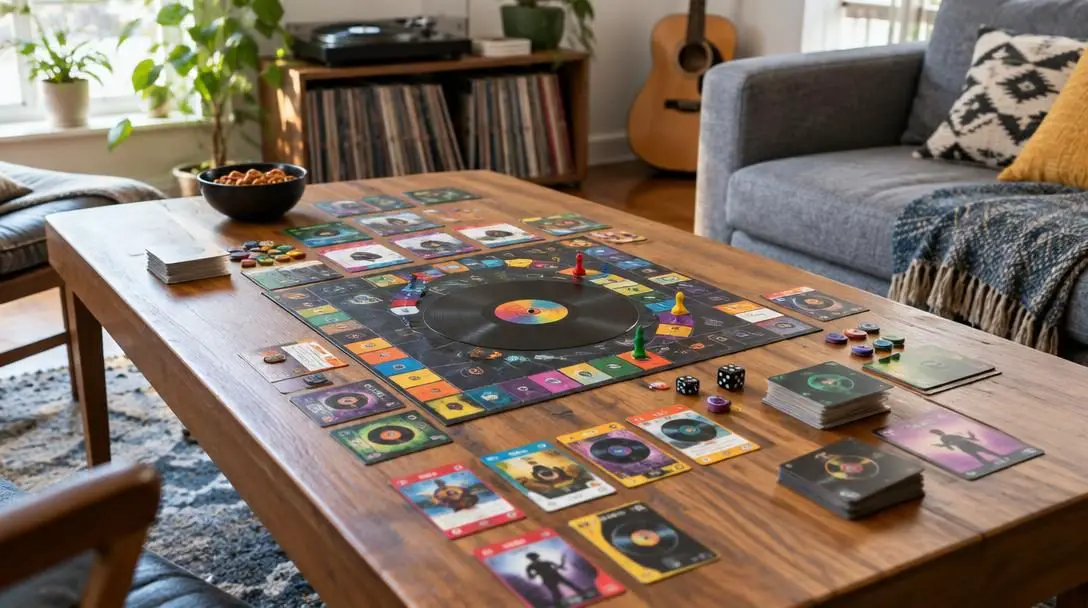
Game nights provide a dependable way to bring friends and family together for an evening filled with laughter, friendly rivalry, and shared memories. Gathering around a common table offers an authentic social connection that digital screens simply cannot match, creating a lively atmosphere where conversations flow freely. Yet, when the same standard card decks and conventional board games make an appearance week after week, the routine can begin to feel overly familiar.
Introducing music-focused tabletop games is an effective way to revitalize your gatherings. These titles break away from quiet, purely analytical mechanics and invite everyone at the table to whistle, recall lyrics, test their trivia recall, or belt out favorite choruses. Because melody and rhythm resonate across different age groups and backgrounds, adding a musical dimension turns an ordinary get-together into an energetic, collaborative celebration.
Key takeaways
- Music-themed tabletop games shift social dynamics from quiet strategic planning to lively vocal participation and spontaneous laughter.
- Different formats cater to varying preferences, ranging from rapid-fire singing duels to extensive rock history quizzes.
- Matching the chosen title to your player count and group temperament prevents player hesitation and keeps momentum steady.
- Simple hosting preparations, such as setting lyric-verification rules and preparing score sheets, ensure a smooth and engaging session.
The unique social appeal of music-centered tabletop games
Music is a universal language that effortlessly bridges generation gaps and diverse personalities. When a tabletop activity incorporates musical cues, the mood in the room immediately shifts. Traditional strategy games often require extended periods of silence and intense individual contemplation, which can inadvertently sideline less competitive guests. In contrast, games based around songs stimulate memory, invite laughter, and evoke shared nostalgia from the very first turn.
Furthermore, these games engage an entirely different set of cognitive abilities. Instead of calculating optimal resource paths or managing complex decks, players rely on auditory recall, verbal agility, and fast association. Some participants shine when recalling obscure album details from decades past, while others excel at rapidly remembering catchy pop lyrics under the pressure of a ticking timer. This blend of knowledge and performance levels the playing field, making the experience welcoming for casual listeners and devoted audiophiles alike.
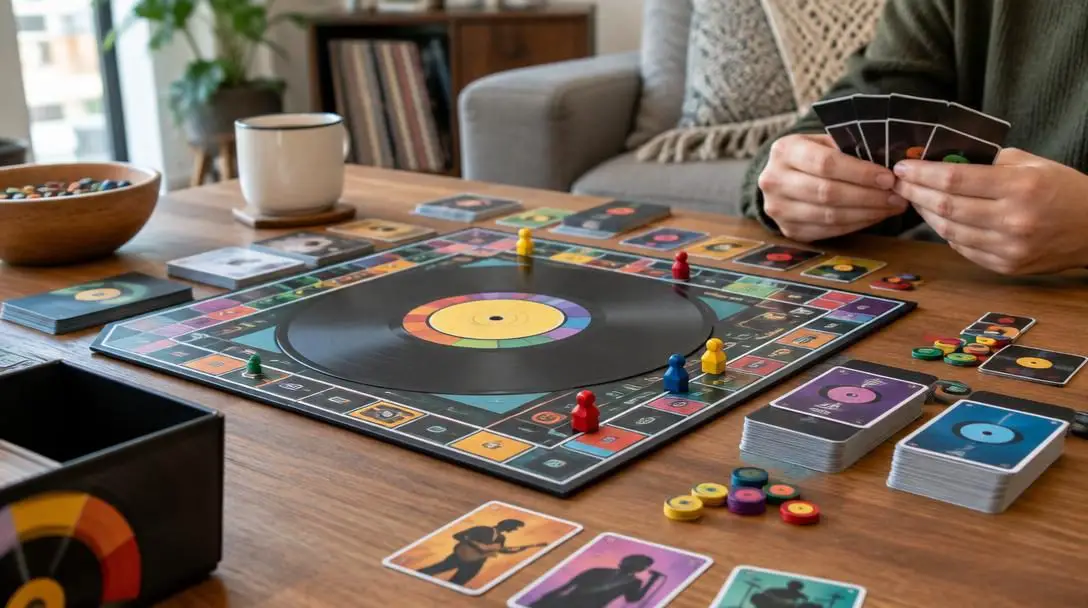
Gathering around a table with musical challenges turns passive listeners into active performers, sparking immediate laughter and nostalgia across the room.
Five standout music games for your next gathering
To help you select the ideal title for your crowd, the following breakdown explores five distinct options, detailing their mechanics, components, player requirements, and overall playstyle.
| Game | Recommended Age | Player Requirement | Core Mechanic | Key Materials Needed |
|---|---|---|---|---|
| Name That Tune | 10 and up | Any number of players | Humming or whistling song clues | Paper, pencil, music access |
| Spontuneous | Not specified | At least 4 players | 15-second lyric recall | Board game set |
| Rock and Roll Trivia | 12 and up | Individual or team play | 1,400+ historical questions | Board game set, paper, pencil |
| Encore! | Not specified | At least 4 players | Chained singing by last letter | Board game set |
| Music Mad Libs | 10 and up | Individual or team play | Fill-in-the-blank storytelling | Book or printouts, pencils |
Name That Tune

- Age range: Ages 10 and up
- Player count: Any number of players
- Core dynamic: Auditory guessing via humming or whistling
- Scoring: One point awarded per correct title guess
Name That Tune is a timeless staple that has entertained music fans for decades. Rather than relying on complicated cardboard setups, specialized dice, or intricate miniatures, the experience centers purely on ear-to-ear listening and auditory recognition. The game tasks players with recognizing well-known melodies stripped down to their most basic forms, creating instant excitement as participants race to be the first to identify the track.
The rules are elegantly simple: on a player's turn, they select a song and either hum or whistle the melody to the room. The other participants listen closely and attempt to guess the correct title. The first person to accurately state the song's name earns a point on the score sheet. Because the rules are so easy to grasp, the game accommodates groups of virtually any size, from an intimate two-person matchup to a packed living room of party guests.
Spontuneous

- Age range: Broad group appeal
- Player count: At least 4 players
- Core dynamic: Rapid lyric retrieval and singing
- Time limit: 15 seconds per turn
If your group thrives on energy, fast pacing, and theatrical outbursts, Spontuneous delivers a high-stakes environment where hesitation results in elimination. The fundamental objective is to be the first participant to sing a song containing a specified trigger word. The game relies entirely on spontaneous lyric recall, turning everyday vocabulary words into musical challenges.
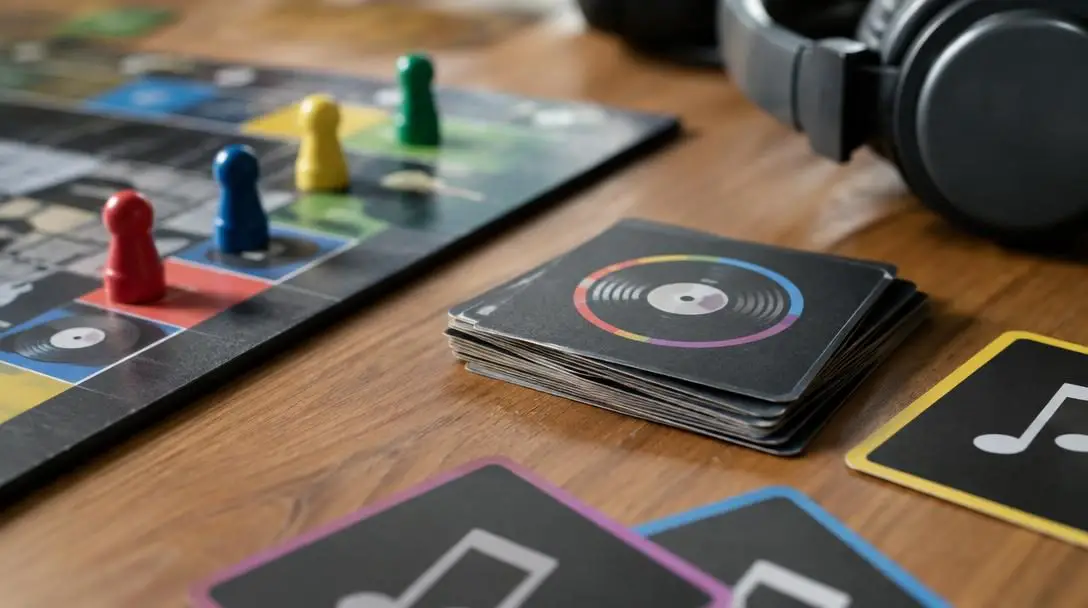
During each round, a designated player announces a word out loud. Immediately, the other players have a strict 15-second window to search their memories, find a matching lyric, and sing it aloud. The urgency of the timer creates frantic table talk and hilarious misfires as players scramble to remember choruses under pressure. If a player fails to produce a viable song before the time expires, they are knocked out of the running for that round. The competition continues until only one player remains standing to claim victory.
Rock and Roll Trivia

- Age range: Ages 12 and up
- Player count: Flexible; playable individually or in teams
- Question volume: Over 1,400 questions
- Content focus: Rock history, artists, songs, and albums
For gatherings of dedicated music historians and classic album enthusiasts, Rock and Roll Trivia provides an extensive deep dive into decades of musical culture. This game shifts the focus away from vocal performance and concentrates entirely on factual recall, historical context, and band lore. With a robust catalog of more than 1,400 questions, the box offers immense replay value that will not feel repetitive even after multiple game nights.
The gameplay challenges participants on a broad spectrum of rock subjects, including landmark album releases, iconic guitarists, charting singles, and legendary band lineups. Points are earned by answering questions correctly, with players moving across the board toward victory. Because it supports both solo competition and collaborative team play, it is exceptionally adaptable: groups can split into rival squads, allowing less confident trivia buffs to brainstorm together alongside experienced rock aficionados.
Encore!

- Age range: Group party dynamic
- Player count: At least 4 players
- Core dynamic: Word matching with alphabet chaining
- Elimination: Instant knockout upon hesitation or missed matches
Encore! takes the concept of lyrical recall and introduces an extra layer of strategic restriction. While it begins similarly to other singing games by requiring players to belt out a tune containing a specific prompt word, it introduces a demanding chaining mechanic that tests mental flexibility and lyrical range in real time.
Once a player sings a line containing the target word, the turn passes to the next person. That subsequent player must quickly sing a completely different song, but with a twist: the new song must begin with the final letter of the previous song. This chained requirement severely restricts the available song pool and prevents players from simply leaning on their favorite rehearsed tracks. Participants who hesitate, lose the rhythm, or fail to produce an acceptable tune are eliminated from the round, leaving the final standing vocalist as the winner.
Music Mad Libs

- Age range: Ages 10 and up
- Player count: Individual or team play
- Core dynamic: Fill-in-the-blank comedy writing
- Materials: Specialized booklet or printouts and pencils
Not every musical activity requires vocal acrobatics or comprehensive historical recall. Music Mad Libs provides a lighthearted, low-stress alternative centered on comedic wordplay and creative improvisation. By replacing missing words in music-themed stories, players generate absurd narratives filled with nonsensical band names, unusual instrumental techniques, and unexpected concert scenarios.
To play, one participant prompts the room for specific parts of speech—such as musical instruments, genres, verbs, or adjectives—without revealing the story context. The contributors shout out suggestions, which are transcribed into the blanks. Once every blank is filled, the host reads the complete passage aloud to the group. The resulting tales are uniformly funny and absurd, serving as an outstanding icebreaker that loosens up guests before they transition into more competitive board games.
Step-by-step guide to hosting a music game night
Hosting a memorable tabletop gathering requires more than simply opening a box on the dining table. A small amount of deliberate preparation ensures that the evening unfolds smoothly and that every guest feels comfortable joining in.
- Assess your guest list and group personality: Examine the size of your group and how comfortable they feel speaking or singing in public. Groups of four or more outgoing guests thrive with vocal titles like Spontuneous or Encore!, while more reserved groups often prefer the seated trivia format of Rock and Roll Trivia.
- Gather essential tabletop supplies: Inspect your game boxes well before guests arrive. Confirm that you have sharpened pencils, adequate writing paper, printed score sheets, and all necessary prompt cards or dice within arm's reach.
- Organize audio lookup tools: Set up a smartphone, tablet, or home audio system close to the table. Having instant access to music catalogs allows you to confirm song titles during Name That Tune or verify lyrical accuracy without pausing the party.
- Start with a low-pressure warm-up: Kick off the night with an informal exercise such as Music Mad Libs. This low-stakes activity allows late arrivals to join naturally and encourages reserved players to laugh and speak up before competitive rounds begin.
- Brief everyone on house rules: Spend two minutes explaining round structure, timing rules, and point criteria before beginning. Clarifying expectations early prevents disputes and maintains high energy throughout play.
Common mistakes to avoid during play
While music games are designed to be accessible and fun, small oversights can quickly disrupt the flow of play. Avoiding these frequent missteps will keep your evening lively and fair for all participants:
- Neglecting lyric verification rules: Fast-moving singing games frequently lead to friendly debates over whether an uttered lyric actually exists. Establish early on whether players may conduct a ten-second internet search or if the table will simply vote on questionable submissions.
- Failing to enforce strict time limits: In countdown-based games like Spontuneous, the 15-second timer creates the fun. Allowing players extended time to ponder answers slows the momentum and diminishes the competitive rush for everyone else.
- Relying on mental scorekeeping: Trying to remember points across multiple rounds almost always results in confusion and arguments. Always assign a scorekeeper and use a visible sheet of paper to log results accurately.
- Forcing vocal participation: Pressuring shy guests to sing solo can make them uncomfortable. If a participant prefers not to sing in games like Encore!, allow them to participate as scorekeeper, timekeeper, or part of a two-person team.
- Mismatching the game to the gathering: Subjecting an energetic party crowd to a dense, seated 1,400-question quiz—or pushing vocal improvisation on a quiet group of trivia buffs—can stall the evening. Read the room and switch titles if the energy begins to drop.
Structuring an evening progression
To keep the energy engaging across several hours, consider sequencing your games strategically rather than playing a single box all night long. A structured progression helps manage energy peaks and valleys as guests arrive, socialize, and wind down.
Begin the evening with Music Mad Libs while guests are settling in, fixing snacks, and mingling. Because it requires zero setup and no board tracking, it accommodates latecomers seamlessly. Once everyone has arrived and settled, transition to Rock and Roll Trivia or Name That Tune. These seated formats foster engaging table discussion and encourage collaborative brainstorming, allowing players to demonstrate their knowledge without physical pressure.
Finally, as the evening hits its peak, bring out the high-energy elimination titles like Spontuneous or Encore!. The quick turns, singing outbursts, and ticking countdowns provide an exciting, laughter-filled climax that leaves guests thoroughly entertained. By varying the game styles throughout the night, you ensure that every participant finds a moment to shine.
Frequently asked questions
Can people who cannot sing still enjoy music board games?
Yes. Games like Rock and Roll Trivia require factual recall rather than vocal talent, while Name That Tune relies on simple humming or whistling. In games like Spontuneous and Encore!, points are awarded for lyric recall, meaning vocal skill is not scored.
What equipment is needed to play Name That Tune at home?
You only need paper and a pencil to record player scores, along with access to a wide variety of music—such as a streaming app, phone, or home library—to reference melodies and settle title questions.
How many players are required for Encore! and Spontuneous?
Both Encore! and Spontuneous require at least four players to function properly, making them particularly well-suited for medium to large party gatherings.
What is the main difference between Spontuneous and Encore!?
While both games involve singing songs that contain specific words, Spontuneous gives players a strict 15-second countdown to sing a matching lyric, whereas Encore! adds a chaining mechanic where each new song must start with the final letter of the previous song.
Which music game is best suited for younger players and families?
Name That Tune and Music Mad Libs are both suitable for players ages 10 and up, offering simple mechanics and flexible group sizes that work well for family gatherings.
The bottom line
Music-themed tabletop games offer an engaging alternative to standard game nights, turning quiet gatherings into energetic, communal celebrations. Whether your group prefers testing their knowledge across 1,400 classic rock questions, deciphering hummed melodies, or racing against a 15-second clock to belt out classic choruses, there is a musical format to match every dynamic. By matching the right game to your guest list and preparing your table in advance, you can easily turn your next get-together into an unforgettable, song-filled tradition.