5 Weird Laws That Are Still Technically In Force In England
The statute books of England hold a remarkable archive of centuries of human conflict, monarchical decrees, and Victorian social engineering. While modern society functions through digital systems and contemporary legal frameworks, the United Kingdom never wiped its legal slate clean. Instead, centuries of statutory enactments remain layered upon one another, preserved through continuous common-law traditions and legislative accumulation.
Because an Act of Parliament stays legally valid until a subsequent statute explicitly repeals it, bizarre medieval decrees and nineteenth-century public order mandates continue to exist in legal reality. From fourteenth-century factional warfare in legislative corridors to strict rules about walking livestock down city streets, these five peculiar English laws remain technically in force today.
Key takeaways
- Acts of Parliament in the United Kingdom remain in full legal force indefinitely unless expressly repealed by later legislation.
- Medieval statutes dating back to the reign of King Edward II still govern parliamentary attire and ownership of beached sea life.
- Victorian legislation continues to outlaw everyday activities such as placing bets in municipal libraries and herding cattle down London roads during the day.
- Certain historical infractions, such as unauthorized breeding with animals from the royal household, once carried capital penalties that remained on the books until 1965.
How Antiquated Statutes Survive in Modern English Law
To grasp why centuries-old rules remain enforceable, one must understand how the English legal system treats older legislation. Unlike legal jurisdictions that periodically repeal and reconstitute their national civil or criminal codes from the ground up, the British system is characterized by continuous statutory accumulation. When a pressing social crisis, aristocratic feud, or public order nuisance struck England in the 1300s or 1800s, Parliament drafted narrow legislation to address that specific grievance. As generations passed and those immediate crises receded into the past, parliamentarians simply moved on without systematically scrubbing obsolete provisions from the statute books.
Modern legal bodies do undertake periodic purges of expired legislation. The Law Commission works to recommend obsolete enactments for removal via specialized Statute Law (Repeals) Acts. However, the immense volume of accumulated parliamentary history ensures that many hyper-specific edicts slip through unnoticed. A law does not simply dissolve because modern citizens no longer obey it or because modern prosecutors rarely charge people under its provisions; unless formal repeal legislation passes through both Houses of Parliament, ancient words remain statutory reality.
At a Glance: Five Peculiar English Laws Still on the Books
| Law / Enactment | Origin Year | Key Authority | Prohibited or Mandated Action | Statutory Scope |
|---|---|---|---|---|
| Bearing of Armour Act | 1313 | King Edward II | Entering Parliament wearing military armor | Houses of Parliament |
| Royal Prerogative on Beached Whales | 1322 | King Edward II | Whale head and spermaceti must be given to the Crown | English coastlines and shores |
| Metropolitan Streets Act | 1867 | Parliament of the United Kingdom | Walking cows through city streets from 10 am to 7 pm | London streets |
| Library Offences Act | 1898 | Victorian Parliament | Engaging in betting or gambling on premises | Designated public lending libraries |
| Royal Household Animal Mating Rule | Historical | Royal Household Protections | Allowing domestic pets to mate with royal animals | Royal household properties |
Five Bizarre English Laws That Never Got Repealed
These specific statutes demonstrate the bizarre ways historical disputes, Victorian moral standards, and monarchical prerogatives continue to cast long legal shadows over everyday modern life.
Suits of Armor in Parliament Quarters

- Statutory Name: 1313 Bearing of Armour Act
- Originating Monarch: King Edward II
- Primary Objective: Prevention of armed factional brawls
- Applicable Venue: Houses of Parliament
Members of Parliament and visiting citizens are strictly barred from wearing a full suit of armor inside the parliamentary chambers. This prohibition originates directly from the 1313 Bearing of Armour Act, codified during the turbulent reign of King Edward II. During this era, violent tensions simmered between opposing political factions inside the legislative assembly, particularly between pro-royalist Lancastrians and the anti-royalist partisans allied with the Earl of Gloucester.
Fearing that armed peers and knights would turn floor debates into literal bloodbaths, the monarch enacted an outright ban on entering parliamentary quarters while clad in defensive iron or bearing personal weapons. While modern politicians rely on verbal barbs and procedural maneuvers rather than broadswords, the statute remains on the books, legally barring anyone from donning plate armor inside the Palace of Westminster.

Gambling in Public Libraries

- Statutory Name: Library Offences Act 1898
- Legislative Era: Late Victorian Britain
- Target Activity: Gambling, wagering, and disorderly behavior
- Restricted Venue: Public lending libraries
Visitors who engage in casual bets inside a municipal reading room commit an explicit statutory violation. Under the Library Offences Act of 1898, gambling inside a public library is entirely prohibited. Whether two patrons place a casual five-dollar wager on whether Jane Austen authored an obscure period drama or attempt to organize an active game of chance, the enactment treats the behavior as an offense against the solemn purpose of the institution.
Victorian civic authorities designed public lending institutions as serious sanctuaries for moral elevation, literacy, and sober study. Lawmakers specifically targeted betting, drinking, and disorderly conduct to ensure that libraries did not degenerate into casual taverns or gathering spots for backroom bookmakers. The law remains operative, ensuring that lending spaces retain their quiet, non-commercial atmosphere under threat of legal sanction.
Centuries of statutory accumulation mean medieval royal edicts and Victorian street controls still carry formal legal weight in modern Britain.
Beached Whales on English Shores

- Statutory Name: Prerogativa Regis (Whale Decree)
- Originating Monarch: King Edward II
- Year Enacted: 1322
- Monarchical Allocation: Whale head and spermaceti
When a whale washes ashore on an English beach, general rules of salvage do not apply. By virtue of a royal decree enacted by King Edward II in 1322, all beached whales are classified as royal fish. Under the express terms of this fourteenth-century statute, the head and spermaceti of any beached whale legally belong to the reigning monarch, while the finder receives the remaining portion of the carcass.
During the medieval era, spermaceti and whale oil were exceptionally valuable commodities used for lamps, soaps, and royal cosmetics. The statute established an automatic Crown monopoly over the most lucrative parts of these massive sea animals whenever ocean currents deposited them on English sands. While presenting a severed whale head to the Queen's Guard or King's household would confuse modern sentries, the underlying monarchical prerogative remains valid law.
Royal Household Corgis

- Protected Class: Animals belonging to the Royal Household
- Historic Penalty: Capital punishment (repealed 1965)
- Core Prohibition: Unauthorized mating with royal animals
- Targeted Domestic Breed: Domestic corgis and family pets
Dog owners harboring ambitions of producing a Westminster Legend Trophy winner by cross-breeding their family pet with a royal companion face an insurmountable legal obstacle. English law forbids letting a domestic pet mate with any animal residing within the royal household without explicit monarchical sanction. This statutory protection was historically established to safeguard the pristine pedigree and prestige of royal animals from unauthorized contamination by common stock.
The severity with which English authorities historically approached this transgression was absolute: unauthorized breeding with royal household animals was legally punishable by death until capital punishment was formally repealed for the crime in 1965. Although a modern dog owner will no longer face an executioner for failing to keep their pet away from a royal corgi, the underlying statutory ban continues to govern interactions near palace grounds.
Cows on London Streets
- Statutory Name: Metropolitan Streets Act 1867
- Originating Jurisdiction: London Metropolitan Area
- Prohibited Hours: 10:00 am to 7:00 pm
- Exemption Source: Written note from the Police Commissioner
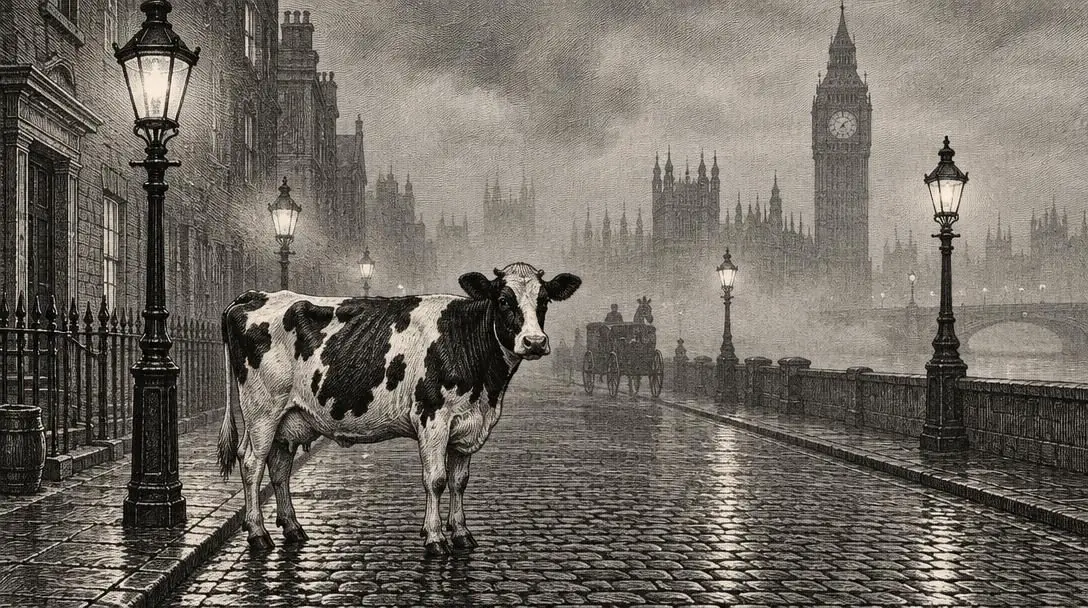
Urban farmers and pet cow owners cannot lead their bovine companions through city streets during business hours. Under the Metropolitan Streets Act 1867, driving or walking cows down the public streets of London between the hours of 10 am and 7 pm is strictly illegal. The mid-Victorian statute sought to eliminate the chaos caused by drovers pushing herds of livestock through dense urban thoroughfares packed with horse-drawn carriages, streetcars, and pedestrians.
The law does provide an administrative mechanism for those who genuinely need to move livestock across urban streets during daylight hours. Movement is permissible only if the individual obtains an official exemption note issued directly by the Commissioner of Police. Without this specific permit, anyone walking a cow down a London street in broad daylight remains in breach of an active Act of Parliament.
The Statutory Mechanics Behind Ancient English Laws
Ancient statutes function through clear legal mechanisms that differentiate them from informal customs or outdated traditions. When parsing through centuries of English legislative history, these operational principles determine how statutes continue to hold legal force:
- Strict Statutory Language: Acts like the Library Offences Act 1898 define prohibited conduct objectively without requiring evidence of malicious intent or premeditated harm. The mere execution of a wager on library grounds constitutes the completed violation.
- Temporal and Geographic Boundaries: Many older enactments limit their reach to precise hours or distinct territories. The Metropolitan Streets Act 1867 focuses exclusively on daytime transit within the administrative boundaries of London streets, leaving nighttime livestock driving and rural herds untouched by that particular clause.
- Executive Discretionary Relief: Archaic public management statutes frequently retain formal safety valves. By allowing the Commissioner of Police to issue written authorization, Victorian lawmakers balanced commercial necessity against public transit disruption.
- Crown Prerogative Rights: Decrees such as the 1322 royal whale statute operate via sovereign prerogative. The title to the valuable anatomical portions of the animal automatically vests in the Crown the instant the creature touches English soil.
How to Navigate and Verify Historical English Statutes
- Verify the statute's legislative standing. Search official parliamentary databases to confirm that subsequent statutory consolidation or a Statute Law (Repeals) Act has not quietly eliminated the provision.
- Identify the geographic jurisdiction. Establish whether the enactment governs the entire realm, applies only to designated quarters like Parliament, or restricts municipal zones like the streets of London.
- Check for administrative exemptions. Read the full text of the statute to determine whether modern officials, such as the Commissioner of Police, possess discretionary authority to grant written permission.
- Respect municipal institution rules. Observe statutory prohibitions inside civic buildings, ensuring that games of chance and wagers are kept off library property.
- Notify authorities of beach salvage. Report any beached whale to maritime authorities to honor the Crown's historic statutory claim to royal fish before making salvage claims.
- Maintain restraint around royal properties. Keep domestic dogs securely leashed near royal residences to avoid violating historical bans on unauthorized breeding with royal household animals.
Common Misconceptions About Antiquated British Legislation
Because unusual statutes generate widespread curiosity, numerous misconceptions surround their legal application. When evaluating historic British laws, avoid these common assumptions:
- Assuming old laws expire automatically: Many people assume that a statute loses force after several centuries of inactivity. Under the British constitution, an Act of Parliament never expires due to age unless an express sunset clause was included in its original draft.
- Confusing municipal bylaws with national statutes: Commentators often assume daytime cow-walking rules are local city council bylaws, when in truth the ban was established directly by an Act of Parliament in the Metropolitan Streets Act 1867.
- Treating library wagers as private matters: Casual visitors often assume private friendly bets are exempt from scrutiny, ignoring the strict terms of the Library Offences Act 1898.
- Believing historical penalties remain unchanged: Observers sometimes believe execution remains on the table for breeding pets with royal stock, overlooking the fact that the death penalty for this offense was repealed in 1965.
- Assuming maritime salvage is finders-keepers: Discoverers of stranded sea life frequently assume total personal ownership, disregarding the 1322 royal decree reserving the head and spermaceti for the monarch.
Frequently asked questions
Can you actually be arrested for wearing armor in Parliament today?
While parliamentary security would simply deny entry to anyone wearing a suit of armor, the legal basis for that refusal remains the 1313 Bearing of Armour Act enacted by King Edward II.
Does the royal whale law apply to all marine mammals?
The 1322 decree specifically designates whales as royal fish, granting the head and spermaceti to the reigning monarch while leaving the remainder of the carcass to the finder.
Can a farmer walk cows down London streets if they have permission?
Yes. The Metropolitan Streets Act 1867 provides a statutory exception allowing daytime cattle movement between 10 am and 7 pm if the owner obtains a written note from the Commissioner of Police.
When was the death penalty removed for breeding pets with royal household animals?
The capital punishment provision attached to unauthorized mating with royal household animals remained on the statute books until Parliament formally repealed it in 1965.
Why hasn't Parliament wiped out all of these ancient laws?
Parliament routinely repeals dead law through Statute Law (Repeals) Acts drafted by the Law Commission, but the vast accumulation of centuries of legislation means obscure, harmless statutes are often prioritized below pressing modern matters.
The bottom line
The persistence of these five unusual laws highlights the enduring nature of the English legal tradition. Rather than discarding centuries of statutory history to build a sterile new code, the legal system of the United Kingdom allows its legislative past to coexist alongside modern governance. From medieval royal prerogatives over beached sea life to Victorian restrictions on reading-room wagers and London livestock, these vintage statutes remain legal reminders of England's colorful, uninterrupted history.