Crossword Puzzle Etiquette: Dos and Don’ts for Solving Puzzles in Public

Crossword puzzles have long stood out as a beloved pastime for people of all generations. For decades, solvers have relied on these intricate grids to challenge their vocabulary, pass quiet hours, and connect with fellow word lovers. While the classic image of the hobby centers on a quiet kitchen table accompanied by a morning cup of coffee, modern enthusiasts routinely take their word games into the wider world, working through clues on commuter trains, in neighborhood cafes, inside public libraries, and across park benches.
Bringing a solitary game into communal areas introduces a distinct social dimension. When you open a newspaper grid or fire up an electronic tablet in a shared venue, your personal recreation merges with the public sphere. These shared environments depend on mutual courtesy and situational awareness. Cultivating sound public puzzle etiquette ensures your pursuit of intellectual play remains a relaxing diversion for you without disrupting the comfort, peace, or concentration of the people around you.
Key takeaways
- Public puzzle solving requires constant situational awareness to balance personal entertainment with community comfort.
- Keep your physical footprint compact by selecting an appropriate format and containing writing tools within your personal space.
- Respect the privacy and boundaries of fellow patrons by never hovering over their grids or offering unsolicited answers.
- Calibrate your volume to the specific venue, matching the silent baseline of a library or the lively hum of a cafe.
- Embrace the lighthearted spirit of the game by maintaining emotional composure and solving with personal integrity.
Essential Dos for Considerate Public Solving
Navigating public spaces while solving requires positive habits that preserve harmony and invite welcome social interaction. When you bring your hobby into communal settings, keeping a few foundational practices in mind ensures that your recreation adds value to your day without causing friction for others.
Mind Your Physical Surroundings
Public venues are inherently communal, which means every patron must remain conscious of the physical space they occupy. When working on a puzzle, regularly check whether your elbows, sprawling broadsheet pages, or bags are encroaching on adjacent seats or blocking walkways. Staying aware of your posture and personal footprint ensures that neighbors can sit comfortably, read, or work without feeling crowded out by your materials.
Share Your Grid Selectively
One of the greatest pleasures of crossword solving is the organic sense of community it can foster. In friendly, relaxed environments like neighborhood coffee shops or casual community centers, inviting a curious onlooker to tackle a difficult piece of wordplay can be a delightful icebreaker. Collaborating over a tricky clue can spark engaging conversations, bridge gaps between strangers, and even lead to lasting friendships when both parties are eager to participate.
Respect Personal Privacy and Boundaries
While spontaneous collaboration can be rewarding, individual privacy must always remain the priority. If someone nearby gives subtle cues that they prefer quiet—such as looking away, wearing headphones, or focusing intently on their own reading—respect that boundary immediately. Never badger another person to help with an anagram or force casual banter onto someone who simply wants to enjoy their public solitude in peace.
Embrace the Fun and Celebrate Small Wins
At its foundation, wordplay is designed to be an enjoyable pastime rather than a high-stakes competition. Avoid taking yourself too seriously when an obscure clue or confusing theme leaves you stumped. Cultivate the ability to laugh off mistakes, accept dead ends with good humor, and celebrate small breakthrough moments with quiet satisfaction as you work your way across the grid.
Core Don'ts: Behaviors to Avoid in Shared Spaces
Just as positive habits foster a warm environment, specific missteps can quickly turn public solving into a nuisance. Eliminating these disruptive behaviors keeps shared spaces pleasant, functional, and relaxing for everyone present.
Avoid Disruptive Noises and Outbursts
Cracking a particularly stubborn Saturday clue can spark a rush of excitement, but you must prevent that enthusiasm from boiling over into disruptive noise. Shouting out answers, groaning theatrically at a bad pun, or slamming a pen down on a tabletop breaks the concentration of everyone around you. Solvers must monitor their vocal volume and keep physical reactions measured, especially in venues where patrons expect quiet focus.
Do Not Monopolize Shared Tables and Seats
Table space is often at a premium in busy coffee shops, transit stations, and campus lounges. Spreading out multiple reference books, broadsheet newspaper sections, digital tablets, and pencil cases across an entire communal table is inconsiderate. Restrict your belongings strictly to the immediate area in front of your chair so that other patrons do not have to hunt for seating or ask you to clear away your clutter.
Refrain from Looking Over Someone's Shoulder
When you spot a fellow enthusiast working on a puzzle in the wild, the temptation to crane your neck and read their grid can be nearly irresistible. However, leaning over someone else's shoulder is an invasive breach of personal space. It makes people feel monitored, self-conscious about their spelling or vocabulary, and physically uncomfortable. Always grant other solvers the same visual privacy you would expect for yourself.
Etiquette functions as a continuous assessment of your environment, your behavior, and the body language of the people sharing the room with you.
Avoid Cheating in Plain Sight
Looking up solutions or consulting an answer key directly defeats the purpose of engaging with a mental challenge. Beyond undermining your own sense of achievement, blatant cheating in a public setting can create awkward situations if fellow hobbyists notice. Maintaining personal integrity throughout the solve keeps the activity rewarding and protects you from embarrassing moments in public.
Understanding the Spectrum of Shared Environments
Etiquette is fundamentally an exercise in situational awareness and empathy. Because shared spaces operate under vastly different social contracts, a behavior that feels natural in one location may be inappropriate in another. A successful public solver evaluates the room and adjusts their footprint accordingly.
In a bustling cafe, the background hum of espresso machines, music, and casual conversation provides a forgiving acoustic buffer. In that setting, quiet collaboration and moderate conversation are entirely welcome. By contrast, a public library reading room or a designated quiet car on a commuter train demands strict restraint. In these places, silence is the baseline expectation, meaning every pencil tap, sigh, or rustling paper is amplified.
| Venue Type | Noise Baseline | Space Availability | Social Openness |
|---|---|---|---|
| Neighborhood Coffee Shop | Moderate ambient hum | Variable and limited | High for friendly interaction |
| Public Library Reading Room | Strictly quiet | Generous table space | Low; independent focus expected |
| Commuter Transit / Train | Moderate mechanical noise | Very tight seating | Low; passengers prefer privacy |
| Public Park or Plaza | Open outdoor sounds | Flexible seating | Moderate to high |
Recognizing where your current setting falls on this spectrum allows you to adapt. A solver who knows how to calibrate their behavior will always be a welcome patron, whether tucked into a library carrel or sitting at a busy cafe counter.
Practical Steps: A Considerate Solver's Routine
To enjoy a rewarding puzzle session while remaining an exemplary community member, follow an intentional routine every time you unpack your grid in public.
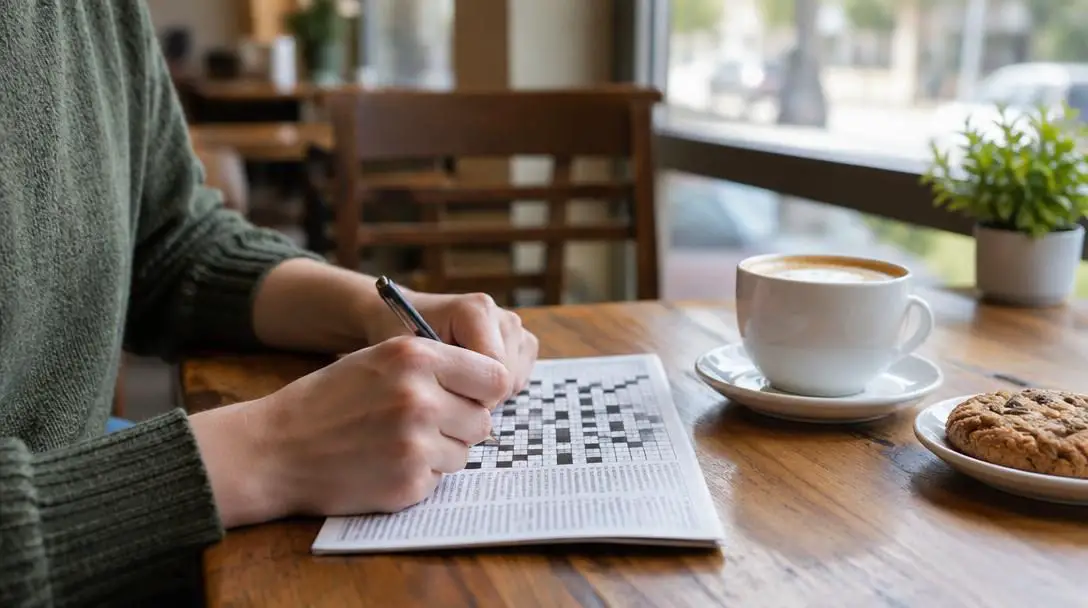
- Select the right solving format for your venue: Choose a compact paper booklet, a neatly folded single newspaper quadrant, or an electronic tablet when visiting crowded venues rather than wrestling with a full broadsheet.
- Choose your seat thoughtfully: Look for a spot that accommodates your workspace without blocking main walkways, service counters, or display racks, keeping your body and gear within your designated chair boundary.
- Unpack only what is necessary: Limit your equipment to your puzzle and a single writing instrument, leaving bulky dictionaries, reference guides, and multiple pencil cases stowed inside your bag.
- Observe the room's energy before engaging: Assess the mood of the patrons around you; if nearby individuals are absorbed in work or wearing headphones, focus entirely on your own grid in silence.
- Maintain quiet emotional control throughout the solve: Counteract the urge to groan, tap, or mutter during tricky clues, and savor your answers with a quiet internal celebration rather than an audible outburst.
- Pack up cleanly before departing: Gather all your materials, inspect the table surface, and collect any eraser shavings into a napkin or your hand to deposit in a trash receptacle so the space stays tidy.
Frequent Mistakes to Catch Early
Even well-meaning solvers can slip into inconsiderate habits when absorbed in a demanding theme. Reviewing common pitfalls helps you stay mindful of your habits before they cause discomfort to others.
- Communal table creep: Allowing your beverage, phone, pens, and loose papers to expand across a shared table until nearby patrons have no room to set down their own items.
- Blurting out unsolicited answers: Calling out a solution to someone else's puzzle without being invited, which robs them of the joy of cracking the wordplay on their own.
- Repetitive tactile fidgeting: Drumming fingers against hard surfaces, repeatedly clicking mechanical pencils, or rolling pens across tables while pondering an obscure clue.
- Visual lingering: Letting your gaze linger on someone else's screen or paper for an extended period, creating an uncomfortable sense of surveillance.
- Compromising solving honesty: Resorting to search engines on your phone out of frustration, which cheapens the mental challenge and can look awkward to fellow enthusiasts nearby.
Adapting Your Format and Finding Community
As your solving habits develop, consider how the physical format you choose influences your public presence. A solver who relies on bulky newspapers might find that switching to a slender spiral-bound puzzle book or a smartphone app dramatically reduces table clutter on daily commutes. Selecting the right tool for the location demonstrates respect for fellow travelers sharing limited space.
If you find that the collaborative, social side of solving is your favorite part of the hobby, look for dedicated spaces where that energy is actively encouraged. Many towns and cities feature local puzzle clubs, library game meetups, and board-game cafes where enthusiasts gather specifically to dissect crosswords, share wordplay tips, and crack complex themes as a team. Joining an organized group provides an outlet for lively discussion without the need to suppress your enthusiasm.
Frequently asked questions
Is it ever acceptable to give someone an answer if they are clearly stuck?
Only provide an answer if the person explicitly asks for help or invites collaboration. Blurting out solutions unprompted robs the solver of the satisfaction of solving the clue independently, even if your intention is helpful.
What is the best way to handle eraser shavings at a coffee shop or library?
Never sweep eraser shavings onto the floor or leave them scattered across the table. Brush them neatly into the palm of your hand or onto a napkin, then discard them in the nearest trash bin before you leave.
How should I react if someone leans over my shoulder to read my crossword?
You can gently angle your paper or tablet away to signal a desire for privacy. If the person persists, a polite, direct statement such as "I prefer to work through this on my own, thank you" will establish a clear boundary without causing a scene.
Does public etiquette differ between paper grids and digital puzzle apps?
The core rules of volume, privacy, and personal space remain identical regardless of medium. However, digital solving typically requires less physical table space, provided you mute all device sounds, keyboard clicks, and celebratory chimes.
Can I bring a crossword dictionary or reference book to a public venue?
You can, provided space allows, but in crowded cafes or transit seats, multiple books create clutter. Sticking to a single grid and writing utensil is the most considerate approach when sharing tight quarters.
The bottom line
Public crossword solving brings a delightful personal ritual into the vibrant fabric of everyday community life. By maintaining situational awareness, keeping your physical belongings tidy, respecting the privacy of those around you, and adjusting your noise level to your venue, you can enjoy every grid while serving as a considerate ambassador for the pastime.