
How to Create a Budget That Works for You

Creating a budget is one of the most transformative steps you can take toward securing long-term financial stability. Rather than serving as a restrictive instrument designed to eliminate enjoyment, a thoughtfully structured budget acts as a clear roadmap that allows you to direct your income with purpose and confidence. Without an intentional spending plan, personal finances can rapidly unravel into disorganization, sparking avoidable stress, missed financial milestones, and persistent vulnerability to sudden emergencies.
The secret to establishing a budget that endures lies in personal customization. Financial plans often collapse when they rely on rigid, unrealistic rules that ignore the friction of everyday life, irregular expenses, and deeply ingrained personal habits. When you tailor your financial architecture around your authentic lifestyle, your actual obligations, and your long-term ambitions, money management transforms from an exhausting monthly chore into an empowering and sustainable habit.
Key takeaways
- A practical budget serves as an intentional financial roadmap rather than a restrictive tool that strips away personal freedom.
- Distinguishing between short-term milestones and long-term financial targets gives every dollar a concrete purpose.
- Tracking both fixed and variable expenses over a full month provides the honest data required to build balanced spending limits.
- Viewing your budget as an evolving, living document ensures your finances adapt smoothly as income, living costs, and life circumstances change.
Clarifying Your Short-Term and Long-Term Goals
Before you begin crunching numbers or entering figures into a ledger, you must define what you expect your money to accomplish. Operating without clear targets makes it remarkably difficult to maintain the focus and discipline needed to stick to a spending plan month after month. Meaningful goals give your cash flow a clear sense of direction, making day-to-day spending trade-offs far easier to navigate.
Financial goals generally fall into two distinct horizons that require different funding approaches:
- Short-term goals: Objectives you plan to accomplish in the immediate future, such as building an emergency fund to handle unexpected repairs or systematically paying down smaller, high-interest balances.
- Long-term goals: Ambitions that require continuous, patient dedication over several years or decades, such as amassing a down payment on a house, eliminating major liabilities, or funding a secure retirement.
When you have absolute clarity regarding your primary financial focus—whether that means shedding high-interest debt or safeguarding your family with an emergency cushion—daily decisions become instinctive. Instead of questioning whether a sudden impulse purchase is technically affordable, you can assess whether it supports the broader vision you have set for your financial life.
Tracking and Categorizing Your Monthly Expenses
To design an effective budget, you need an uncompromising, accurate view of your current financial habits. Spend at least one full month tracking every single transaction, from monthly housing charges and utility bills down to convenience store runs and digital entertainment subscriptions. It is remarkably common to underestimate how quickly small incidental purchases accumulate, and recording every outflow brings essential visibility to your real spending patterns.
Once you gather a full month of accurate transaction history, divide your outflows into two primary structural categories: fixed expenses and variable expenses.
Fixed expenses are predictable costs that remain identical from one billing cycle to the next. Typical examples include rent or mortgage payments, scheduled car payments, and recurring insurance premiums. Because these obligations are non-negotiable in the short term, they establish your essential cost of living—the non-negotiable baseline of capital required every month simply to keep your life operating smoothly.
Variable expenses encompass costs that fluctuate depending on your choices, immediate needs, and schedule. Routine examples include groceries, dining out, recreation, entertainment, and personal travel. Because these transactions are directly influenced by discretionary lifestyle choices, variable expenses represent the area where you possess the greatest flexibility and control to make immediate spending adjustments.
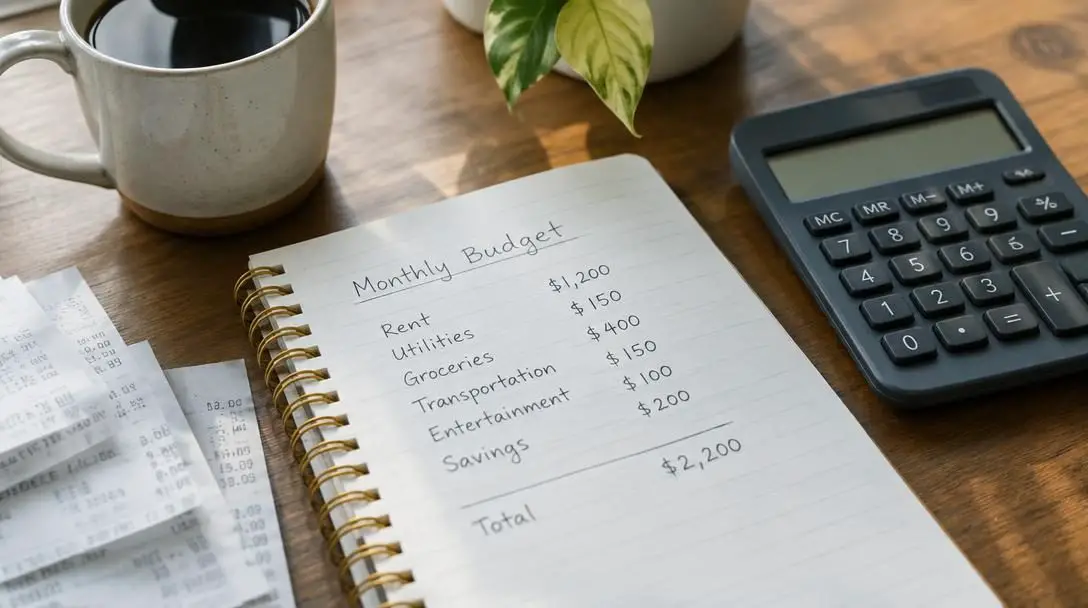
A budget is not a financial prison; it is a personalized roadmap that gives every dollar intentional purpose.
Calculating an Accurate Income Baseline
Before allocating money across your expense buckets, you must determine your exact monthly earnings. A successful spending framework requires a realistic baseline to guarantee that your planned expenses never outstrip the funds you actually receive. Establishing an accurate baseline requires taking full inventory of every incoming revenue source.
Be sure to tally all forms of consistent net income, including:
- Your primary salary or hourly wages after taxes and mandatory deductions.
- Predictable monthly commissions or regular performance bonuses.
- Secondary earnings, including freelance contracts, side business operations, or rental property disbursements.
By relying on a conservative, baseline calculation of your earnings, you safeguard your budget against sudden shortfalls. If your income happens to exceed your baseline during a high-earning month, you can redirect the surplus straight toward your financial milestones without leaving your core living expenses vulnerable.
Step-by-Step Guide to Assembling Your Spending Plan
With an accurate assessment of your income and a comprehensive log of your monthly expenditures ready, you can assemble your working budget. Follow this methodical, step-by-step process to structure and balance your monthly numbers effectively.
- Calculate your total net income: Combine all predictable income streams to arrive at a single net figure that forms your spending ceiling for the month.
- Prioritize your fixed expenses: Allocate funds to satisfy mandatory fixed obligations first, covering rent or mortgage payments, auto loans, and insurance premiums so your housing and mobility remain secure.
- Assign realistic caps for variable expenses: Draw upon your tracked spending history to establish practical allowances for variable outlays, such as groceries, entertainment, travel, and personal incidentals.
- Incorporate dedicated savings and reserves: Treat savings contributions as mandatory line items rather than optional leftovers, designating specific amounts toward an emergency fund and long-term targets.
- Balance the totals: Subtract all planned expenses, debt payments, and savings allocations from your net monthly income to ensure your planned outflows do not exceed your earnings.
If your initial calculations reveal that your projected outlays exceed your incoming cash, review your variable categories immediately. Trimming spending on entertainment, discretionary travel, or dining out allows you to balance the equation without jeopardizing essential fixed expenses or core savings goals.
Selecting the Right Budgeting Tools and Software
Relying on mental calculations or shoeboxes filled with paper receipts can quickly undermine your budgeting efforts. Modern software solutions eliminate tedious manual arithmetic and provide dynamic visibility across all your financial accounts. The right platform can automate transaction tracking, monitor progress toward your milestones, and warn you when you are nearing category limits.
| Tool | Primary Focus | Core Capabilities | Ideal User Profile |
|---|---|---|---|
| Mint | Automated expense tracking and spending alerts | Account syncing, automated categorization, threshold notifications | Beginners seeking automated overviews of everyday spending |
| YNAB | Proactive goal planning and zero-based tracking | Direct transaction allocation, category adjustments, goal progress | Users seeking strict intentionality and aggressive savings |
| Personal Capital | Net worth tracking and wealth management | Multi-account aggregation, investment tracking, liability monitoring | Individuals managing broader asset portfolios alongside cash flow |
Mint

- Category: Automated personal finance app
- Key Features: Account aggregation, spending alerts, category limits
- Primary Benefit: Hands-off spending and bill tracking
Mint is widely known for automated transaction tracking and account aggregation. By linking your financial accounts directly to the platform, transactions are populated and categorized automatically without requiring you to retain paper receipts. The software sends spending alerts when you approach or exceed predetermined limits in categories like groceries or entertainment, making it easier to keep daily lifestyle costs under control.
YNAB

- Category: Proactive budgeting platform
- Key Features: Category prioritization, goal progress tracking, mobile syncing
- Primary Benefit: Encourages deliberate allocation of every dollar
YNAB (You Need A Budget) emphasizes deliberate, forward-looking money management. Rather than simply logging transactions after money has already left your account, the software encourages users to allocate every dollar of income toward specific obligations, savings targets, or debt-paydown priorities. This proactive posture helps users stay focused on their financial goals while remaining flexible enough to shift funds between categories when unexpected expenses arise.

Personal Capital

- Category: Wealth and financial tracking tool
- Key Features: Net worth monitoring, investment analysis, account aggregation
- Primary Benefit: Comprehensive visibility across debts, cash, and assets
Personal Capital offers a broader, holistic perspective on personal finance, pairing day-to-day cash flow monitoring with comprehensive net worth tracking. The platform aggregates bank accounts, mortgage loans, consumer debts, and investment balances into a single, unified interface. This comprehensive visibility allows users to evaluate their daily spending habits directly alongside long-term wealth accumulation and overall financial health.
Five Common Budgeting Traps to Avoid
Even the most dedicated individuals can become discouraged if they fall victim to common, avoidable budgeting errors. Recognizing these widespread pitfalls early helps you design a resilient financial plan that you can comfortably maintain over time.
- Setting unrealistically harsh spending caps: Eliminating all discretionary spending—such as allowing zero dollars for social events, dining out, or entertainment—fosters resentment and quickly leads to budgeting burnout. A sustainable budget always preserves room for modest enjoyment.
- Overlooking irregular and seasonal costs: Failing to plan for non-monthly expenses, such as holiday travel, annual subscriptions, or quarterly bills, can instantly derail an otherwise balanced monthly budget.
- Failing to log minor day-to-day transactions: Disregarding small incidental purchases creates a substantial blind spot over thirty days, producing a wide discrepancy between what you believe you spent and what actually left your account.
- Quitting entirely after an accidental overage: Exceeding your spending target in a single category does not signify that your entire budget has failed. A common error is abandoning the plan altogether instead of simply reducing other variable expenses to offset the difference.
- Relying on rough estimates instead of real data: Guessing your grocery bills, fuel costs, or recurring utilities almost always leads to an inaccurate, fragile budget that cannot withstand actual living expenses.
Treating the Budget as an Evolving Living Document
A successful budget is never set in stone. Because personal circumstances, living costs, and career milestones shift over time, your financial plan must function as a dynamic, living document. Expecting a static spending template to remain effective through changing seasons of life will only generate needless frustration.
Schedule a routine review at the end of each month to compare your planned allocations against your actual bank statements. Use this dedicated session to assess what worked well, identify persistent friction points, and rebalance your category limits for the upcoming month. If your grocery or utility bills are consistently running higher than anticipated, raise those limits while trimming discretionary categories to keep the bottom line balanced.
Conversely, if you discover surplus funds at the end of the month, celebrate the achievement and direct those dollars toward your stated goals. Funneling extra cash into an emergency fund, making an extra payment on outstanding debts, or saving for a down payment transforms extra margin into tangible financial progress.
Advanced Next Steps for Financial Momentum
Once you have established a dependable monthly budgeting routine that runs smoothly, you can begin pursuing advanced strategies to optimize your financial position and build sustained wealth.
- Accelerating debt elimination: With your day-to-day spending stabilized, evaluate your variable expense margins to determine if you can direct additional funds toward rapidly eliminating remaining debt balances.
- Expanding your emergency reserve: As your baseline budget matures, verify whether your existing cash cushion provides adequate protection against major disruptions, expanding your emergency fund to cover three to six months of essential fixed costs.
- Advancing toward major milestones: Revisit your primary long-term targets, such as accumulating a down payment on a home, to evaluate whether increased monthly allocations can shorten your timeline.
- Automating your savings transfers: Establish scheduled automatic transfers that move dedicated savings allocations out of your primary checking account immediately after payday, ensuring your goals are funded before money can be spent elsewhere.
Frequently asked questions
How long should I track my expenses before setting up a budget?
You should track all of your expenses for at least one full month before establishing fixed category limits. Logging every bill, grocery trip, and incidental purchase over thirty days reveals your true spending patterns and prevents you from relying on inaccurate estimates.
What is the difference between fixed and variable expenses?
Fixed expenses are predictable costs that remain the same each month, such as rent, mortgage payments, auto loans, and insurance premiums. Variable expenses fluctuate depending on your choices and needs, including groceries, dining out, entertainment, and travel.
How should I create a budget if my income is irregular?
If you earn irregular income from freelance contracts, shift work, or sales commissions, calculate a conservative baseline using your lowest-earning months. Structuring your necessary living expenses around that baseline ensures you will not overspend during leaner seasons.
What should I do if I overspend in a specific category?
Overspending in one category does not mean your financial plan has failed. Simply review your other variable categories—such as dining out or entertainment—and reduce spending there to compensate for the overage and restore balance to your overall monthly plan.
Are digital budgeting apps better than traditional spreadsheets?
Digital apps such as Mint, YNAB, and Personal Capital provide valuable features like automated account tracking and spending alerts, but spreadsheets and notebooks are equally effective. The best budgeting tool is simply the one you feel comfortable using consistently.
The bottom line
Constructing a functional budget is not about denying yourself everyday pleasures; it is about taking intentional ownership of your financial trajectory. By clarifying your personal goals, confronting your spending realities through diligent tracking, establishing an honest income baseline, and selecting budgeting tools that suit your workflow, you can craft a spending plan that serves your lifestyle.
Remember that financial mastery is a continuous journey rather than a one-time setup. Treat your budget as an adaptable guide, maintain flexibility when unexpected expenses arise, and commit to regular monthly check-ins. With patience and persistence, your budget will become the foundation of your long-term financial security and freedom.