Nurturing Love for Learning: Top 5 Ways to Foster Curiosity in Your Child
While academic success is frequently gauged by formal report cards and standardized test results, genuine long-term achievement rests upon an entirely different foundation: an enduring, self-motivated passion for knowledge. When a child views the world through a lens of wonder and inquiry, acquiring new concepts stops feeling like an exhausting obligation and evolves into a continuous, rewarding adventure.
Children naturally enter the world primed for investigation, intuitively using their senses to test, manipulate, and comprehend their surroundings. When parents intentionally build environments that validate this instinct, children develop the resilience, intellectual stamina, and enthusiasm needed to navigate complex educational environments and life challenges far beyond the classroom.
Key takeaways
- Fostering innate wonder transforms learning from an extrinsic chore into an internally driven lifelong adventure.
- Interactive, multi-sensory experiences and open-ended play cement abstract concepts far more effectively than passive memorization.
- Reframing mistakes as normal iterations in problem-solving builds emotional resilience and analytical independence.
- Parental modeling of curiosity and intellectual humility offers the most persuasive blueprint for a child's learning habits.
The Developmental Foundations of Curiosity and Engagement
Understanding the cognitive mechanisms of childhood curiosity allows families to establish supportive homes without resorting to constant surveillance or rigid drill work. Because young learners are intrinsically motivated to resolve gaps in their understanding, curious children do not rely on rewards or punishments to investigate novel concepts. Instead, their natural cognitive drive compels them to explore causal relationships, test boundaries, and piece together the inner workings of their daily environment.
Retention increases markedly when instruction shifts away from passive listening and toward physical, kinetic involvement. Traditional memorization methods frequently cause fatigue because they treat children as passive repositories. When a child engages multiple sensory pathways—using their hands to assemble materials, testing physical balance, or actively navigating a concept game—abstract ideas materialize into concrete knowledge.
When learning ceases to be a tedious chore, it transforms into an ongoing adventure driven by wonder, questioning, and discovery.
Literacy accelerates this trajectory by granting immediate access to unfamiliar worlds, diverse cultures, and alternate ways of thinking. As children read or listen to stories, they naturally begin questioning why characters behave in certain ways or how natural processes unfold. This habit of questioning establishes a continuous cycle of inquiry, where every discovered fact prompts a fresh line of investigation.
Top Five Approaches to Cultivating Curiosity in Children
Guiding a child toward enthusiastic self-directed education involves deliberate adjustments to everyday routines, home design, and conversational patterns. The following five foundational approaches give children the space, resources, and encouragement to develop their cognitive independence.
1. Encouraging Exploration and Discovery
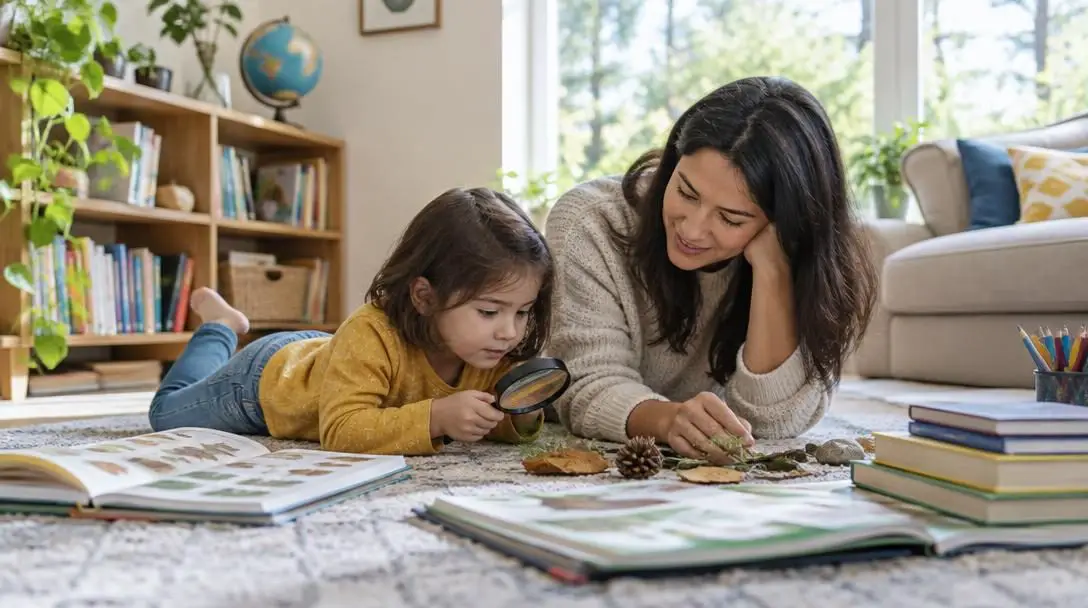
Children comprehend their world best when granted the autonomy to engage directly with physical items without forced outcomes. Parents can stimulate this exploratory instinct by curating designated zones within the household that hold open-ended supplies, such as modular building sets, craft elements, and beginner science tools. Accessible storage allows children to embark on spontaneous experiments the moment an idea surfaces, eliminating procedural friction.
Outside the household, regular excursions into nature preserves, neighborhood parks, and interactive science centers present deep sensory richness. Whether an afternoon involves sifting through garden soil, collecting varied leaf specimens along a wooded trail, or testing gears at an interactive exhibit, children require unstructured periods to follow unexpected observations. If an unexpected question arises, parents can ask, "What do you think will happen if we try this?" to turn a passing observation into an active experiment.

2. Making Learning Fun and Interactive
Education flourishes when it escapes the confines of quiet desks, formal recitations, and passive screen viewing. Introducing physical movement, gamified exercises, and tactile routines transforms conceptual challenges into vibrant, memorable experiences. When physical movement joins mental effort, children form stronger cognitive associations while staying energized and focused throughout the activity.
Digital applications can serve as valuable supplements when balanced with offline play. Platforms such as Khan Academy Kids and Duolingo introduce basic subjects, language structures, and logic patterns through colorful, interactive exercises. To prevent digital fatigue, parents should pair these screen-based tools with tactile home activities, such as measuring ingredients during kitchen science experiments, engaging in active outdoor math games, and exploring textured sensory bins.
3. Cultivating a Love for Reading
Reading remains one of the most versatile tools for intellectual growth, exposing young minds to realities far beyond their immediate neighborhoods. Regular reading habits introduce complex sentence structures, widen vocabularies, and ignite deep questions regarding historical events, geography, and human motivations. Over time, consistent reading nurtures empathetic thinking by prompting children to see the world from perspectives unlike their own.
Establishing an enduring reading habit involves carving out dedicated time each day for both shared read-aloud sessions and peaceful independent exploration. Families should supply a wide variety of reading materials matched to the child's evolving tastes, including vibrant picture volumes, introductory nature guides, graphic novels, and factual non-fiction books. Designing a comfortable reading space stocked with soft cushions and devoid of digital distractions helps children link reading with comfort, autonomy, and relaxed focus.
4. Teaching Problem-Solving Skills
Guiding children to develop analytical problem-solving skills alters their self-perception, turning them from passive consumers of instruction into capable, determined investigators. When encountering intellectual hurdles—such as constructing a stable block tower, completing an elaborate jigsaw puzzle, or understanding an arithmetic puzzle—children discover how to parse big obstacles into bite-sized components and test multiple strategies.
Parents can reinforce this resilience by resisting the impulse to solve dilemmas on the child's behalf. When a child feels stuck or frustrated, sit nearby, talk through the observable constraints, and brainstorm potential fixes together. Emphasizing that troubleshooting is an iterative, step-by-step process teaches children that mistakes are not shameful dead ends, but rather informative guideposts directing their next move.
5. Modeling a Genuine Love for Learning
Because children closely observe and mimic adult behavior, parental modeling serves as one of the most potent mechanisms for instilling curiosity. When adults demonstrate personal enthusiasm for acquiring skills, exploring hobbies, and reading challenging literature, children internalize the idea that learning is a fulfilling lifelong endeavor rather than an arbitrary chore required only in childhood.

Parents can exhibit this growth mindset by allowing children to witness them reading, practicing an instrument, learning a new language, or troubleshooting home maintenance tasks. Speaking openly about the hurdles encountered during adult study normalizes the friction of mastery. Furthermore, when an unfamiliar question leaves you stumped, replying with "I don't know, let's look it up together" models intellectual humility and demonstrates practical research skills in real time.
At a Glance: Curiosity-Building Approaches
The following table outlines the five core strategies, highlighting how the physical environment, parental responses, and available resources combine to nurture self-directed learning.
| Approach | Primary Objective | Key Environment | Recommended Materials |
|---|---|---|---|
| Exploration & Discovery | Encourage self-directed testing and observation | Home activity corners, nature reserves, science museums | Building sets, art media, magnifying lenses, science kits |
| Interactive Learning | Anchor abstract theory in physical and digital play | Living rooms, kitchen counters, outdoor spaces | Khan Academy Kids, Duolingo, kitchen science items |
| Love for Reading | Broaden perspectives and inspire deep questions | Quiet, comfortable reading nooks | Illustrated books, nature field guides, non-fiction volumes |
| Problem-Solving Skills | Build analytical thinking and emotional resilience | Work tables, collaborative play areas | Jigsaw puzzles, logic games, building challenges |
| Parental Modeling | Demonstrate intellectual humility and lifelong study | Shared household spaces, daily family interactions | Personal books, hobby equipment, shared research tools |
How to Build an Inquiry-Driven Daily Routine
Translating broad educational concepts into practical home routines does not demand an exhausting overhaul of your family's schedule. Parents can establish an inquiry-friendly household through structured, manageable steps.
- Designate accessible discovery zones: Place art materials, building sets, and investigative tools on low shelves so your child can start creative projects without asking for adult assistance.
- Schedule regular unstructured outings: Dedicate weekly time windows for walks through local parks, nature centers, or museums without imposing a rigid schedule or mandatory route.
- Incorporate reflective questioning into daily talk: When your child asks why a natural phenomenon happens, respond with open-ended prompts like "What do you notice about it?" before offering facts.
- Balance digital platforms with tactile experiments: Follow up interactive sessions on apps like Duolingo or Khan Academy Kids with hands-on cooking, sensory sorting, or active outdoor games.
- Anchor a shared daily reading period: Reserve twenty to thirty minutes each day to read together in a cozy space free from mobile phones and television noise.
- Brainstorm through academic hurdles collaboratively: When your child struggles with homework or a spatial puzzle, outline the parameters together instead of stepping in to complete it.
- Display your own learning pursuits: Read books openly, share your efforts to learn new skills, and invite your child to research answers beside you when you meet an unknown topic.
Common Pitfalls That Stifle Childhood Curiosity
Even conscientious caregivers can fall into habits that inadvertently suppress a child's natural drive to learn. Staying mindful of these missteps helps preserve a child's intellectual enthusiasm over the long haul.
- Supplying immediate answers: Resolving every question instantly deprives children of the chance to hypothesize, test theories, and experience the thrill of personal deduction.
- Over-scheduling exploratory play: Imposing strict agendas, checklists, and expected outcomes onto nature walks or craft afternoons converts spontaneous fun into a stressful chore.
- Treating mistakes as failures: Expressing irritation when answers are wrong creates anxiety around risk-taking, encouraging children to guess safely rather than think boldly.
- Forcing irrelevant subject matter: Mandating extended study of subjects outside a child's current interests without connecting those concepts to their everyday world induces boredom.
- Prioritizing speed over deep processing: Demanding rapid solutions values superficial memorization over the slower, more valuable work of conceptual understanding.
- Disconnecting adult habits from family expectations: Expecting children to read voraciously while adults spend all personal leisure scrolling on devices sends an inconsistent message.
Frequently asked questions
How can I encourage my child to read if they show little interest in books?
Begin by aligning reading selections directly with their established interests, whether that means graphic novels, field guides, or books about mechanics. Dedicate a quiet, screen-free space for shared reading sessions where you read aloud together without grading their performance or forcing them to read for arbitrary time quotas.
What should I do when my child asks a complex question I cannot answer?
Welcome the moment as a learning opportunity by saying, "I don't know, let's look it up together." Demonstrating how to evaluate reference books or perform a web search shows your child that not knowing an answer is natural and teaches them the research methods needed to find reliable information.
Can digital educational apps fully replace hands-on learning?
No. While platforms like Khan Academy Kids and Duolingo offer valuable interactive practice, digital tools lack physical feedback. They should be balanced with tactile experiments, physical movement, sensory bins, and outdoor exploration to ensure healthy cognitive and physical development.
How can I help my child stay resilient when they get frustrated by a difficult problem?
Acknowledge their frustration and frame the mistake as useful data rather than a personal failure. Sit beside them to break the complex obstacle into smaller, manageable parts, and encourage them to brainstorm alternative approaches collaboratively rather than taking over the project yourself.
At what age should parents begin nurturing curiosity in children?
Curiosity begins in infancy, when babies explore their surroundings through touch, sound, and sight. Parents can foster this natural inclination from the earliest stages by offering safe objects to touch, talking through daily observations, and providing unhurried time for open-ended play.
The Bottom Line
Fostering an authentic love for learning is an ongoing family practice that evolves alongside your child's developing interests and developmental stages. As children grow, their fascinations will shift naturally from building blocks and simple sensory textures to elaborate scientific questions, foreign languages, or fine arts. By observing these changes, parents can routinely refresh home supplies and tailor upcoming family outings to match emerging curiosities.
Ultimately, the objective is to nurture a household atmosphere where inquisitiveness is embraced and celebrated as a shared value. Commending a thoughtful question just as warmly as an accurate answer teaches children that the process of discovery matters far more than rote performance. By exploring new concepts together and reframing obstacles as necessary steps in learning, you provide your child with the intellectual tools and curiosity needed to thrive throughout life.