Simple Tricks for Rounding Numbers to the Nearest Cent

In modern commerce, bookkeeping, and personal finance, everyday calculations rarely produce neat, two-decimal figures. Whether you are splitting a restaurant tab among friends, calculating sales tax on a retail purchase, tabulating interest on a savings balance, or managing business invoices, mathematical operations frequently result in three, four, or more digits after the decimal point. Because physical cash and standard electronic point-of-sale systems operate strictly in whole units and hundredths of a unit, these long decimal tails must be converted into practical, spendable currency.
Rounding numbers to the nearest cent transforms unwieldy figures into clean, actionable prices. Mastering a few dependable mental arithmetic shortcuts ensures that your totals stay aligned, your accounting registers balance smoothly, and you never feel uncertain when verifying receipts or calculating payments.
Key takeaways
- Currency values rely on two decimal places, meaning amounts must be rounded to the nearest hundredth of a unit.
- The digit immediately following the cent position determines whether the cent stays the same or rounds up by one.
- If the evaluating digit is 5 or higher, round up to the next cent; if it is 4 or lower, round down to the current cent.
- Always keep two decimal positions in final currency figures, including trailing zeros like 7.90 or 6.50, to preserve clarity.
- Multiplying by 100 offers a reliable way to round decimals as whole numbers before returning them to standard currency format.
Understanding Currency Place Value and Rounding
To round money accurately, you must first become comfortable with place values located to the right of the decimal point. In standard financial formatting, the decimal point separates whole units of currency from fractional pieces. The first digit to the right of the decimal point signifies tenths of a dollar, which corresponds to dimes. The second digit marks hundredths of a dollar, which represents individual cents. This second decimal slot is universally recognized in retail and accounting as the cent position.
When you need to adjust an extended figure to the nearest cent, your attention shifts to the place value immediately to the right of that cent. In rounding rules, this target evaluation digit determines the fate of your final price. If this evaluating digit is 5 or greater, you round upward to the next cent. If this digit is less than 5, you round downward, keeping the current cent as it is. Once you make this determination, any remaining fractional figures further along the decimal chain are dropped.
Consider the figure 12.573 as an example. When inspecting this value to round it to the nearest cent, you evaluate the digit sitting immediately to the right of the cent. That digit is 3. Because 3 is less than 5, the rule directs you to round down. The cent figure remains 57, and the trailing 3 is discarded, leaving a clean result of 12.57.
Core Tricks for Rounding Numbers to the Nearest Cent
Different individuals process arithmetic through different mental frameworks. While some prefer standard memorized rules, others find it easier to group numbers into binary categories or convert decimal values into whole units. Below are four reliable methods you can use to process cents quickly and accurately.
The Five or Greater Rule
The five or greater rule serves as the baseline technique taught in fundamental arithmetic and forms the bedrock of retail calculation. Under this rule, you identify the evaluating digit immediately to the right of the cent position. If that value is 5, 6, 7, 8, or 9, you add 1 to the cent digit located directly to its left, and then drop every digit that follows.
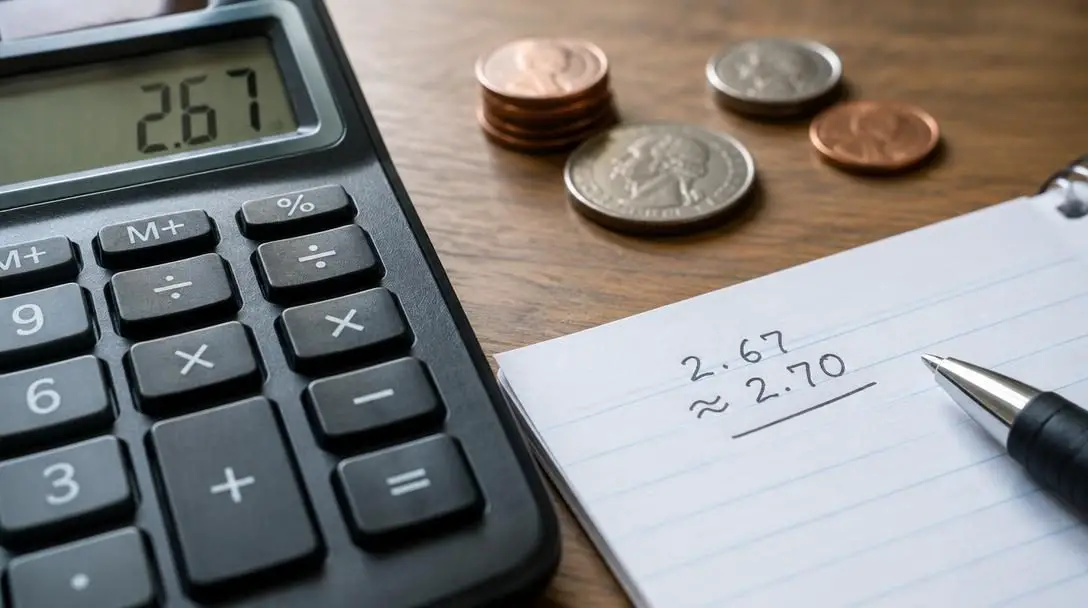
This rule guarantees that any value sitting halfway or higher across the span of a single cent receives credit toward the next whole penny. For instance, examine the figure 15.786. Looking at the evaluating position, the digit is 8. Because 8 is 5 or greater, you add 1 to the cent digit immediately to the left, shifting the 8 in the cents place to a 9. Once the trailing numbers are eliminated, the final rounded amount is 15.79.
The Nine Rule
The nine rule focuses specifically on instances where the evaluating digit immediately following the cent is a 9. While the underlying logic matches the principle of rounding upward, figures containing 9s frequently cause confusion because of the rollover effect they trigger across adjacent columns.
When applying the nine rule, you add 1 to the cent digit directly to the left and drop all trailing numbers. Because 9 represents the highest single-digit value, rounding up frequently rolls the adjacent number into the next register. For instance, in the number 7.899, the evaluating digit is 9. Rounding up requires you to add 1 to the cent position, which is also a 9. Adding 1 turns 89 cents into 90 cents, producing a rounded result of 7.90. In financial notation, retaining the zero at the end is mandatory to show that the cent position is explicitly zero rather than an omitted fraction.
Retaining trailing zeros in currency calculations ensures that fifty cents is never mistaken for five cents.
The Round Up or Down Rule
If managing specific criteria feels cumbersome, the round up or down rule provides an easy, two-way decision framework. Rather than memorizing distinct rules for individual digits, you sort every evaluating digit into one of two straightforward groups: lower values or higher values.
Digits evaluated as 0, 1, 2, 3, or 4 fall into the low bucket, instructing you to hold the cent value steady and drop the tail. Digits evaluated as 5, 6, 7, 8, or 9 fall into the high bucket, instructing you to raise the cent value by 1. For example, consider the figure 6.504. The evaluating digit is 4, which sits in the low bucket. Consequently, you round down to the current cent, leaving 6.50. Keeping the final zero preserves the two-decimal format required for cash registers and financial balances.
The Multiplication Rule
The multiplication rule is an ideal method for people who prefer working with whole numbers rather than tracking decimal points mentally. This approach temporarily shifts the entire calculation out of fractional currency and into raw cent counts.

To use this trick, take your original figure and multiply it by 100, which moves the decimal point two places to the right. Next, round that resulting figure to the nearest whole integer using standard whole-number arithmetic. Finally, divide the rounded whole number by 100 to return it to standard dollars and cents. For instance, take the value 9.162. Multiplying 9.162 by 100 yields 916.2. Rounding 916.2 to the nearest whole number gives 916. Dividing 916 by 100 returns the final figure of 9.16.
Comparing Rounding Tricks at a Glance
Each of the four rounding tricks achieves the same practical outcome. Choosing the right one depends on whether you prefer standard decimal observation, rollover management, simple high-low categorisation, or whole-integer arithmetic.
| Rounding Trick | Primary Logic | Best Used When | Example Input | Rounded Output |
|---|---|---|---|---|
| Five or Greater Rule | Add 1 to cent if target digit is 5 or above | Standard baseline arithmetic | 15.786 | 15.79 |
| Nine Rule | Add 1 to cent and manage column rollover | Target evaluating digit is 9 | 7.899 | 7.90 |
| Round Up or Down Rule | Binary split: 0 to 4 stays; 5 to 9 increments | Quick mental checks without math jargon | 6.504 | 6.50 |
| Multiplication Rule | Multiply by 100, round integer, divide by 100 | Avoiding mental decimal tracking | 9.162 | 9.16 |
Step-by-Step Guide to Rounding Currency
To ensure consistent accuracy when processing receipts, invoices, or ledger balances, follow an orderly series of steps. Applying this routine prevents calculation errors and ensures uniform formatting every time.
- Finalize all preceding mathematical calculations, such as percentage discounts, tax additions, or division operations, before beginning the rounding process.
- Locate the decimal point and identify the cent digit, which is the second number to the right of the point.
- Inspect the evaluating digit situated immediately to the right of the cent position.
- Check whether the evaluating digit is less than 5, or 5 and higher.
- If the evaluating digit is less than 5, leave the cent digit unchanged and discard all trailing digits to its right.
- If the evaluating digit is 5 or greater, increment the cent digit by 1 and discard all trailing digits to its right.
- Write out the finished sum with exactly two digits after the decimal point, preserving any trailing zeros.
Common Mistakes to Avoid When Handling Cents
Even though rounding rules are direct, routine calculations often suffer from minor oversights. Being mindful of these frequent missteps will keep your books clean and error-free:
- Rounding prematurely: Applying rounding adjustments to sub-totals before completing a full formula introduces cumulative drift into your final figures. Always carry extended decimal places through your formula and round only the final answer.
- Inspecting digits too far down the line: Looking at the fourth or fifth decimal place instead of focusing strictly on the digit immediately beside the cent can lead to improper double-rounding.
- Dropping terminal zeros: In general mathematics, an ending zero after a decimal point is often dropped, turning 4.50 into 4.5. In financial records, writing 4.5 makes it ambiguous whether the total is 5 cents or 50 cents. Always write both decimal places.
- Failing to carry rollover values: When adding 1 to an existing 9 in the cents column, remember that it rolls over to 0 and adds 1 to the tenths column to its left.
- Misinterpreting round down: Rounding down does not mean subtracting one cent from the existing value. It simply means retaining the current cent value while eliminating the fractional remainder behind it.
Frequently asked questions
Why must currency always show two decimal places?
Currency systems that divide primary units into hundredths require two decimal places to distinguish tenths from hundredths clearly. Writing 12.5 could easily be misinterpreted as 12 dollars and 5 cents rather than 12 dollars and 50 cents. Displaying two digits guarantees unambiguous pricing.
What should I do if the evaluating digit is exactly 5?
Under the standard five or greater rule, an evaluating digit of 5 rounds upward to the next cent. For example, a calculated balance of 8.245 rounds up to 8.25.
Does rounding down mean subtracting a penny?
No. Rounding down means keeping the existing cent digit exactly as it is while removing the fractional digits to its right. For instance, rounding down 4.321 results in 4.32, not 4.31.
How does the multiplication rule work for mental math?
The multiplication rule converts a decimal problem into a whole-number problem. Multiplying 3.456 by 100 produces 345.6 cents. You round 345.6 to the nearest whole cent, which is 346, and then divide by 100 to arrive at 3.46.
When should rounding be performed during complex financial calculations?
Rounding should only be carried out at the very end of your calculation. Keeping all decimal figures intact during intermediate calculations prevents rounding errors from compounding into significant discrepancies.
The bottom line
Rounding numbers to the nearest cent is a practical financial skill that simplifies everyday monetary transactions. By mastering the core place values of currency and selecting a method that suits your thinking—whether it is the five or greater rule, the nine rule, the binary round up or down rule, or the multiplication rule—you can process retail receipts, split bills, and balance budgets with absolute confidence.
With regular use, these rounding rules become an effortless mental habit. Whether you rely on mental math at the grocery store checkout or review figures inside automated spreadsheet applications, maintaining systematic rounding habits keeps your financial records accurate, transparent, and easy to interpret.