
The History of 2048
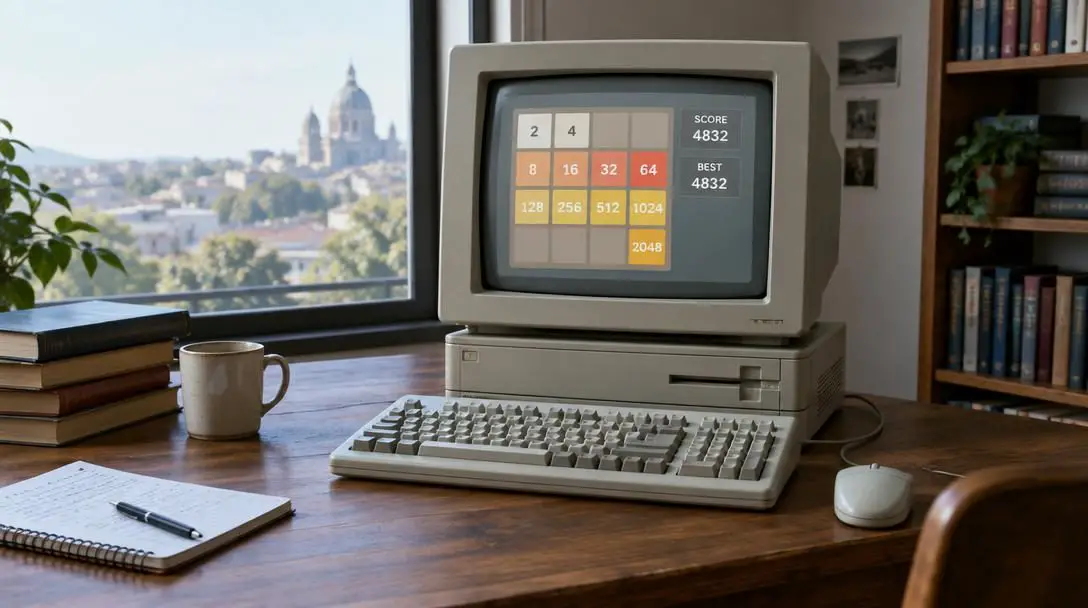
In March 2014, an unassuming web application altered the landscape of mobile and desktop puzzle games almost overnight. Created over a single weekend by an Italian developer, 2048 captured global attention with an intuitive mechanic: slide numbered squares across a grid to merge matching pairs and double their value until reaching the 2048 tile.
While the vast majority of mobile and browser games vanish into obscurity shortly after their debut, 2048 evolved into a permanent digital fixture. Despite its elementary arithmetic rules, the game presents a deceptively rigorous strategic challenge that drew in millions of players, spawned thousands of variations, and cemented its place in modern digital puzzle history.
Key takeaways
- Gabriele Cirulli developed 2048 over a single weekend in March 2014 using basic front-end web technologies.
- The game was directly inspired by 1024, but featured faster pacing and open-source availability on GitHub Pages.
- Out of the first 100 million recorded attempts worldwide, roughly one percent of players reached the winning 2048 tile.
- Resisting aggressive commercialization, Cirulli opted against in-app ads and subsequently built a career in productivity software.
The Weekend Project That Became an Overnight Phenomenon
The origins of 2048 lie in casual experimentation rather than a calculated corporate release. In early 2014, Gabriele Cirulli was an independent Italian developer navigating an unconventional early career. Having finished high school the previous year, Cirulli chose not to enter university immediately. Instead, he worked as a digital freelancer while spending his spare hours exploring interface programming and sharpening his technical craft.
Seeking an engaging way to pass a quiet weekend, Cirulli sat down to code a lightweight puzzle game. Using only standard client-side languages—JavaScript and CSS—he constructed the interface, animation rules, and tile-merging mechanics from scratch. By Monday morning, the playable project was complete. Cirulli uploaded the application to GitHub Pages as an open-source side project, entirely unaware that his modest experiment would soon attract tens of thousands of simultaneous users.
Within days of hitting the web, the game spread rapidly across forums, social platforms, and programming communities. Within two months, third-party developers ported versions to both iOS and Android app storefronts. Millions of active players quickly found themselves sliding blocks on their phones and browsers, attempting to crack an elegant mathematical maze that felt effortless to start but nearly impossible to complete.
Out of the first 100 million games recorded worldwide, only about one percent of players managed to build the elusive 2048 tile.
The runaway popularity of 2048 shared the spotlight with another cultural sensation of early 2014: Flappy Bird. Both titles dominated casual gaming discussions worldwide as players repeatedly challenged their high scores. However, their long-term trajectories diverged sharply. While the creator of Flappy Bird ultimately pulled his game from app stores to escape overwhelming public scrutiny, 2048 remained completely accessible to anyone with a web browser or smartphone, establishing itself as an enduring classic.
Inspiration, Ethics, and the Decision to Open Source
The core concept of 2048 was not conceived in a total vacuum. Cirulli drew direct structural inspiration from an existing puzzle title named 1024. While Cirulli enjoyed the mathematical puzzle at the heart of 1024, he found its gameplay rhythm somewhat sluggish. He set out to make an alternative that accelerated tile movement, delivered snappier tactile animations, and set an even more ambitious target ceiling.

Because his design adapted mechanics pioneered by other creators, Cirulli faced an ethical choice when his version overshadowed its predecessors. The developers behind 1024 expressed frustration that a weekend iteration had eclipsed their original product in the global eye. Acknowledging that his software stood directly on the shoulders of existing work, Cirulli decided against privatizing or patenting the project.
Rather than monetizing the influx of millions of visitors with intrusive banners or full-screen advertisements, Cirulli placed a small, discreet voluntary donation button on the site. Across the peak of the viral storm, this link yielded only a few hundred dollars. Cirulli viewed the viral boom not as a cash opportunity, but as a technical calling card that confirmed the value of clean, unencumbered web engineering.
Comparing Early 2014 Casual Gaming Sensations
The casual gaming sphere in 2014 witnessed rapid shifts in audience attention, open-source adoption, and mobile monetization. The following comparison highlights how 2048 stood alongside its direct inspiration and its biggest viral contemporary.
| Game Title | Initial Release | Primary Platform | Monetization Strategy | Long-Term Availability |
|---|---|---|---|---|
| 1024 | Early 2014 | Mobile and Web | Standard Storefront Model | Overshadowed by derivative works |
| Flappy Bird | May 2013 / Viral in 2014 | iOS and Android | Mobile Ad Impressions | Voluntarily removed by its creator |
| 2048 | March 2014 | Browser (GitHub Pages) | Modest Voluntary Donations | Fully open-source and continuously active |
Software Projects in Gabriele Cirulli’s Career
The explosive visibility of 2048 brought Cirulli numerous employment opportunities from technology firms across Italy and around the globe. Despite his sudden status as a celebrated indie game maker, Cirulli made it clear that he had no ambition to remain inside the game development sector. Instead, he channeled his expertise into product architecture, user interface design, and consumer utility software.
1Password

- Role: Developer and product designer
- Category: Digital security application
- Focus: Secure credential management
Cirulli joined the team behind 1Password, an industry-leading security suite designed to hold login information, financial records, and private documents inside an encrypted vault. His work contributed to crafting responsive, secure user interfaces that reduce everyday friction while safeguarding critical personal information.
Plantie

- Developer: Gabriele Cirulli
- Category: Plant care management
- Target Audience: Houseplant enthusiasts
Venturing into independent lifestyle software, Cirulli designed Plantie, a focused mobile utility created to help users care for indoor plants. The application assists plant owners by providing structured tracking routines, watering schedules, and health logging to prevent neglect.
Budge

- Developer: Gabriele Cirulli
- Category: Personal budgeting and finance
- Core Capability: Continuous real-time data analysis
Cirulli also engineered Budge, a financial utility that streamlines personal money management. By delivering continuous, real-time data analysis on user spending and balances, Budge avoids the dense, opaque menus typical of enterprise accounting tools in favor of an intuitive, direct interface.
Anatomy of the Mechanics: How the Board Operates
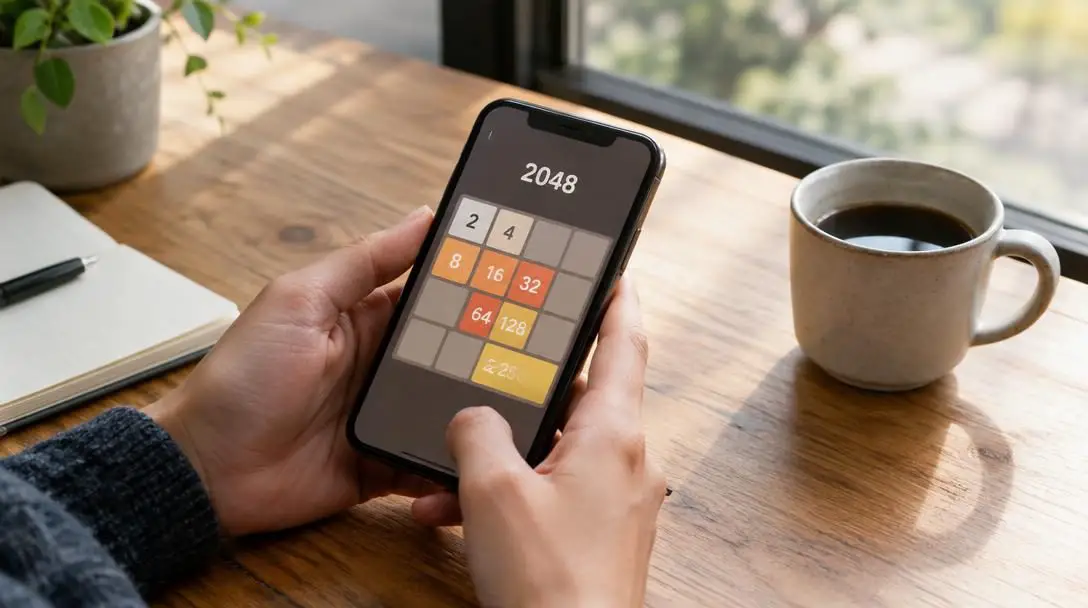
Beneath the clean aesthetic of 2048 lies a deterministic set of mathematical interactions. The entire system is governed by a small collection of interlocking rules that turn a small grid into a complex spatial logic puzzle.
- The Four-by-Four Grid: The arena contains sixteen fixed slots. Because spatial real estate is scarce, every open square represents vital maneuvering room for future combinations.
- Simultaneous Tile Collisions: When an arrow key or directional swipe is executed, every movable block on the board slides in that direction until stopped by an edge or another tile. If two identical numbers make contact during the slide, they fuse into a single tile displaying their sum.
- Turn-Based Spawning: Every legal slide triggers the creation of a new tile in an unoccupied slot chosen at random. The spawned tile is almost always a 2, with an occasional 4 appearing to challenge board balance.
- Victory and Terminal States: The player officially wins the baseline game the moment two 1024 tiles combine into a single 2048 square. A game-over occurs only when all sixteen spaces are filled and no adjacent tiles share identical values, freezing the board completely.
Step-by-Step Strategic Framework for Success
Because only one out of every hundred attempts reached the 2048 marker during the game's initial launch period, random swiping will almost inevitably clog the board. To navigate crowded grids, players must employ a disciplined, repeatable strategy.
- Establish a Master Anchor Corner: Select one fixed corner—typically the bottom-left or bottom-right—and keep your single highest-value tile locked there throughout the entire run.
- Construct a Decreasing Monotonic Chain: Arrange your secondary numbers along the perimeter wall leading away from your anchor corner, ordering them strictly from highest to lowest value.
- Restrict Motion to Three Directions: Limit your movements to three primary keys (for example: Down, Left, and Right). Completely eliminating the fourth direction prevents your primary anchor tile from drifting into the center of the board.
- Build Clean Merge Ladders: Group and merge smaller tiles (such as 2, 4, and 8) on the flexible side of the board before sliding them toward your anchor wall, ensuring smooth sequential updates.
- Inspect Unoccupied Spaces Before Each Slide: Pause before executing each move to evaluate where the next random tile might spawn, verifying that the chosen path does not isolate a 2 behind your largest numbers.
Common Pitfalls and Structural Board Lockouts
Even seasoned players run into sudden deadlocks when spatial control breaks down. A single careless swipe on a crowded board can trigger an irreversible failure cascade.
- Directional Indiscretion: Swiping toward the prohibited fourth boundary pulls your highest tile away from its corner, instantly inviting a new low-value tile to spawn in its vacated spot and cutting off your main merge chain.
- Incomplete Anchor Rows: Attempting to slide your supporting tiles laterally while your primary wall has an empty cell allows a newly spawned block to slide directly into the anchor position.
- Premature Matching: Combining numbers simply because they are touching often scatters mismatched tiles across the playing field, making future adjacent alignments impossible.
- Disparate Island Traps: Leaving solitary low-value blocks stranded between high-value blocks divides the board into separate, unworkable zones that quickly seize up as new tiles appear.
Beyond 2048: Endless Play and Algorithmic Analysis
Reaching the 2048 tile marks the end of the standard game, but the software allows players to keep sliding indefinitely as long as valid moves remain. Dedicated enthusiasts routinely push the mathematical boundary to build 4096, 8192, and even higher values, testing the absolute physical limits of the sixteen-cell board.
The deterministic physics of the game also turned it into a popular playground for computer science experiments. Software engineers and academic researchers have built algorithmic solvers using expectimax tree searches, depth-first evaluations, and machine learning heuristics. These automated systems confirm what human masters discovered: success relies on preserving monotonicity, managing open space, and keeping high values locked along the edges.
Frequently asked questions
Who originally created 2048 and when?
The game was created by Italian developer Gabriele Cirulli in March 2014, who built the entire project over a single weekend when he was nineteen years old.
Is 2048 an original concept or based on an earlier game?
2048 was directly inspired by an existing game named 1024. Cirulli enjoyed 1024 but felt its pacing was sluggish, prompting him to design a snappier version with an expanded final objective.
How much money did the creator make from 2048?
Gabriele Cirulli declined to place ads on the game or monetize user traffic, releasing it as open-source software on GitHub Pages. He collected only a few hundred dollars through an optional voluntary donation link.
What percentage of players actually beat the game?
According to data gathered during the initial peak of the game's release, only about one percent of players reached the winning 2048 tile out of the first 100 million games played.
Can you keep playing after reaching the 2048 tile?
Yes. Although reaching 2048 triggers the official victory screen, the game permits players to continue merging tiles toward 4096, 8192, and beyond until the board runs out of legal moves.
The bottom line
The enduring success of 2048 demonstrates that captivating digital experiences do not require complex graphics, massive production budgets, or predatory monetization schemes. By combining elementary math with responsive controls and an open-source ethos, Gabriele Cirulli created an iconic digital puzzle that continues to challenge minds more than a decade after its spontaneous creation.