The Magic of Istanbul – 5 Unique Attractions in This Amazing City
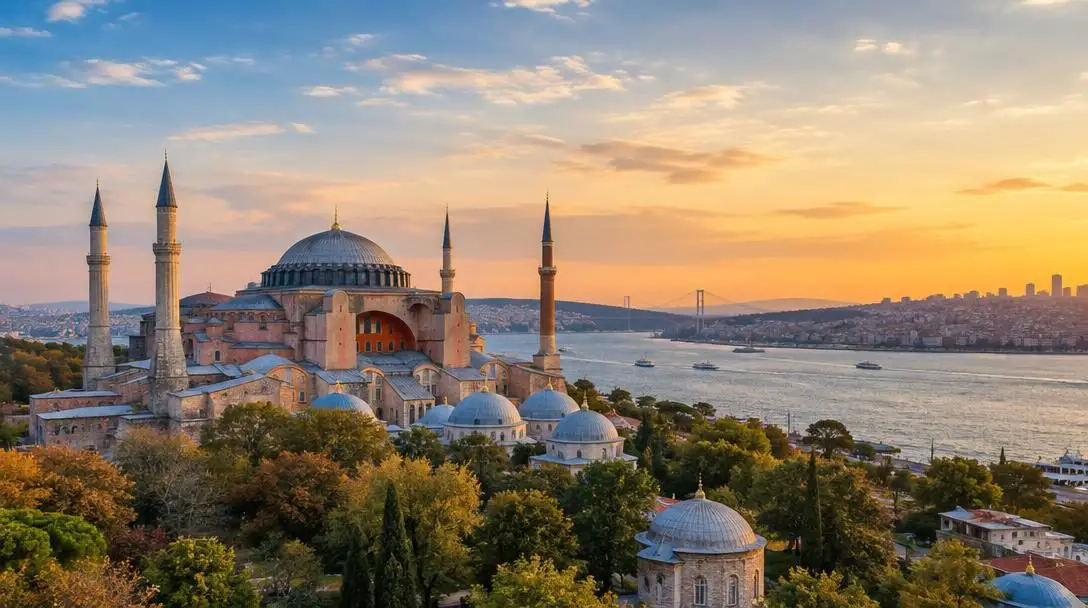
Known historically as the City of the World’s Desire, Istanbul bridges two continents and holds thousands of years of imperial heritage within its lively neighborhoods. First-time visitors naturally gravitate toward globally celebrated landmarks such as the Blue Mosque, Hagia Sophia, and the bustling Spice Market. These grand destinations showcase the profound shifts between empires, world religions, and artistic traditions that transformed Constantinople into modern Istanbul.
Yet beyond the well-worn paths lies a deeper layer of urban wonder waiting to be explored. Istanbul is filled with subtle architectural experiments, imperial resting places, hidden infrastructure, and unexpected cultural crossroads. By looking past the standard tourist circuit, travelers can encounter five unique attractions that reveal the rich, layered texture of this historic metropolis.
Key takeaways
- Istanbul offers subterranean engineering marvels, delicate micro-architecture, and imperial monuments tucked just steps away from the busiest plazas.
- Centuries of international influence brought global actors like the Norse Varangian Guard directly into the city's most sacred halls.
- Ottoman architectural reverence honored departed sultans with freestanding palatial mausoleums and protected urban wildlife through ornate bird palaces.
- Planning an itinerary by geographic cluster and paying attention to architectural elevations ensures travelers do not miss these subtle treasures.
The layered foundations of imperial Istanbul
To fully appreciate Istanbul's lesser-known sites, it helps to understand how the city evolved under successive world empires. Before serving as the capital of the Ottoman Empire, the settlement flourished as Constantinople, the fortified hub of the Byzantine Empire. During this Christian era, sustained urban expansion and the constant threat of siege warfare forced Byzantine rulers to undertake ambitious engineering projects. Emperor Justinian I played a monumental role in the sixth century, commissioning massive civic infrastructure designed to guarantee essential resources while projecting imperial prestige.
Constantinople also operated as an energetic geopolitical crossroads, attracting merchants, envoys, and mercenaries from every corner of the medieval world. Among these visitors were Norsemen who traveled across Europe to serve as the Varangian Guard, an elite imperial bodyguard unit. These fierce warriors lived inside the capital, watched over royal ceremonies, and spent hours stationed in the grandest halls of state, leaving behind traces of their presence that survive to this day.
When the Ottomans conquered the city in 1453, the urban landscape underwent another dramatic transformation. Ottoman builders embraced both civic duty and natural harmony, infusing public masonry with charitable structures for people and animals alike. Rather than erecting dark or forbidding tombs, imperial architects treated the final resting places of rulers as vibrant extensions of palace architecture. Today, contemporary cultural venues like Miniaturk allow modern travelers to view this sweeping architectural legacy in a single, comprehensive space.
At a glance: Five extraordinary Istanbul sites
| Attraction | Primary Era | Location Context | Distinctive Feature |
|---|---|---|---|
| Basilica Cistern | Byzantine (532 CE) | Underground Sultanahmet | 336 marble columns and carved Medusa heads |
| Ottoman Bird Palaces | Ottoman Era | Historic facades and bridges | Miniature multi-level architectural shelters for birds |
| Tombs of the Sultans | Ottoman Era | Hagia Sophia periphery | Palatial standalone mausoleums with intricate tilework |
| Viking Runes | Byzantine Era | Hagia Sophia upper gallery | Runestone graffiti etched by a Varangian guardsman |
| Miniaturk | Modern Era | Golden Horn shoreline | 15-acre open-air park with 1/25 scale historic models |
Five unique attractions to add to your itinerary
While the standard sights deserve their fame, venturing toward these five distinctive highlights reveals an intimate, multifaceted portrait of Istanbul across different centuries and perspectives.
Basilica Cistern
- Year built: 532 CE
- Commissioned by: Emperor Justinian I
- Water capacity: 80,000 cubic meters
- Structural support: 336 marble columns
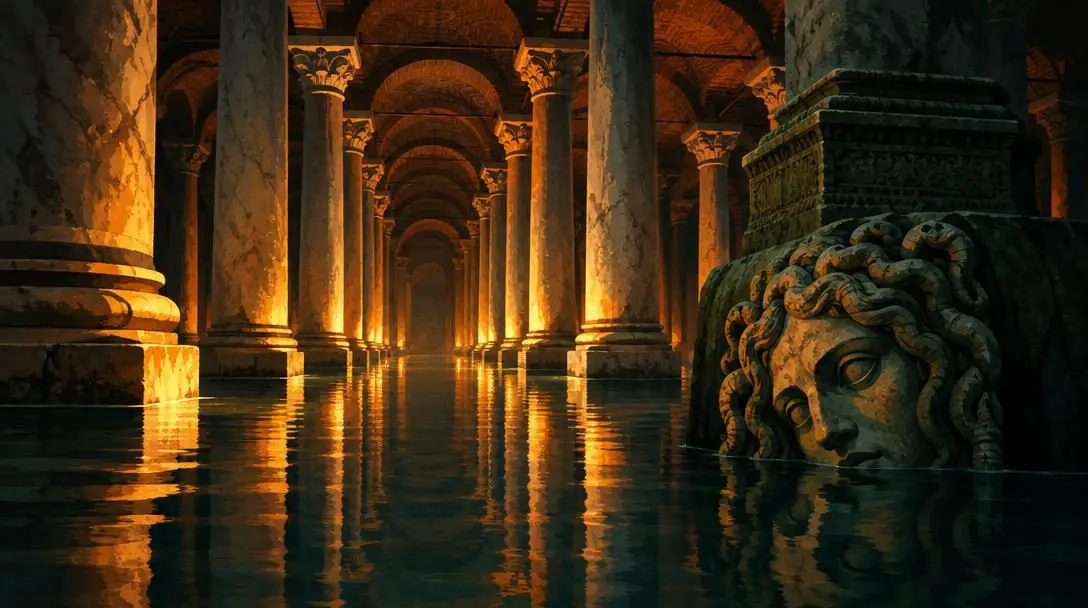
The Basilica Cistern is an enormous subterranean reservoir that functioned as an early water storage and filtration system for Constantinople. Built in 532 under Byzantine Emperor Justinian I, the reservoir secured municipal water reserves for the Great Palace and neighboring civic structures, protecting the population during periods of drought or military siege. Covering an expansive footprint roughly the size of two football fields, this underground marvel could hold an astonishing 80,000 cubic meters of fresh water brought from surrounding regions.
Descending into the dim, atmospheric chamber reveals a forest of 336 carved marble columns arranged in precise, symmetrical rows. The columns support vaulted brick ceilings that reflect across shallow, illuminated waters below. Toward the back of the cistern, visitors discover two massive column plinths sculpted with the likeness of Medusa heads. Repurposed from ancient Roman structures during sixth-century construction, these enigmatic carvings—one placed sideways and the other inverted—continue to fascinate travelers and historians with their mysterious placement and striking artistry.
Ottoman Bird Palaces
- Architectural style: Miniature multi-story pavilions
- Placement: Public fountains, mosques, schools, and bridges
- Oldest known site: Büyükçekmece Bridge
- Primary purpose: Avian shelter and civic benevolence
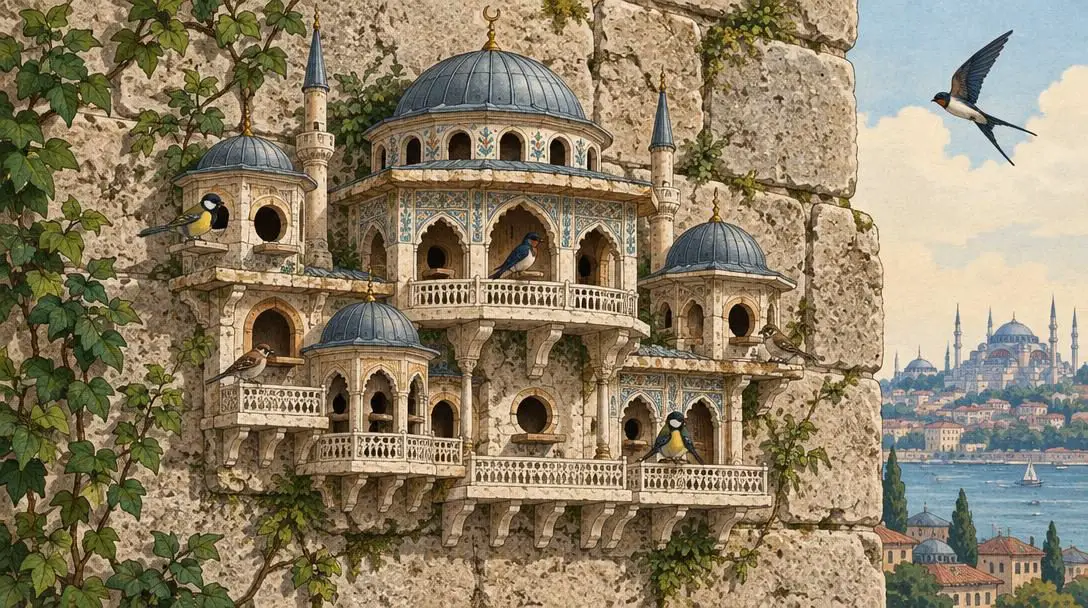
While the Basilica Cistern showcases monumental underground engineering, the Ottoman bird palaces demonstrate exquisite micro-architecture built high above street level. People living in the region had fashioned modest nesting cavities for birds long before the rise of the Ottoman Empire, but Ottoman builders elevated the practice into a celebrated art form. Rather than carving plain holes into stone walls, craftsmen constructed ornate, multi-tiered miniature residences featuring cantilevered balconies, domes, eaves, and decorative arched windows.
Reflecting an imperial culture steeped in charity, religious benevolence, and deep reverence for the natural world, these miniature palaces were embedded directly into the exterior stone facades of mosques, schools, fountains, and bridges. They provided safe nesting spaces and shelter from winter winds for sparrows, swallows, and pigeons. While weathering and city development have claimed many examples over the centuries, surviving bird palaces still grace older structures throughout the city. The oldest known surviving bird palace remains perched upon the historic Büyükçekmece Bridge, showcasing the same sophisticated craftsmanship found in royal dwellings.
Tombs of the Sultans
- Notable rulers buried: Mehmed III, Selim II, Murad III, Brahim I, Mustafa I
- Setting: Exterior gardens of Hagia Sophia
- Design approach: Standalone royal pavilions
- Interior features: Polychrome tiles and calligraphic domes
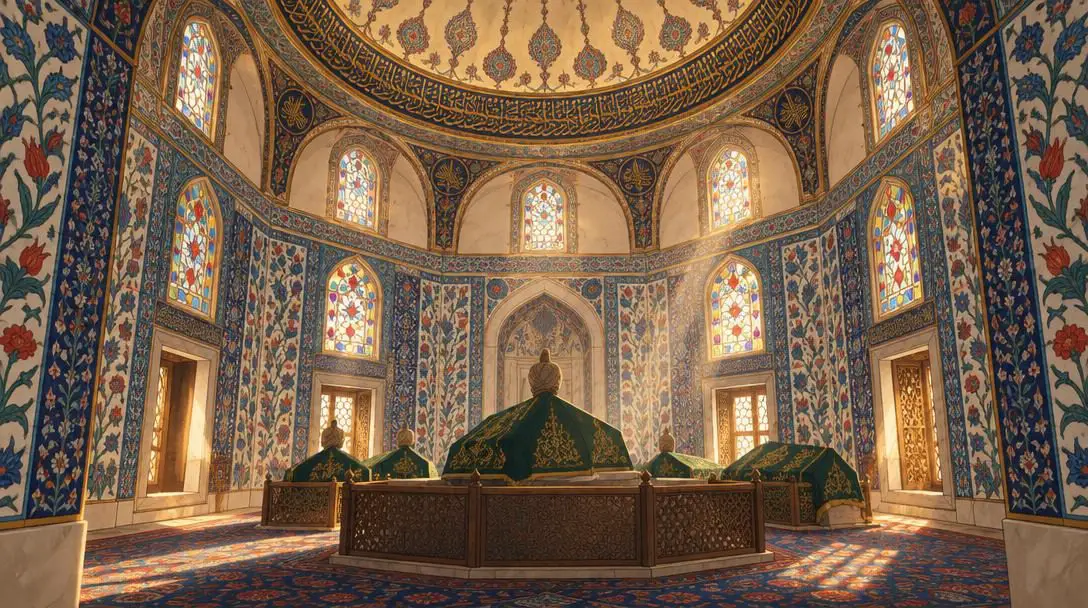
Mausoleums are often envisioned as somber, shadowy crypts, but the Tombs of the Sultans challenge every conventional expectation of funerary architecture. Situated in the tranquil outer gardens surrounding the Hagia Sophia, these standalone royal structures serve as the resting grounds for prominent Ottoman rulers, including Mehmed III, Selim II, Murad III, Brahim I, and Mustafa I, alongside members of their immediate families.
Rather than grim burial chambers, each tomb functions as a splendid royal pavilion designed to celebrate imperial legacy and architectural splendor. Stepping inside reveals soaring domed ceilings painted with intricate calligraphic inscriptions, walls draped in vibrant Iznik ceramic tiles, and patterned marble flooring that mirrors the elegance of royal reception rooms. Because these pavilions stand in the outer courtyard along the monument's exterior perimeter, many travelers rushing to the central hall miss them entirely, passing by some of the most refined decorative art in the Islamic world.
Viking Runes in Hagia Sophia
- Location: Upper gallery marble balustrades
- Author: Halfdan, a Varangian Guard mercenary
- Script style: Medieval Norse runic carving
- Translation intent: Informal personal marking
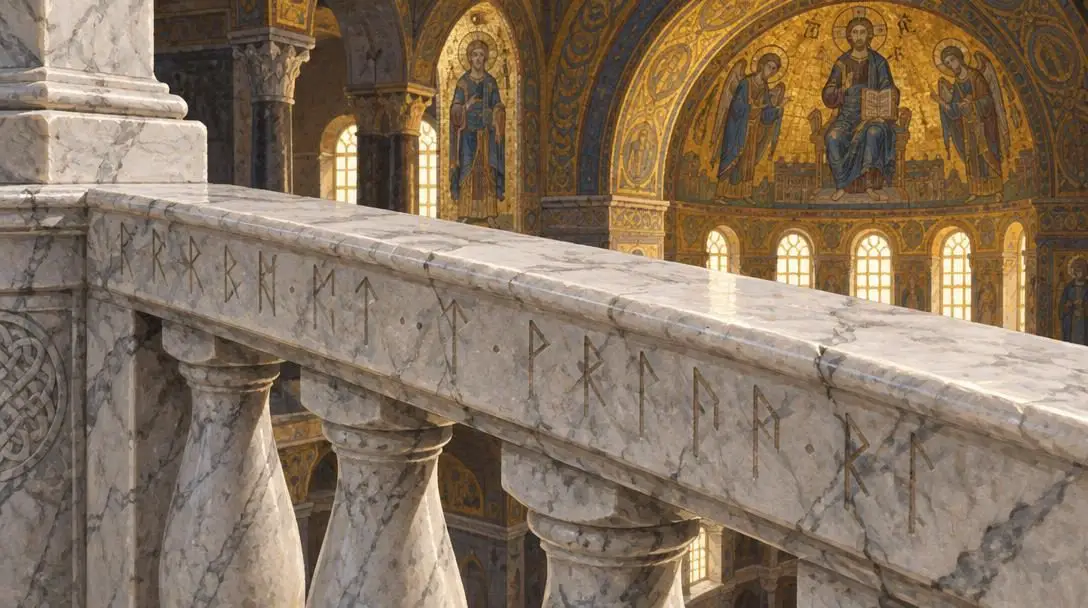
Inside the vast, gilded expanse of the Hagia Sophia, one of the most intimate historical artifacts is easily overlooked. High above the nave in the monument’s upper gallery, a small, weathered etching sits carved into a flat marble balustrade: medieval runic letters left behind by a Norse warrior named Halfdan. Far from an imperial edict or pious dedication, the faint inscription translates roughly to modern graffiti proclaiming that Halfdan was here.
Halfdan was a member of the elite Varangian Guard, an imperial Norse regiment that served the Byzantine emperors as trusted palace bodyguards. Stationed on the marble balconies during long, solemn church services and state ceremonies, this bored guardsman used his weapon or knife to carve his name into the stone balustrade. This small scratch creates a startlingly personal connection across centuries, linking the snowy fjords of Scandinavia directly to the golden mosaics of medieval Constantinople.
Far from an imperial decree, this weathered runic carving bridges centuries to reveal the personal mark of an elite Norse soldier passing time inside the grandest hall of Christendom.
Miniaturk
- Total area: 15 acres
- Scale of models: 1/25 ratio
- Key monuments displayed: Mostar Bridge, Obelisk of Theodosius, Hagia Eirene Church
- Display format: Open-air architectural park
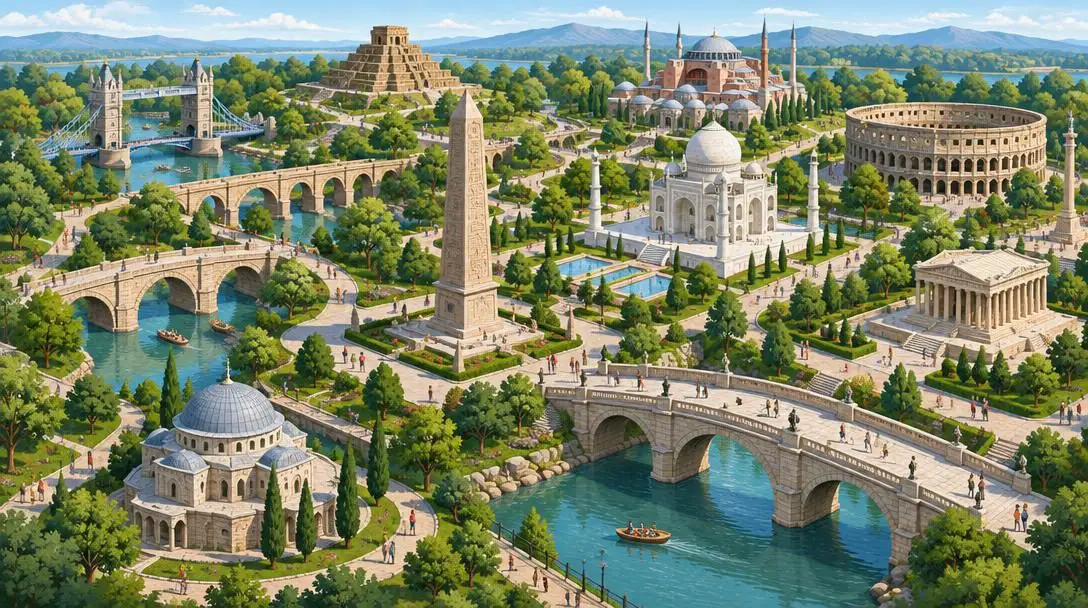
For an entirely different viewpoint on regional heritage, Miniaturk offers an expansive, bird's-eye perspective on imperial architecture. Spanning 15 acres along the edge of the Golden Horn, it ranks as one of the world's largest miniature architectural parks. The complex features dozens of meticulously engineered 1/25 scale models that depict the most celebrated civic, religious, and military structures from Istanbul, Anatolia, and former imperial territories.
Walking through the landscaped grounds allows visitors to inspect complex layouts that are difficult to appreciate from ground level in the real world. Iconic local monuments like the Obelisk of Theodosius and the ancient Hagia Eirene Church stand alongside legendary regional landmarks such as the Mostar Bridge. Miniaturk serves as an ideal orientation for travelers, giving them a tangible understanding of how architectural engineering evolved over successive centuries of imperial rule.
How to organize your walking itinerary
Experiencing these diverse attractions requires deliberate planning, as several sites are hidden in plain sight around the city's busiest historical hubs. Following an efficient route ensures you do not waste transit time or miss subtle details.
- Cluster your Sultanahmet visits: Group the Basilica Cistern, the Viking runes inside Hagia Sophia, and the Tombs of the Sultans together on the same morning. Because all three sites sit within footsteps of one another, you can explore them without long transit delays.
- Ascend Hagia Sophia's upper gallery early: Enter Hagia Sophia as early as possible to access the upper gallery before heavy crowds gather. Slowly scan the smooth marble balustrades along the gallery walkways to locate the weathered runic carving left by Halfdan.
- Inspect the peripheral garden tombs: After touring Hagia Sophia's interior, exit toward the outer courtyard gardens to view the palatial freestanding mausoleums of Mehmed III, Selim II, Murad III, Brahim I, and Mustafa I before leaving the grounds.
- Descend into the Basilica Cistern: Walk directly across the tramway plaza to enter the cool, subterranean expanse of the Basilica Cistern, making your way along the raised wooden walkways to study the 336 marble columns and inverted Medusa heads.
- Pack magnification for bird palaces: When traveling around historic neighborhoods or heading out to inspect the Büyükçekmece Bridge, carry compact binoculars or a telephoto camera lens so you can view the elevated masonry details of surviving Ottoman bird palaces.
- Dedicate an afternoon to Miniaturk: Set aside several hours for the open-air grounds of Miniaturk. Take your time strolling between the 1/25 scale models of the Mostar Bridge, Hagia Eirene Church, and the Obelisk of Theodosius to study structural details from above.
Mistakes to avoid when exploring Istanbul
Because Istanbul contains such an overwhelming concentration of historical wonders, visitors frequently rush through major complexes and overlook extraordinary features. Keep these common missteps in mind during your travels:
- Skipping the Hagia Sophia periphery: Many tourists exit Hagia Sophia immediately after viewing the main prayer hall, entirely missing the freestanding tombs of the sultans situated around the outer gardens.
- Rushing through the subterranean walkways: Walking briskly through the Basilica Cistern prevents you from absorbing the vast scale of its engineering, the reflections across its water reserves, and the curious placement of the Medusa bases.
- Maintaining street-level tunnel vision: Travelers who keep their eyes fixed forward miss the architectural bird palaces perched along higher rooflines, upper facades, and stone bridge spans like the Büyükçekmece Bridge.
- Dismissing ancient graffiti: Visitors unaware of the Varangian Guard often glance at the upper gallery balustrades in Hagia Sophia and mistake Halfdan’s Norse runes for modern defacement rather than valuable eleventh-century history.
- Treating Miniaturk as a brief stopover: Attempting to see Miniaturk in half an hour leaves you rushed; navigating 15 acres of scale models requires adequate time and comfortable footwear.
Broadening your historical journey
Visiting these five unique attractions offers an invaluable gateway into the broader cultural currents that defined Istanbul over thousands of years. Once you have seen these highlights, you can expand your exploration into related avenues of regional history.
First, consider tracing the imperial water network beyond the Basilica Cistern. The cistern was only one reservoir in a vast municipal web fed by massive stone aqueducts spanning valleys from distant northern forests. Tracking remaining above-ground Roman and Byzantine aqueduct arches through local neighborhoods reveals an unvarnished look at city history away from standard tourist enclaves.
Second, dive deeper into the world of Ottoman decorative arts. Seeing the palatial tombs of the sultans and the intricate mini-mansions built for birds highlights how Ottoman architecture united high artistic elegance with functional benevolence. You can trace this design philosophy across the city's historic calligraphy museums, tile pavilions, and palace courtyards.
Finally, let Miniaturk serve as an architectural compass for future travels. By showcasing scaled models of treasures like the Mostar Bridge, the Obelisk of Theodosius, and the Hagia Eirene Church, the park provides an enticing preview of iconic monuments found throughout Anatolia and the surrounding regions.
Frequently asked questions
Where are the Viking runes located inside Hagia Sophia?
The Viking runes are carved into the smooth marble balustrades of the upper gallery inside Hagia Sophia. They were etched by Halfdan, a Norse mercenary serving in the Byzantine emperor's elite Varangian Guard.
How much water could the Basilica Cistern hold?
The Basilica Cistern has a holding capacity of approximately 80,000 cubic meters of fresh water. Commissioned in 532 by Emperor Justinian I, the reservoir measures roughly the size of two football fields and is supported by 336 marble columns.
Which Ottoman sultans are buried in the tombs beside Hagia Sophia?
The palatial freestanding mausoleums located along the outer periphery of Hagia Sophia contain the tombs of Sultans Mehmed III, Selim II, Murad III, Brahim I, and Mustafa I, along with members of their royal households.
Where is the oldest surviving Ottoman bird palace located?
The oldest known surviving Ottoman bird palace can be found sculpted into the stone masonry on the side of the historic Büyükçekmece Bridge, showcasing multi-level architectural details designed to shelter local birds.
What historic monuments can you see at Miniaturk?
Miniaturk features 1/25 scale models of famous regional landmarks spread across a 15-acre open-air park, including the Hagia Eirene Church, the Obelisk of Theodosius, and the Mostar Bridge.
The bottom line
Istanbul remains one of the world's most captivating urban landscapes because its history is not confined to glass museum cases; it is etched into balustrades, submerged beneath city streets, and sculpted onto everyday facades. While the monumental domes of the Blue Mosque and Hagia Sophia command attention, discovering the Basilica Cistern, Ottoman bird palaces, the Tombs of the Sultans, Halfdan's runic graffiti, and the miniature displays at Miniaturk offers a richer, far more memorable encounter with the City of the World’s Desire.