5 Ways to Make Math More Engaging For Your Child
Mathematics plays an indispensable role in daily life, shaping the ways children solve problems, structure information, and make sense of their environment. Despite its universal value, math frequently becomes a source of dread and friction at home and in school. When mathematical concepts are confined to abstract symbols, repetitive drills, and standardized worksheets, children often struggle to grasp the logic behind the steps, breeding frustration and feelings of inadequacy.
A child's difficulty with numbers rarely stems from an inherent lack of logical ability. Rather, it is typically a consequence of how mathematical ideas are introduced and practiced. By moving beyond rigid textbook drills and anchoring mathematical principles in shared household activities, tactile exploration, and supportive encouragement, families can help children replace anxiety with lasting confidence and curiosity.
Key takeaways
- Struggles with math typically reflect abstract instructional methods rather than a child's true cognitive capacity for logic.
- Rooting numbers in daily tasks like cooking, shopping, and scheduling relieves cognitive strain by giving theoretical rules tangible meaning.
- Interactive games, visual puzzles, and low-stakes physical tools transform mistakes into productive learning opportunities.
- Consistent positive reinforcement and close coordination with classroom educators cultivate emotional resilience and steady academic growth.
Understanding Why Math Sparks Frustration and How Engagement Helps
Traditional learning environments frequently introduce mathematics through rote memorization, isolated formulas, and high-stakes evaluations. When a child is asked to execute multi-step procedures without understanding the underlying reasoning, math quickly feels like a sterile, mechanical chore. The emotional friction that follows often convinces young learners that they simply lack a "math brain," creating an unnecessary psychological hurdle that worsens over time.
From a cognitive perspective, learning math strictly through paper-and-pencil exercises forces a child's working memory to manage abstract notation and complex problem-solving simultaneously. This heavy cognitive load frequently triggers mental fatigue and overwhelm. By introducing hands-on tools, physical objects, and interactive problem-solving, parents provide alternate pathways for the brain to process and organize quantitative relationships.
Shifting the learning environment also alters how children perceive errors. In traditional classrooms, mistakes are often marked in red ink as definitive failures, which stifles creative risk-taking. In contrast, informal home exploration creates a low-stakes atmosphere where mistakes are treated as natural experiments. Manipulating tangible materials builds concrete mental models, which later serve as the structural framework needed to master symbolic, advanced mathematics.
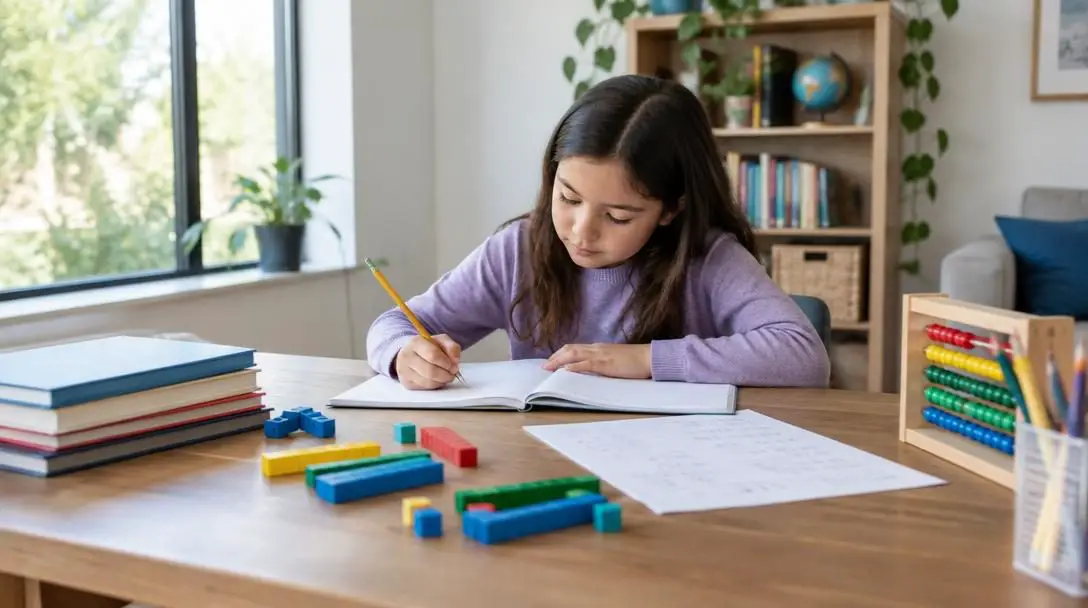
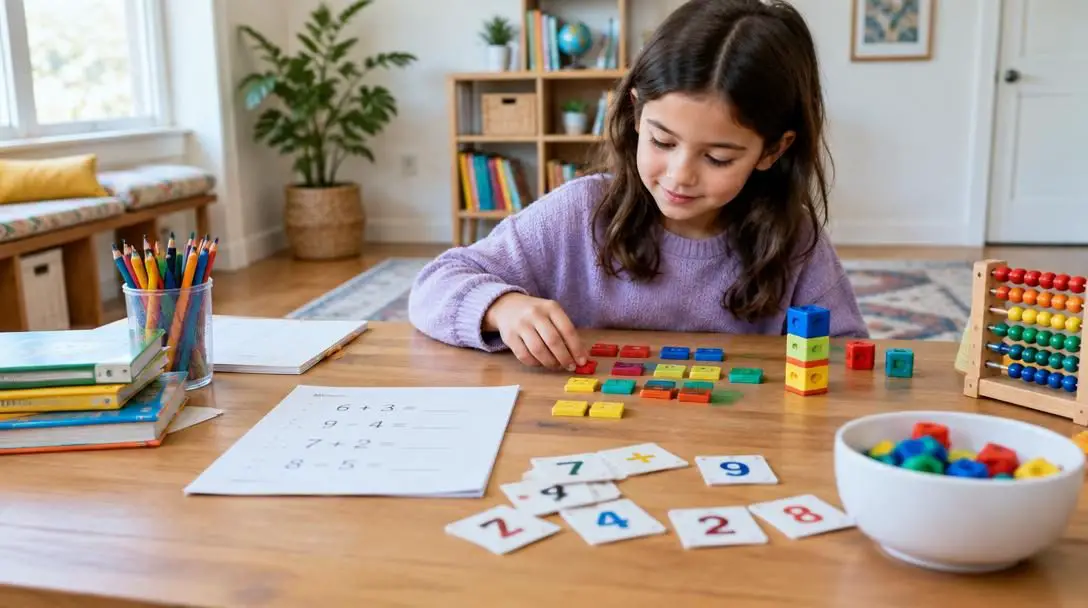
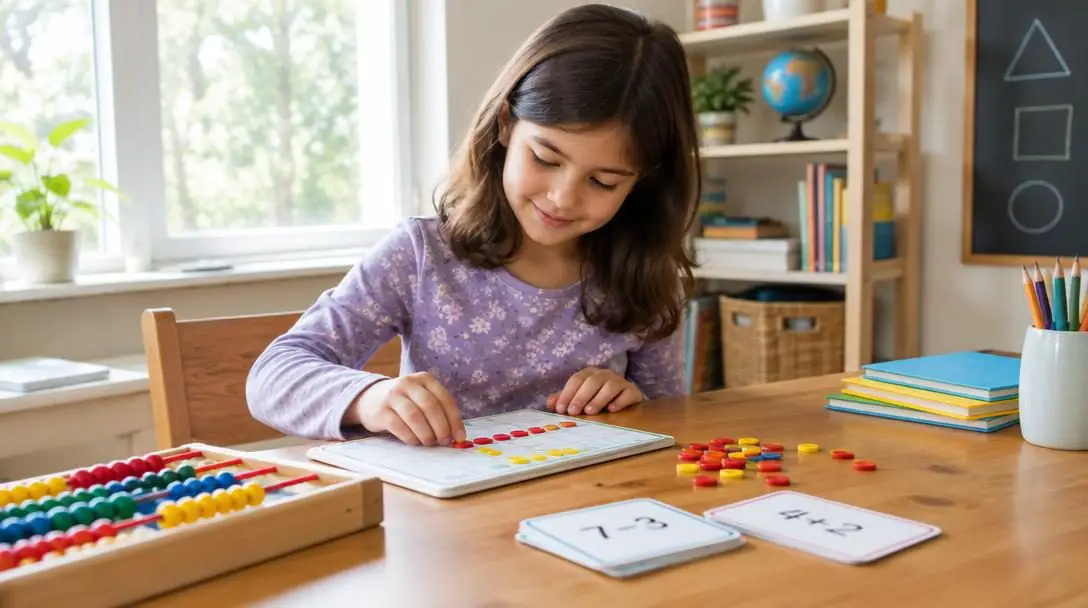
When children manipulate physical materials to solve real challenges, they build concrete mental models that demystify abstract formulas.
Five Practical Strategies to Make Math Engaging at Home
Transforming mathematical thinking from an intimidating chore into an active pursuit does not require an advanced degree or complex curricula. Incorporating five foundational strategies into your home life bridges the gap between academic theory and practical application.
| Strategy | Everyday Tools & Contexts | Target Mathematical Concepts | Primary Learning Benefit |
|---|---|---|---|
| Daily Activities | Kitchen timers, recipes, cash registers, grocery receipts | Elapsed time, estimation, mental arithmetic, unit measurement | Shows real-world utility and removes academic isolation |
| Real-World Examples | Measuring cups, tape measures, standard rulers, basic calculators | Fractions, spatial dimensions, place value, repeated addition | Provides tangible physical models for abstract symbols |
| Playful Learning | Math websites, puzzle books, board games, decks of cards | Spatial reasoning, logical deduction, counting, probability | Fosters organic intrinsic motivation without performance anxiety |
| Positive Reinforcement | Effort praise, small reward systems, milestone tracking | Task persistence, error analysis, iterative problem-solving | Strengthens emotional resilience and long-term self-efficacy |
| Direct Support | Step-by-step problem deconstruction, teacher check-ins | Multi-step algorithms, targeted skill remediation | Alleviates acute math anxiety through tailored guidance |
Incorporate Math into Daily Activities
One of the most seamless ways to build numeracy is to weave it directly into standard family routines. When mathematical operations arise naturally during ordinary tasks, children see that numbers are practical life tools rather than isolated test questions.
The kitchen is an ideal environment for spontaneous arithmetic. During cooking and baking, invite your child to measure dry and liquid ingredients using measuring cups and spoons. Calculating elapsed cooking times—such as working out when a casserole must come out of the oven if it takes forty-five minutes to bake—develops an active sense of time, estimation, and addition.
Regular shopping trips provide continuous practice with mental computation and budgeting. As you browse the aisles, ask your child to calculate the approximate total cost of several items in the cart or determine how much change you should receive after paying with cash. At home, you can also involve them in tracking schedules by using wall clocks and timers to determine how many minutes remain before leaving for an appointment, turning time management into functional arithmetic.
Use Real-World Examples
Because mathematical notation is inherently abstract, children often struggle to connect written numbers with physical reality. Using physical household objects gives mathematical concepts clear visual and tactile forms.
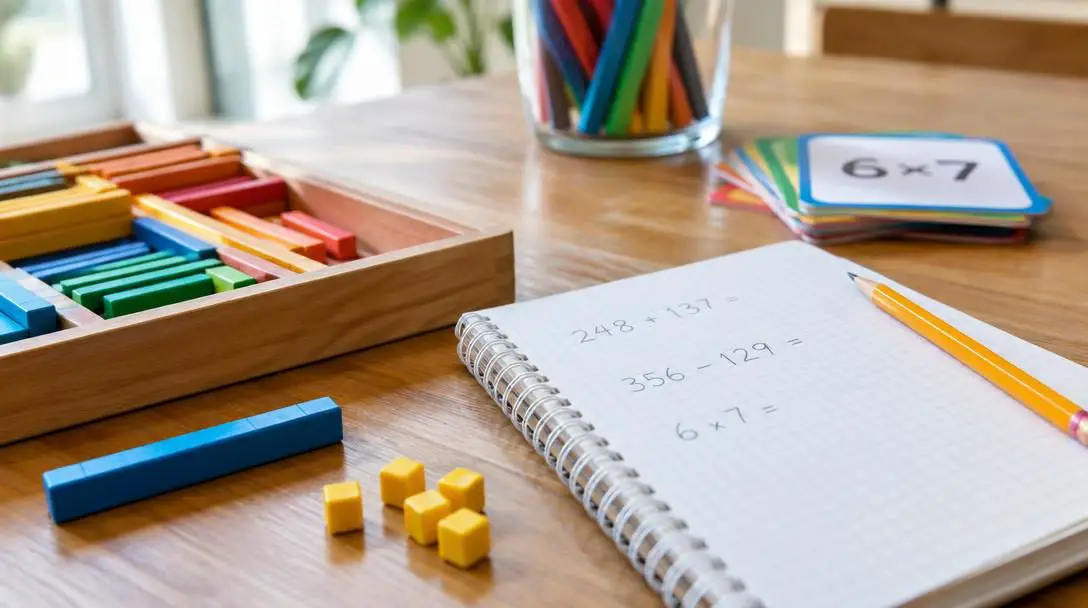
Measuring cups and kitchen containers offer an intuitive introduction to fractions. Filling a half-cup container twice to fill a whole cup demonstrates fraction equivalence far more convincingly than shaded circles on a flat worksheet. Similarly, handling rulers and tape measures turns arbitrary units into concrete dimensions. Children can measure furniture, doorways, and personal belongings, anchoring spatial reasoning in their immediate physical space.
Calculators also serve as powerful exploratory instruments. Rather than using them merely as shortcuts, encourage children to use calculators to verify mental estimates or explore repetitive numerical sequences. Watching numbers grow through repeated addition or multiplication helps young learners notice patterns in place value without stumbling over manual calculation errors.
Make Math Fun
Viewing math as an unending series of repetitive exercises drains curiosity. Infusing play, friendly competition, and recreational puzzles changes the emotional tone surrounding the subject, encouraging children to explore at their own pace.
Digital platforms, interactive educational apps, and math-focused websites present challenges as playful adventures. These tools often employ adaptive pacing, allowing children to practice essential operations independently without adult pressure. Meanwhile, traditional tabletop activities such as board games and card games require players to roll dice, count movements across a grid, manage resources, and tally final scores. Visual puzzles, brainteasers, and logic grids further develop strategic deduction and pattern recognition in an entertaining, collaborative atmosphere.
Provide Positive Reinforcement
Developing genuine competence in mathematics takes sustained focus and patience. Children are far more likely to stay engaged when their steady persistence is recognized and validated by their parents.
Focus your praise on effort, strategy, and perseverance rather than speed or raw correctness. Acknowledging a child's determination to work through a multi-step word problem reinforces emotional stamina. In addition to verbal encouragement, establishing reasonable incentives—such as a small treat or extra screen time—can sustain momentum when school units become particularly demanding. Celebrating incremental milestones, such as mastering a challenging multiplication table or catching an operational oversight independently, reminds children that progress is built through continuous, manageable steps.

Support and Encourage Your Child
When a child encounters difficult academic material, empathetic and attentive parental guidance prevents routine confusion from morphing into chronic math avoidance. Having a reliable sounding board at home ensures the child feels supported during moments of academic frustration.
Provide tailored assistance by deconstructing intimidating, multi-step problems into smaller, distinct stages. When a child feels stuck, walking through the logic one piece at a time makes the material approachable. It is equally important to partner directly with your child's math teacher. Initiating regular communication helps you identify your child's specific academic strengths and gaps, enabling you to align home routines with classroom methodologies. Most importantly, consistently normalize intellectual struggle, reminding your child that working through difficulty is the very process through which the brain grows.
Step-by-Step Guide to Implementing Math Engagement at Home
Introducing new family routines works best when approached systematically. Rushing to change every habit at once can overwhelm both parent and child. Follow this sequence to introduce low-stress mathematical engagement into your home:
- Assess current attitudes: Observe your child during homework sessions to detect whether frustration stems from operational confusion, rushed work, or deep-seated anxiety.
- Select one routine to start: Pick a single everyday moment, such as calculating grocery totals or measuring ingredients during dinner preparation, to practice functional arithmetic.
- Assemble physical measuring tools: Place rulers, measuring tapes, kitchen scales, and calculators in easily accessible spots to support spontaneous hands-on demonstrations.
- Integrate recreational games: Set aside weekly family time for board games, card games, or approved interactive math apps that build arithmetic and reasoning through play.
- Establish an encouragement system: Formulate clear routines for acknowledging hard work, pairing verbal validation with occasional incentives for completing challenging goals.
- Consult your child's educator: Contact the teacher to learn which conceptual areas require extra reinforcement and to ensure consistent problem-solving steps between home and school.
- Review and adapt routines: Periodically gauge your child's shifting confidence and adapt your activities as their developmental and curriculum demands advance.
Common Mistakes to Avoid When Teaching Math at Home
Even well-intentioned support can backfire if it inadvertently introduces anxiety or emotional tension. Be mindful of these widespread parental missteps:
- Projecting personal insecurities: Voicing that math was your worst subject can lead children to assume that mathematical incompetence is an inherited trait that cannot be changed.
- Prioritizing speed over comprehension: Rushing a child through a calculation creates panic and prioritizes superficial answers over thoughtful, foundational reasoning.
- Turning leisure into an endless exam: Quizzing your child on numbers constantly during family outings transforms enjoyable moments into stressful interrogations.
- Relying solely on abstract explanations: Explaining complex numerical relationships through verbal descriptions alone often causes confusion; always reach for physical objects when an idea fails to click.
- Working in isolation from teachers: Attempting to remedy severe conceptual hurdles without consulting the classroom teacher can result in conflicting instructional methods that confuse the child further.
Planning for Long-Term Numerical Growth
As children mature, their mathematical needs shift from basic counting and arithmetic to higher-order logical deduction, ratio analysis, and algebraic thinking. The methods used to support an early elementary student must gradually evolve to match their cognitive stage. Observing how your child responds to hands-on manipulatives, logic games, and positive encouragement provides the feedback necessary to refine your support system over time.
A child's growing comfort with mathematics extends beyond standardized test scores. Learning how to dissect a convoluted numerical problem, isolate known variables, and test solutions methodically builds a durable intellectual toolkit. This systematic problem-solving resilience often carries over into other academic disciplines, bolstering general scholarly self-assurance. Maintaining continuous, proactive communication with teachers ensures your collaborative efforts stay synchronized with rising academic standards.
Frequently asked questions
Why does my child struggle with math even when they do well in other subjects?
Math requires working memory to decode abstract symbols while executing logical procedures at the same time. If concepts are taught only through drills without concrete physical context, children easily feel overwhelmed, even if they excel at reading or creative tasks.
How can I help my child if I struggled with math myself?
You do not need advanced mathematical mastery to help your child. Focus on framing math as an open, curious exploration, use tangible household tools like rulers and measuring cups, and coordinate with their teacher to ensure you reinforce consistent techniques.
Are digital apps and video games actually effective for learning math?
Yes, interactive math websites and educational apps can provide valuable, low-pressure practice. These platforms present numerical challenges as playful adventures with adaptive pacing, helping children build fluency and confidence independently.
What should I do when my child hits an emotional wall during homework?
When frustration peaks, pause the session to avoid reinforcing anxiety. Normalize the difficulty by reminding them that confusion is a regular part of learning, break the complex problem into smaller parts, and use physical household items to illustrate the concept visually.
How often should I connect with my child's math teacher?
Initiate contact whenever you notice recurring struggles at home, or at the start of demanding new units. Ongoing dialogue ensures you understand your child's specific strengths and weaknesses and align your home practice with classroom methods.
The bottom line
Math anxiety is not an unchangeable personality trait, nor is numerical talent a fixed genetic gift. By incorporating math into daily chores, utilizing physical tools, playing strategic games, offering sincere praise for effort, and maintaining a close partnership with educators, parents can reshape how their children experience numbers. With patience and practical exposure, every child can develop the skills and confidence required to navigate the mathematical challenges of school and daily life.