What Makes Trump’s Social Media Strategy So Effective?
Throughout the history of the United States, presidential impeachment has remained an exceedingly rare constitutional event. Across more than two centuries, only three American commanders-in-chief have ever faced formal impeachment proceedings: Andrew Johnson in 1868, Bill Clinton 130 years later, and Donald Trump. Trump not only became the third president to undergo the process but also etched a singular place in the nation's political annals by becoming the first president to be impeached twice. Yet despite facing an uninterrupted sequence of controversies, investigations, and high-profile legislative battles, he managed to retain an exceptionally steadfast political following.
The resilience of this political base proved so extraordinary that a significant contingency of his supporters accepted claims that the 2020 election had been stolen, culminating in the march on the United States Capitol Building on January 6, 2021. For political scientists, campaign managers, and the general public, this phenomenon raised an urgent question: How did a real estate developer and reality television personality with absolutely no prior background in elected office build and sustain such an unshakeable base of support? The answer resides primarily in marketing acumen, behavioral psychology, and a revolutionary command of modern social media mechanics.
Key takeaways
- Donald Trump transformed political communication by bypassing media filters with high-frequency, unscripted social media commentary.
- Targeted digital advertising on Facebook generated nearly $300 million in grassroots contributions while mobilizing an older demographic.
- A minimalist paid media expenditure of $10 million was offset by an unprecedented $1.9 billion in earned media coverage during the 2016 campaign.
- The practice of "big seed" marketing allowed single social posts to drive the national news agenda and crowd out conventional policy debates.
- Total reliance on third-party digital networks carries catastrophic platform risk, as demonstrated by Trump's high-profile social media bans in 2021.
Historical Context and the Breakdown of Political Norms
To grasp the magnitude of Trump's digital impact, one must evaluate the political baseline that preceded his entrance into electoral politics. The standard playbook of American governance had long prioritized institutional decorum, risk mitigation, and message discipline. When Andrew Johnson was impeached in 1868 following Reconstruction-era clashes, and when Bill Clinton faced impeachment 130 years later, the White House messaging machinery operated through formal press briefings, legal briefs, and carefully staged network appearances. Political leaders deliberately avoided unvetted remarks to shield themselves from public backlash.
By the time Donald Trump launched his political operation, standard political protocol dictated that elected officials and candidates treat online channels with intense caution. Candidates historically outsourced their accounts to professional communications teams that meticulously focus-grouped, edited, and scheduled statements. Trump shattered this paradigm entirely. Instead of consulting political strategists or legal counsel before publishing a statement, he shared his raw, unfiltered reactions to virtually every subject, moving seamlessly from macroeconomic policy and foreign diplomacy to commentary on pop culture and televised sports.
This absence of an editorial filter served as a masterclass in anti-establishment branding. By discarding the sanitizing influence of speechwriters, Trump presented himself as an outsider genuinely distinct from the political class. His posting habits mirrored those of ordinary internet users rather than guarded heads of state, firing off statements on an almost hourly basis. Even among opponents who criticized the substance of his messaging, the sheer volume, immediacy, and personal presence of his digital footprint made him impossible to ignore.
Key Figures in the 2016 Media Spending Disruption
The 2016 presidential election cycle demonstrated that sheer financial muscle could no longer guarantee political dominance. Legacy campaign strategies had long assumed that paid television commercials and direct mail were the decisive factors in securing primary and general election victories. The contrasting performance of key figures during this cycle permanently demolished that assumption.
| Campaign Figure | Paid Advertising Spend | Paid Spending Rank | Earned Media Value |
|---|---|---|---|
| Jeb Bush | $82 million | 1st | Not ranked in top tier |
| Donald Trump | $10 million | 8th | $1.9 billion (1st) |
| Hillary Clinton | Undisclosed in top tier | Top tier | $746 million (2nd) |
Jeb Bush
- Paid Advertising Spend: $82 million
- Paid Advertising Rank: 1st overall
- Primary Platform: Traditional broadcast media
Former Florida Governor Jeb Bush entered the 2016 Republican presidential primary backed by immense donor capital and established party networks. Bush's campaign and affiliated groups spent an astounding $82 million on paid advertising, ranking him first among all contenders in the field. Despite this overwhelming financial barrage, his conventional commercials failed to generate organic engagement, leaving his operation vulnerable to opponents who commanded the cultural conversation at zero cost.
Donald Trump
- Paid Advertising Spend: $10 million
- Paid Advertising Rank: 8th overall
- Earned Media Value: Estimated $1.9 billion
- Historical Distinction: First president impeached twice
Rejecting legacy political spending models, Donald Trump spent a modest $10 million on paid advertising during the 2016 campaign, ranking a distant eighth among presidential contenders. Instead of purchasing airtime, Trump mobilized his existing audience and leveraged continuous, polarizing commentary to generate an estimated $1.9 billion in earned media. Reflecting on this dramatic disparity, Trump later observed that social media carried vastly more influence than conventional spending, stating that the sheer power of his online numbers helped him defeat rivals who spent significantly more capital.
Hillary Clinton
- Earned Media Value: $746 million
- Earned Media Rank: 2nd overall
- Strategic Approach: Structured institutional messaging
As the Democratic nominee, Hillary Clinton commanded an expansive, highly professionalized national campaign apparatus. While she maintained substantial visibility across mainstream outlets, her earned media value totaled $746 million—placing her second behind Trump, yet lagging by well over a billion dollars. Her campaign's polished, risk-conscious digital communications could not replicate the rapid-fire virality and perpetual news-cycle capture achieved by her opponent's digital engine.
Brad Parscale

- Campaign Role: Social media manager
- Primary Platform: Facebook
- Capital Raised: Nearly $300 million
Serving as the campaign's social media director, Brad Parscale engineered the back-end technical infrastructure that converted social visibility into cold, hard capital. Parscale recognized that Facebook offered an ideal medium for donor acquisition because its user demographic skewed older compared to its early days, aligning directly with Trump's voter base. Through rigorous ad deployment and optimization, Parscale's Facebook apparatus raised nearly $300 million in campaign contributions, ensuring the candidate did not need to self-finance his operation while triggering third-party platforms to prioritize Trump content to boost their own engagement.
Social media saturation allowed a political newcomer to replace hundreds of millions of dollars in paid commercials with round-the-clock news coverage.
The Mechanics of 'Big Seed' Marketing and Free Coverage
The astonishing discrepancy between Trump's $10 million advertising outlay and his $1.9 billion in free media exposure is explained by a distribution framework known in digital marketing as big seed marketing. Conventional viral marketing typically relies on small nodes sharing content with one another until a wider tipping point is reached. By contrast, big seed marketing begins with a central broadcaster who already possesses a colossal, highly responsive following.
Because Trump entered the 2016 race with millions of established followers who shared his viewpoints, any statement he issued bypassed the standard media gatekeepers immediately. In this environment, the traditional concept of "bad press" essentially ceased to function. If a post was provocative, inflammatory, or controversial, it did not diminish his standing among his core followers; instead, it prompted mainstream television and print journalists to debate his words ad nauseum. News networks broadcast his posts on screen, invited panels of pundits to dissect his language, and pushed granular examinations of policy entirely to the sidelines. A single post drafted in seconds reliably dictated 48 hours of international broadcast coverage.
Five Practical Steps for Applying Digital Communication Principles
The functional mechanics demonstrated during Trump's presidential campaigns offer valuable strategic lessons for public communicators, organizational strategists, and brand builders. Navigating the modern media ecosystem requires a departure from legacy corporate public relations.
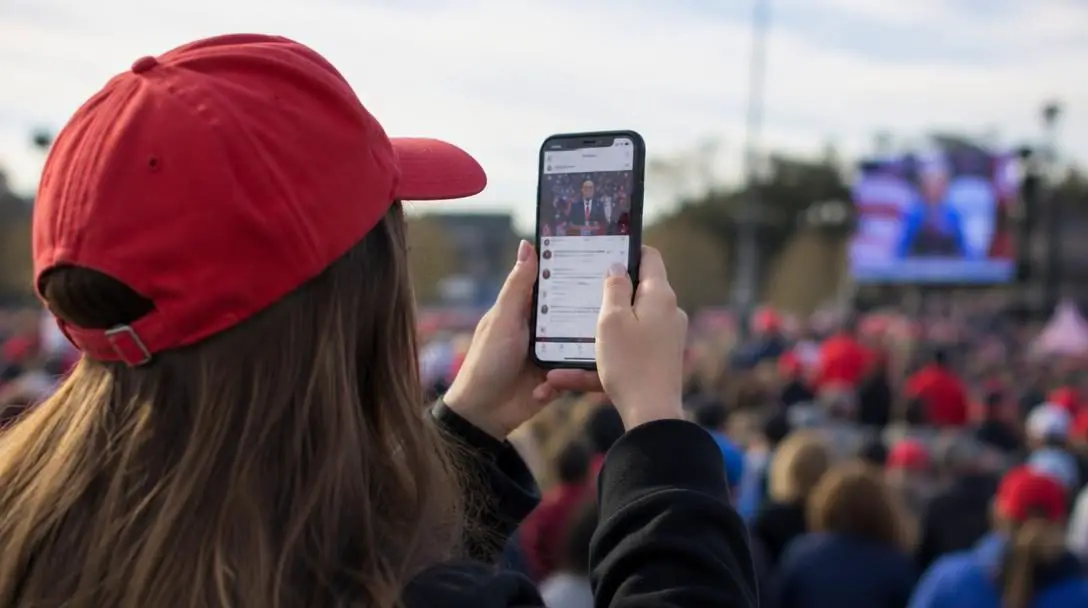
- Embrace a distinct, unvarnished voice: Replace focus-grouped corporate statements with direct, authentic language. Audiences in high-speed digital feeds immediately detect and disregard committee-drafted messaging in favor of raw perspective.
- Maintain high-frequency public distribution: Intermittent posting fails to command attention. Publishing content consistently and frequently conditions followers and media outlets to treat your channels as an immediate primary news source.
- Match strategic messaging to specific platform demographics: Deploy separate platforms for distinct operational goals. Utilize legacy networks with older user bases to drive direct fundraising and grassroots actions, while leveraging rapid-fire networks to steer cultural narratives.
- Prioritize engagement over consensus: Modern algorithmic architectures prioritize interaction, replies, and shares over passive approval. Taking unambiguous positions sparks discussion and expands message distribution far beyond static, neutral commentary.
- Convert proprietary distribution into earned outside media: Structure announcements and statements to serve as ready-made wire copy. When your primary channel consistently breaks news, external media publications are forced to cover your output, driving massive earned publicity.
Common Pitfalls in High-Velocity Digital Marketing
While an aggressive, unfiltered communication strategy can assemble a devoted following and secure enormous free exposure, attempting this approach without recognizing its inherent dangers can produce devastating strategic failures.
- Violating platform terms of service: Relentlessly escalating rhetoric carries catastrophic distribution risks. The permanent or temporary suspensions imposed on Trump across major platforms following the January 6 Capitol advance—culminating in his 2021 Twitter ban—demonstrated that third-party platforms hold absolute sovereignty over access.
- Mistaking hostile attention for productive conversion: The doctrine that "no press is bad press" works only in specialized political contexts where total name recognition and tribal loyalty override all else. For corporations, public institutions, and conventional candidates, relentless controversy can trigger severe financial boycotts, donor flight, and permanent brand damage.
- Ignoring essential back-end data architecture: Observers frequently fixate on provocative public remarks while completely overlooking the analytical machinery running behind the scenes. Without Brad Parscale's targeted Facebook advertising apparatus gathering voter data and collecting nearly $300 million, public visibility would have failed to materialize into an organized ground game.
- Alienating indispensable moderate constituencies: An unyielding focus on activating an impassioned core base inevitably polarizes undecided voters. Over time, continuous boundary-pushing hardens opposition among suburban, professional, and moderate voting blocs who prize conventional institutional stability.
The Future of Political Messaging and Platform Risk
The playbook established during the 2016 campaign and maintained throughout Trump's presidency fundamentally reordered how analysts evaluate communications strategy. Looking forward, the dynamic between political actors and digital platforms presents several critical challenges.
First, the balance of power between paid advertising and organic engagement has permanently changed. When an insurgent candidate can spend $10 million to outmaneuver an establishment frontrunner spending $82 million, legacy media campaigns must reconsider the viability of television-heavy ad budgets. Direct digital reach delivers superior attention economics compared to multi-million-dollar broadcast buys.
Second, organizations must proactively manage the perils of platform reliance. The sudden termination of Trump's access to mainstream networks in early 2021 underscored the precarious nature of building an entire organizational movement on third-party real estate. Modern political figures and advocacy groups increasingly realize that establishing proprietary contact lists, direct text messaging networks, and independent databases is essential to survive unexpected corporate censorship or platform policy shifts.
Finally, media consumption patterns are fragmenting rapidly across demographic fault lines. The Trump campaign capitalized early on the reality that older users on Facebook possessed substantial disposable income for donations, while younger demographics gravitated toward emerging alternatives. Future political operations must continue to dismantle monolithic digital plans in favor of hyper-targeted, platform-specific messaging designed to simultaneously extract revenue, build ideological loyalty, and capture the broader news cycle.
Frequently asked questions
How many United States presidents have been impeached in history?
Only three United States presidents have been impeached: Andrew Johnson in 1868, Bill Clinton in 1998 (130 years after Johnson), and Donald Trump. Trump is the only president in American history to be impeached twice.
How much did Donald Trump spend on paid advertising during the 2016 election?
Donald Trump spent approximately $10 million on paid advertising during the 2016 campaign cycle, which ranked him eighth overall among political candidates. In contrast, Jeb Bush spent $82 million, ranking first.
What was the estimated value of Trump's earned media in 2016?
Trump generated an estimated $1.9 billion in earned media—or free publicity—through news coverage, television discussions, and social media circulation. Hillary Clinton ranked second with $746 million in earned media.
How did Brad Parscale utilize Facebook during the Trump campaign?
Brad Parscale served as the campaign's social media director and capitalized on Facebook's older demographic to raise nearly $300 million in political contributions, reducing the campaign's reliance on personal candidate wealth.
What is 'big seed' marketing in digital political campaigns?
Big seed marketing occurs when a communicator with an enormous existing audience releases direct statements that spread instantly to millions of aligned followers. The resulting viral circulation and public debate compel mainstream media outlets to cover the statements continuously, generating immense free publicity.
The bottom line
Donald Trump's political trajectory transformed modern political communications from a discipline governed by focus groups and scripted speeches into an era defined by speed, emotional authenticity, and algorithmic leverage. By sidestepping traditional political etiquette and treating social platforms as direct broadcast lines, he showed that continuous public attention can outperform conventional campaign expenditures. However, this high-velocity strategy carries substantial vulnerabilities, including platform bans, moderate alienation, and institutional instability. Ultimately, mastering the modern digital landscape requires far more than posting provocative messages; it demands a synchronized engine capable of transforming cultural attention into tangible financial resources and sustained political power.