5 reasons why you should read Japanese light novels and web novels in English

Japanese light novels and web novels have captured an enthusiastic global readership, earning international praise for their imaginative world-building, relatable characters, and fast-paced narratives. Rooted in Japan's dynamic literary and entertainment ecosystems, these works serve as the creative bedrock for some of the world's most recognizable anime, manga, and video game franchises. While purists may lean toward experiencing these stories in their original Japanese, exploring them in English provides an immediate, accessible, and deeply rewarding pathway into modern Japanese storytelling.
From the grassroots origins of serialized web portals to the sleek, illustrated volumes produced by commercial publishers, the medium offers something for every reader. Whether you are an anime enthusiast eager to uncover original source material or a curious book lover seeking fresh literary perspectives, engaging with Japanese light and web novels in English combines pure entertainment with broader cultural and linguistic insight.
Key takeaways
- Web novels and light novels offer inventive, genre-defying narratives that frequently serve as the source material for global anime and gaming franchises.
- Both official licensing programs and volunteer fan translation communities make a vast catalog of Japanese stories accessible to international readers.
- Reading localized Japanese fiction strengthens English vocabulary while introducing linguistic nuances, honorifics, and cultural idioms.
- Engaging with translated series connects readers to passionate worldwide fan communities that analyze cliffhangers, share fan art, and discuss ongoing plotlines.
Understanding the Medium: Web Novels Versus Light Novels
To fully appreciate the world of modern Japanese popular literature, it helps to understand the distinct formats that comprise it. Web novels typically originate on online platforms where amateur, independent, and aspiring authors publish their work chapter by chapter directly for public readers. These online serialization sites act as fertile proving grounds for novel concepts, creative premises, and unconventional storytelling approaches, allowing creators to receive immediate comments and feedback from their audience.
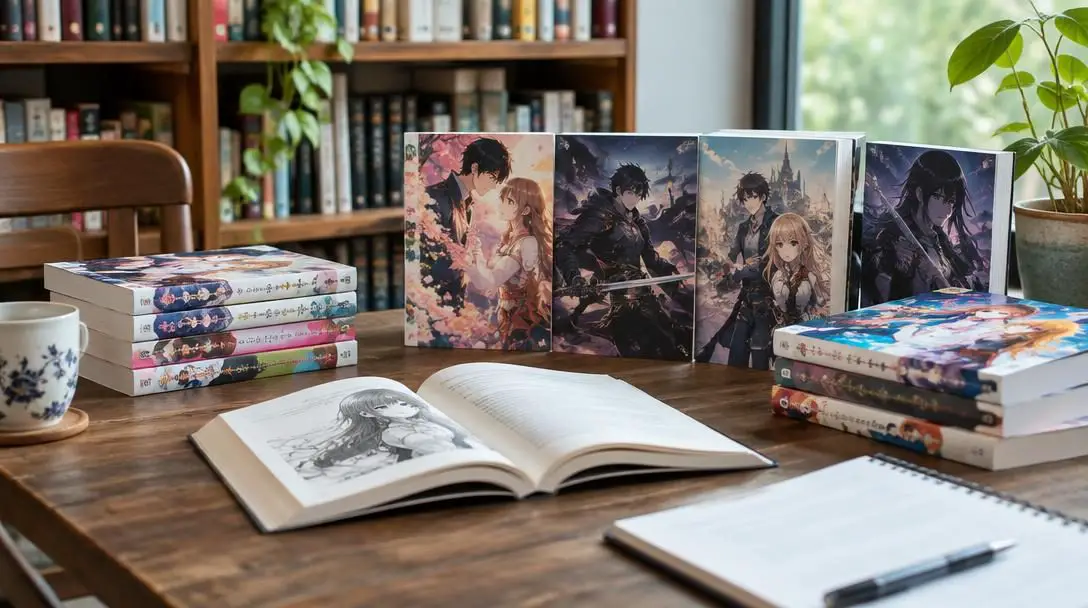
When a web novel achieves substantial popularity or catches the attention of a traditional Japanese publishing house, an editor typically acquires the manuscript. The text is revised, polished, tightened, and expanded with professional oversight. It is then paired with illustrations—frequently drawn in a distinct anime or manga visual style by prominent artists—and released as a commercial light novel. These physical paperbacks are intentionally compact, designed to be portable and easily consumed during daily train commutes, though they are also widely distributed as digital e-books.
Because these printed volumes boast fast pacing, bold concepts, and built-in visual identities, successful light novel franchises routinely transition into secondary media. A single breakout book series can rapidly generate manga spin-offs, long-running television anime adaptations, audio dramas, and console video games. Reading the translated novels allows an international audience to bypass secondary adaptations and enjoy the original, unfiltered stories that set these creative franchises in motion.
| Format | Origin & Platform | Editorial Curation | Visual Presentation |
|---|---|---|---|
| Web Novel | Online independent writing portals | Self-published by independent authors without professional editing | Unillustrated raw text published in serialized chapters |
| Light Novel | Commercial publishing companies and imprints | Substantially revised, polished, and structured by editors | Features full-color cover art and black-and-white chapter illustrations |
| Visual Adaptation | Animation studios and comic publishing magazines | Adapted by external production committees and screenwriters | Full visual animation, voice acting, sound design, or sequential comic art |
The Modern Translation Pipeline: Commercial Licensing and Fan Communities
Bringing a Japanese book to an English-speaking reader requires a dedicated and multifaceted translation ecosystem. Historically, readers outside Japan relied almost exclusively on fan translation communities. In these grassroots networks, bilingual volunteers discovered promising web novels or niche printed paperbacks, organized informal translation groups, and published localized chapters online to share their enthusiasm with fellow international fans. Many acclaimed series that are now household names among anime fans initially built their Western followings through the dedication of amateur translators.
Alongside these grassroots efforts, commercial licensing by international publishing companies has grown into a major industry. When an English-language publisher licenses a title, it enters into a formal legal agreement with the original author and Japanese publishing firm. The publisher employs professional translators, localization editors, proofreaders, and book designers to create an authoritative edition. Professional localization involves much more than swapping words between dictionaries; it demands an artful handling of Japanese cultural nuance, unspoken social contexts, comedic puns, and idiomatic speech so that English prose reads naturally without compromising the author's original voice.

Reading translated Japanese fiction allows international audiences to explore foundational stories behind global entertainment trends without facing an insurmountable language barrier.
Today, the relationship between Japanese publishers and the international market is closer than ever. Surging international readership has shortened the window between a book's physical debut in Tokyo bookstores and its official English release, ensuring that global fans can follow their favorite serialized adventures alongside native readers.
Five Compelling Reasons to Read Japanese Novels in English
Engaging with Japanese light and web novels in English delivers a literary experience that balances escapist entertainment with meaningful intellectual enrichment. Here are five core reasons to incorporate these books into your reading routine.
Diverse and Unique Storylines
Japanese web and light novels are renowned for pushing creative boundaries across a sweeping array of genres, including high-stakes action, romantic comedy, futuristic science fiction, and dark fantasy. Unlike much Western genre fiction, Japanese authors frequently combine seemingly contradictory elements into a unified tale, seamlessly blending ordinary school or corporate routines with cosmic fantasy stakes, philosophical reflection, or psychological tension. Reading these books in English allows you to immerse yourself in layered narrative twists, high-concept world-building, and character-driven conflicts with complete narrative clarity.
Access to a Wide Range of Titles
Japan's publishing sector produces tens of thousands of serialized titles each year, creating an exceptionally vast catalog of fiction. As English licensing companies expand their catalogs to meet international demand, readers can explore an astonishingly broad spectrum of stories that have no direct domestic equivalent. From quiet historical period dramas set in rural eras to complex strategic fantasies exploring resource logistics, reading in English provides immediate entry to a rich universe of titles that would otherwise remain out of reach behind a foreign language.
Improved Language Skills
Exploring Japanese fiction in translation offers distinct linguistic benefits. For English native speakers, well-localized commercial light novels introduce fresh vocabulary, varied sentence structures, and creative phrasing rarely found in everyday conversational reading. For bilingual learners and students of Japanese, reading translated works provides an educational masterclass in localization. You can observe how skilled translators resolve structural differences, render Japanese honorific systems like -san or -senpai, and adapt complex cultural idioms into fluid English, sharpening your overall reading comprehension and communication insight.
A Window into Japanese Culture
Because light and web novels are written primarily for a domestic Japanese readership, they reflect authentic cultural realities, social expectations, and generational attitudes. As characters navigate daily life, readers absorb rich details about traditional seasonal festivals, regional cuisines, train etiquette, school club dynamics, and folklore. Experiencing these details in English allows readers to develop a natural, nuanced appreciation for contemporary Japanese society and historical heritage without needing an academic textbook to decipher everyday customs.

Community and Connection
Reading translated light novels connects you to a vibrant, highly interactive global subculture. Because novel chapters and serialized volumes release on regular schedules, online discussion boards, social forums, and reader clubs routinely light up with vibrant discussion. Fans gather across geographic boundaries to dissect narrative cliffhangers, draft speculative theories about upcoming plot twists, critique translations, and share original fan art. Participating in these online hubs turns an individual reading habit into a shared social pastime where you can build friendships around mutual creative interests.
Practical Steps to Start Reading Japanese Novels
Transitioning into light novels or serialized web fiction is straightforward once you know how to navigate the medium. The following step-by-step approach will help you establish an enjoyable reading habit.
- Identify your preferred genres: Consider the themes, storytelling tropes, and styles you naturally enjoy in books, movies, or anime. Whether your preference is speculative science fiction, lighthearted comedy, or gritty mystery, target novels that emphasize those foundational qualities.
- Select your reading format: Choose between purchasing physical paperback volumes with collectible cover art, downloading digital e-books for mobile reading, or browsing verified web platforms hosting authorized digital serializations.
- Start with a completed or standalone arc: Many light novel series extend across dozens of continuous volumes. To prevent initial fatigue, select a short series, an anthology, or a title whose opening volume functions well as a self-contained narrative arc.
- Sample preview chapters before buying: Take advantage of the free preview samples available on major digital book portals. Reading the opening chapter lets you evaluate the translator's stylistic flow, grammatical polish, and tone before investing money.
- Maintain a simple reading log: Because light novel casts can expand rapidly and series titles may seem similar, tracking character rosters, unique terminology, and your current volume in a notebook or tracking app helps keep narrative threads organized.
Common Misconceptions and Pitfalls to Avoid
Navigating the light and web novel landscape requires an understanding of unique publishing conventions. Being mindful of these common missteps will keep your reading experience smooth and rewarding.
- Assuming light novels are solely for children: The word "light" refers to the breezy physical format, short chapter lengths, and conversational writing style rather than an exclusively juvenile target demographic. Many series tackle mature psychological dilemmas, political philosophy, and intricate dramatic narratives.
- Confusing web novels with their commercial releases: Treating a raw web novel draft and an officially published light novel as identical can cause confusion. Commercial versions regularly introduce new supporting characters, delete extraneous subplots, and rewrite crucial story climaxes.
- Judging books by their lengthy titles: Modern web and light novel creators frequently use complete descriptive sentences as book titles to catch readers' eyes on crowded digital platforms. Bypassing a book simply because it has an eccentric, paragraph-long title can cause you to overlook deeply emotional, well-crafted prose.
- Skipping localization and translation notes: Commercial translators and fan groups often include short margin notes or appendices detailing historical context, wordplay, and untranslatable social customs. Reading these notes deepens your contextual understanding of the scene.
- Neglecting official releases: While informal fan translations can introduce hidden gems, supporting official licensed editions guarantees that authors and illustrators receive royalties, directly funding the translation of future volumes.
Deepening Your Engagement: Beyond the Printed Page
Once you are comfortable reading light and web novels in English, you can expand your appreciation of the art form in several fulfilling ways. One of the most engaging activities is comparing the prose of an original novel with its visual adaptations. Because animated television series face strict runtime constraints, directors must compress storylines, condense secondary character backgrounds, and visualize internal monologues through environmental cues. By returning to the translated source book, you can discover all the granular world-building, political lore, and character motivations that had to be cut from the screen adaptation.
Furthermore, reading translated works often acts as an inspiring springboard for personal development. Many international readers find themselves motivated to begin studying the Japanese language, utilizing the translated English version alongside the original Japanese text as a practical study aid. What begins as an entertaining weekend reading session can gradually blossom into a lifelong appreciation for international literature, foreign language study, and cross-cultural communication.
Frequently asked questions
What makes a light novel different from a standard novel?
A light novel is a style of Japanese prose fiction featuring shorter volume lengths, conversational narrative pacing, and manga-style illustrations interspersed throughout the text, traditionally published in a compact paperback size.
Are web novels and light novels the same thing?
No. A web novel is typically an unedited, self-published draft serialized online by an author, whereas a light novel is a professionally edited, polished, illustrated, and commercially published physical or digital book.
Why do so many light novels have extremely long titles?
Authors on digital web portals use detailed, sentence-length titles to clearly explain the core premise of their stories immediately, allowing readers browsing competitive novel platforms to understand the concept at a glance.
Can reading light novels in English help me learn Japanese?
Yes. Reading professionally translated novels exposes you to Japanese cultural concepts, idiomatic thought processes, and honorific systems, providing valuable contextual understanding if you choose to study the Japanese language.
Where can I legally read Japanese light novels in English?
Official English editions can be purchased through mainstream digital book platforms, local brick-and-mortar bookstores, and specialized commercial manga and light novel publishers offering digital subscriptions and physical paperbacks.
The Bottom Line
Diving into Japanese light novels and web novels in English offers a gateway to vibrant creativity, intricate world-building, and authentic cultural discovery. Backed by dedicated translation pipelines and a welcoming global community, these stories combine high entertainment value with meaningful reading rewards. By starting with titles tailored to your favorite genres and engaging with the community, you can enjoy an expansive library of international fiction and perhaps discover your next all-time favorite book.