5 Reasons Why You Should Shuffle Your Playlist

Music is an essential part of daily life across cultures, age groups, and routines. People turn to audio tracks to entertain themselves during a morning commute, elevate their spirits during challenging moments, relax after a stressful day, and find creative inspiration. Over the past few decades, the way listeners collect and consume sound has undergone a fundamental transformation. In earlier eras, listening habits were tied directly to physical formats such as vinyl records, cassette tapes, and compact discs. While these analog and physical media possessed their own charms, they inherently guided listeners down a linear, sequential path. Moving away from an album's preselected running order required manual effort, such as precisely lifting and repositioning a turntable stylus or waiting through the mechanical whir of a tape rewinding.
The dawn of digital media files and cloud streaming services dismantled those physical limitations, establishing the custom playlist as the primary method for organizing personal music collections. Today, listeners can aggregate hundreds of tracks into curated lists organized by genre, activity, season, or mood. Yet this total freedom has introduced an ironic side effect: extreme predictability. Many listeners spend hours curating comprehensive audio libraries, only to hit play on track one and listen in the exact same sequence day after day. When a playlist becomes an unvarying routine, even your favorite songs can lose their emotional resonance. Activating the shuffle button is the simplest and most effective way to break that monotony and revitalize your entire music library.
Key takeaways
- Shuffling your playlist surfaces neglected songs buried deep in your library, expanding your musical horizons without requiring new purchases.
- Randomizing track order combats listening fatigue and sensory boredom by removing predictable transitions during repetitive daily tasks.
- Unprompted playback challenges your brain to identify melodies and lyrics without relying on familiar transitional cues between sequential tracks.
- Modern streaming shuffle tools use balanced pseudo-random algorithms designed to mimic physical card shuffling rather than purely mathematical randomness.
From Physical Grooves to Digital Predictability
To understand why listening routines become stale, it helps to examine how listening habits evolved alongside audio technology. For decades, commercial recorded music was strictly album-centric. Artists and producers spent weeks perfecting the sequence of an album, paying close attention to key signatures, tempos, lyrical themes, and the sonic transition between the end of one track and the beginning of the next. Listeners accepted this fixed sequence because physical limitations made alternative navigation cumbersome. Skipping a song on a vinyl record risked scratching delicate grooves, while cassette tapes required imprecise fast-forwarding.
The rise of digital audio players and modern streaming platforms inverted this paradigm. Suddenly, songs were unbundled from the album format, allowing listeners to construct their own bespoke compilations. However, human habit frequently recreates the exact linear constraints that digital technology removed. When you listen to a custom playlist in the same order dozens of times, your brain establishes strong predictive associations. You stop processing each song as an individual creative piece and begin treating the sequence as an unbroken, predictable soundscape. By reintroducing variability through the shuffle function, you restore the spontaneous excitement that made those songs appealing in the first place.
The 5 Core Reasons to Shuffle Your Playlist
Activating the shuffle function does more than just scramble a tracklist; it fundamentally alters the cognitive and emotional impact of your listening session. Reorganizing your collection on the fly produces several immediate psychological and experiential benefits.
Discover New Music
One of the primary advantages of shuffling a playlist is rediscovering forgotten tracks buried inside your existing collection. When a playlist is arranged sequentially, songs near the top receive the overwhelming majority of plays, while tracks positioned lower on the list are frequently cut off when a workout, commute, or study session ends. Over time, dozens of excellent songs become effectively lost in the digital archive. Shuffling bypasses this bias entirely, thrusting neglected recordings into prime listening positions. You often find that tracks you saved months or years ago suddenly sound completely fresh, granting you the sensation of discovering new music without needing to browse external recommendation feeds.
Eliminate Boredom
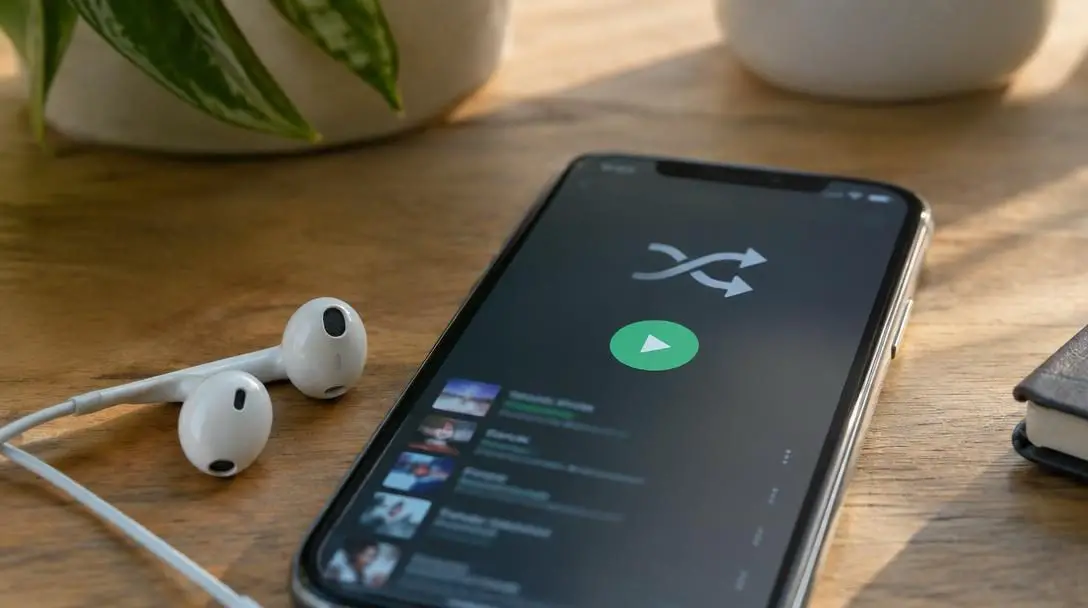
Listening to an identical sequence of tracks creates auditory habituation. The human brain is a pattern-recognition machine that thrives on novelty; when it can effortlessly predict every transition, musical stimulation morphs into dull background noise. Breaking auditory monotony is particularly vital when you are engaged in repetitive activities such as distance running, weightlifting, or household cleaning. In these settings, an unexpected song provides a welcome cognitive jolt, resetting your attention span and supplying a burst of motivation to help you finish the task at hand.
Enhance Your Mood
Music exerts a well-documented influence on emotional states, but overfamiliarity can dull that emotional impact. If you always anticipate the exact moment a high-energy guitar solo or soaring vocal chorus will arrive, your psychological response becomes muted. Elevating emotional resonance occurs when an upbeat anthem or a deeply comforting melody appears without warning. That unexpected arrival can trigger an impromptu mood lift, particularly if you are experiencing a midday slump or dealing with elevated stress levels.
Contextual contrast transforms familiar recordings, making a quiet acoustic melody feel brand new when it unexpectedly follows a driving stadium anthem.
Challenge Your Memory
When you play a fixed playlist repeatedly, your brain builds predictive bridges: the lingering reverb of track four automatically triggers your recollection of the opening chord of track five. Testing mental recall through shuffling severs these artificial cues. When the algorithm selects a song at random, your mind must work independently to recall the artist, the title, and the lyrics without relying on transitional hints. Engaging your active memory in this manner keeps your brain sharper and deepens your internal catalog of your favorite music.
Create a Fresh Listening Experience
The emotional perception of any individual track is deeply dependent on the context that precedes it. In a static playlist, a song always follows the same sonic backdrop. Introducing contextual contrast creates an entirely new listening experience out of familiar material. A melancholic indie ballad takes on a completely different emotional tone when it emerges right after a loud synth-pop track than when it follows another slow song. Shuffling places your library into continuous dialogue with itself, creating surprising pairings and dynamic shifts that keep your audio rotation feeling endlessly renewable.
At a Glance: How Shuffling Upgrades Your Listening Session
| Reason to Shuffle | The Underlying Problem | Cognitive or Practical Benefit | Best Everyday Scenario |
|---|---|---|---|
| Discover New Music | Back-of-queue neglect | Revives forgotten songs without buying new tracks | Casual evening listening or library cleaning |
| Eliminate Boredom | Auditory habituation | Restores novelty and resets sensory focus | Workouts, chores, and long commutes |
| Enhance Your Mood | Blunted emotional response | Delivers surprise emotional lifts via unexpected tracks | Stressful workdays and afternoon energy slumps |
| Challenge Your Memory | Predictive mental shortcuts | Strengthens spontaneous lyrical and melodic recall | Music trivia prep and active listening sessions |
| Create a Fresh Experience | Rigid sonic predictability | Reveals new contextual contrasts between disparate styles | Deep listening sessions and long road trips |
Algorithmic Mechanics: How Modern Shuffle Features Work
Most listeners assume that pressing the shuffle icon simply instructs their media player to pick tracks at pure mathematical random. In reality, the mechanics of modern digital shuffling are far more sophisticated. Understanding how software platforms approach this task helps explain why modern playback feels varied and balanced.
In the early days of digital media players, developers attempted purely random track selection, where every track in a list had an equal mathematical probability of playing next. However, true mathematical randomness frequently results in clusters that human ears perceive as artificial or broken. Under pure randomness, an artist with several tracks on a list might be selected three times in a row, or a song might replay after only two intervening tracks. Because human beings instinctively search for patterns, listeners routinely complained that true random algorithms were biased or malfunctioning.

To solve this perception problem, software engineers shifted to pseudo-randomization algorithms. Instead of rolling an independent mathematical die for every song choice, the platform treats the playlist much like a physical deck of cards. When you press shuffle, the software creates a newly scrambled index of the entire list. It deals tracks one by one from that randomized order until the entire deck has played through, ensuring that every song is heard once before any repetition occurs. Advanced platforms incorporate additional algorithmic constraints, such as deliberately spacing out tracks by the same artist and alternating tempos to prevent jarring auditory collisions.
Best Practices to Maximize Your Shuffled Sessions
While activating shuffle requires only a single tap, curating your playlists properly ensures that your randomized sessions deliver the highest possible audio satisfaction. Implementing a deliberate strategy keeps the experience engaging and minimizes unwanted skips.
- Audit your playlist volume: Ensure your playlist contains enough tracks to prevent rapid recycling. A playlist with only twelve songs will feel repetitive within an hour, regardless of how thoroughly the software randomizes the order.
- Prune songs you routinely skip: When an unappealing track pops up during a shuffled session, resist the urge to merely skip it. Open the playlist editor and remove the song from that collection entirely to keep your randomized selection pool pristine.
- Group playlists by broad atmosphere: Rather than sorting by hyper-narrow subgenres, build collections around overarching activities or energy levels, such as high-intensity workouts or focused study sessions. This allows the shuffle engine to mix genres while preserving a coherent mood.
- Inspect the upcoming playback queue: Open your media player's queue screen to see what the algorithm has lined up. If you notice a track that directly clashes with your current focus, dismiss that single item without disrupting the rest of the randomized order.
- Reset the shuffle seed periodically: If you notice your streaming application falling into similar algorithmic loops, toggle the shuffle setting off and on again. This forces the application to generate an entirely new randomized index from scratch.
Common Mistakes to Avoid When Shuffling
Shuffling is an exceptional tool for broad personal collections, but misapplying it can detract from your enjoyment. Watch out for these common missteps when managing your listening playback:
- Shuffling concept and narrative albums: Many records are composed as unified artistic works with deliberate key shifts and continuous thematic arcs. Shuffling narrative albums scrambles track segues and ruins the composer's intended dramatic pacing.
- Leaving shuffle active indefinitely: If you leave the shuffle setting permanently engaged, you may never learn the intended structure of newly released albums or carefully arranged guest compilations. Always switch back to linear mode when evaluating new records.
- Abandoning a session after one bad track: By its very nature, a randomized system introduces occasional unexpected choices. Skipping an entire session simply because the first track was an awkward fit defeats the purpose of introducing serendipity into your routine.
- Applying shuffle to tiny collections: Randomizing a playlist containing fewer than twenty tracks will cause songs to repeat in close proximity, accelerating listening fatigue rather than eliminating it.
Frequently asked questions
Why does my music app always seem to play the same songs on shuffle?
Most modern streaming platforms use pseudo-random algorithms that take into account listening history, song popularity, and artist variety rather than relying on pure randomness. If your playlist is relatively small or if you frequently skip certain songs, the playback engine may default to tracks it predicts you are most likely to finish.
Is true mathematical randomness better than algorithmic shuffling?
True mathematical randomness is generally less satisfying for listeners because it allows for clusters, such as the same artist playing three times consecutively or a track repeating shortly after it finishes. Pseudo-random shuffling mimics a shuffled deck of cards, ensuring all tracks play once before repeating while distributing artists evenly.
Can shuffling my music actually improve mental focus during work?
Yes. When your brain is engaged in a repetitive or taxing task, predictable audio sequences can cause sensory habituation and mental fatigue. An unexpected track introduces brief moments of novelty that help reset attention without demanding substantial cognitive effort.
When should I avoid using the shuffle feature?
You should avoid shuffling when listening to concept albums, classical symphonies, theatrical soundtracks, or any collection where tracks seamlessly cross-fade into one another. These formats rely on chronological storytelling and intentional structural transitions that random playback destroys.
How many songs should a playlist have for optimal shuffling?
For the best results, aim for a playlist with at least 50 to 100 tracks. A larger collection provides the randomization algorithm with enough variety to generate unique combinations across multiple sessions without causing noticeable track repetition.
The bottom line
Music is meant to be a dynamic, emotionally engaging presence in your daily life, not an unvarying loop of predictable background sounds. While sequential playlists provide a comfortable sense of order, clinging to that order guarantees that your favorite recordings will eventually lose their luster. Shuffling your library breaks open static tracklists, pushes neglected gems back to the surface, and challenges your brain to appreciate familiar melodies in novel settings.
The next time you sit down to work, lace up your sneakers for a run, or set out on a long drive, take a moment to hit the shuffle button. Embracing a little algorithmic spontaneity will help you eliminate boredom, elevate your mood, and fall in love with your personal music collection all over again.